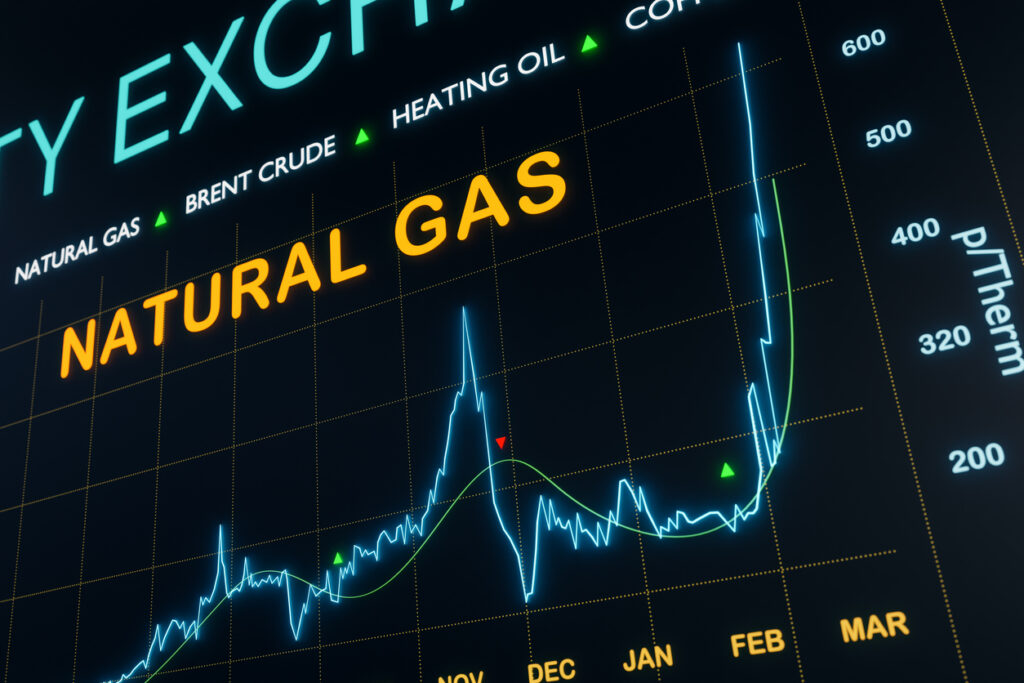
The U.S. natural gas market currently presents a paradoxical picture for investors: a persistent storage surplus weighing on near-term prices, yet a compelling long-term upside driven by structural demand growth. While gas prices have retreated significantly in recent months, our analysis, aligning with expert insights, suggests that this merely defers, rather than derails, a constructive outlook for Henry Hub, with a strong price recovery now anticipated to materialize more firmly in the first half of 2026.
Near-Term Headwinds: A Market Awash in Supply
The immediate landscape for U.S. natural gas is defined by an oversupply that has suppressed prices. As of today, natural gas prices show a modest uptick, rising 2.4% to $3.138 per million British thermal units (MMBtu). However, this daily gain comes against a backdrop of significant weakness, with prices down approximately 9% over the past month and over 13% since the start of the year. This contrasts sharply with broader energy market movements today, where our live market data shows Brent crude trading at $90.38, down over 9% on the day, and WTI crude at $82.59, also experiencing a sharp daily decline of more than 9%, indicating a more widespread bearish sentiment in crude markets.
The primary drivers for the natural gas slump are clear: inventories built at an above-normal rate through much of the April-June period. This surplus accumulation stemmed from a combination of mild spring weather, robust domestic supply, crucial maintenance at key LNG facilities, and weaker year-over-year power burns. While storage changes in July moved closer to seasonal norms, they proved insufficient to offset the substantial surplus accumulated in the preceding months. With the peak summer heat now largely in the rearview mirror and August forecasts skewing mild, the reality of entering the 2025-26 winter season with above-average inventories appears increasingly locked in.
The 2026 Horizon: LNG Demand and Underinvestment Fueling Future Upside
Despite the current bearish sentiment, the structural undercurrents point towards a significant rebound. Our analysis of investor inquiries reveals a keen focus on long-term price trajectories, with many asking about oil price predictions for late 2026. A similar forward-looking perspective is critical for natural gas, where the interplay of rising LNG demand and insufficient investment is setting the stage for a price spike. Experts believe that current investment levels in new drilling activity remain below what is required to adequately meet the projected surge in LNG demand into 2026. This creates a looming supply deficit that will eventually force prices higher.
The current price environment, hovering near $3/MMBtu, exacerbates this issue. While there has been a recent uptick in drilling activity, these lower price points could easily defer further rig additions. Producers, facing tighter margins, are less incentivized to commit capital to new projects, thereby restricting future supply growth. This dynamic is a critical factor in the revised timeline for price recovery. Initially, a strong constructive Henry Hub outlook with prices rising above $5/MMBtu was projected for the second half of 2025. This has now been pushed back to the first half of 2026, not because the fundamental thesis has weakened, but because the market conditions have extended the period of underinvestment, delaying the supply response.
Navigating the Path to Recovery: Key Events and Market Signals
For investors positioning for this deferred upside, monitoring upcoming market signals and events is crucial. While the immediate focus might be on inventory builds and weather patterns, several broader energy market indicators on our proprietary event calendar can offer peripheral insights. The upcoming Baker Hughes Rig Count reports, scheduled for April 24th and May 1st, will provide vital intelligence on drilling activity. Any sustained deceleration or decline in rig counts at current gas price levels would reinforce the thesis of underinvestment and the eventual tightening of supply.
Furthermore, while primarily focused on crude, the EIA Weekly Petroleum Status Reports on April 22nd and April 29th offer a broader pulse on U.S. energy demand and refinery activity, which can indirectly influence sentiment across the energy complex. Although OPEC+ meetings (like the JMMC on April 18th and the full Ministerial on April 19th) are primarily concerned with crude oil production quotas, the overall geopolitical and supply management discussions can subtly shift investor appetite and risk perception across all energy commodities. Ultimately, the pace of new LNG export capacity coming online and any significant deviations from mild weather forecasts will be direct catalysts or roadblocks to the 2026 natural gas price trajectory.
Investment Implications: Strategic Positioning for the Upside
The current market presents a compelling, albeit delayed, opportunity for strategic investors. The consensus view that natural gas prices will rise above $5/MMBtu in 1H 2026, despite near-term surplus, suggests that the market is currently undervaluing future supply constraints relative to surging LNG demand. For investors asking about specific company performance or broader market trends, understanding these nuanced timing shifts is paramount. This deferral offers a potential window for accumulating positions in natural gas-focused exploration and production (E&P) companies, or through natural gas futures, before the market fully prices in the anticipated deficit.
However, investors must remain cognizant of risks. A prolonged period of exceptionally mild weather could further delay inventory drawdowns, while a significant global economic slowdown could dampen industrial demand for natural gas. Conversely, an earlier-than-expected acceleration in global LNG demand, perhaps driven by geopolitical shifts or a colder winter in 2025-26, could pull forward the anticipated price recovery. The core takeaway remains clear: the structural demand for U.S. LNG is a powerful force that, coupled with current underinvestment, is setting the stage for a robust natural gas price rally, even if the timeline has shifted slightly.