Valero Energy Corporation, a prominent player in the downstream energy sector, recently unveiled its second-quarter financial performance, revealing a dip in net profit despite robust refining margins. For the three-month period ending in June, the company reported a net profit of $714 million, alongside an adjusted net profit matching that figure. This represents a decline from the $880 million and $887 million recorded in the corresponding quarter of the previous year, primarily attributed to reduced refining throughput volumes.
Despite the overall profit contraction, investors found a silver lining in the adjusted earnings per share (EPS). Valero posted an adjusted EPS of $2.28 on a diluted basis, significantly surpassing the Zacks Consensus Estimate of $1.73. This beat suggests operational efficiencies or better-than-expected segment performance in certain areas. Furthermore, the company demonstrated its commitment to shareholder returns by declaring a dividend of $1.13 per share for the upcoming Q2 2025 period, indicating confidence in future cash generation.
Refining Sector Performance: Margins Up, Volumes Down
The core refining segment, a critical driver of Valero’s profitability, processed an average of 2.92 million barrels per day (MMbpd) during the April-June quarter. This figure marks a decrease from the 3.01 MMbpd processed in Q2 2024, contributing to the overall decline in net profit. The reduction in throughput volumes across several regions was a key factor in the quarter’s results.
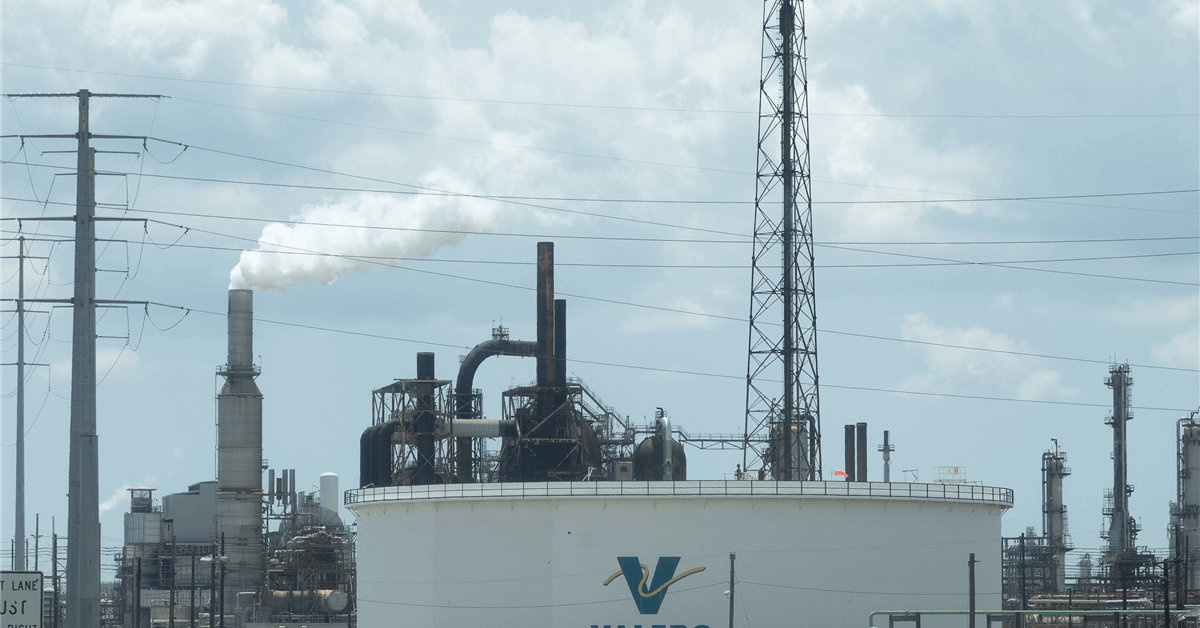
However, an important highlight emerged from the company’s U.S. Gulf Coast operations. Lane Riggs, Valero’s chairman, chief executive, and president, underscored a significant achievement, stating, “we set a record for refining throughput rate in our U.S. Gulf Coast region in the second quarter, demonstrating the benefits of our investments in growth and optimization projects.” Throughput volumes in this strategic region reached 1.84 MMbpd, a slight increase from 1.83 MMbpd in Q2 2024. This performance showcases the success of targeted capital expenditures in enhancing operational capacity and efficiency in a vital refining hub.
Conversely, other key regions experienced declines in throughput. The U.S. Mid-Continent saw volumes fall to 423,000 bpd, while the North Atlantic region processed 396,000 bpd. The U.S. West Coast operations also reported a reduction, with volumes reaching 262,000 bpd. These regional variations in refining activity collectively impacted the total throughput for the quarter.
Overall refining yields, representing the total output from processed crude, stood at 2.95 MMbpd, compared to 3.04 MMbpd in the prior year’s second quarter. The product mix saw gasoline and blendstocks contributing 1.44 MMbpd, while distillates accounted for 1.11 MMbpd of the total yield.
Despite the lower volumes, Valero’s refining margin per barrel of throughput demonstrated strength, averaging an impressive $12.35. This marks a notable increase from the $11.14 recorded in Q2 2024, indicating favorable market conditions or improved operational leverage on each barrel processed. This higher margin partially mitigated the impact of reduced volumes on the segment’s financial performance. For the quarter, the refining segment generated substantial revenue of $28.33 billion and delivered an operating income of $1.22 billion, solidifying its position as the company’s primary earnings engine.
Renewable Fuels and Ethanol Segments: Mixed Performance
Valero’s strategic diversification into renewable fuels, particularly through its Diamond Green Diesel (DGD) joint venture with Darling Ingredients Inc., faced headwinds during the quarter. The renewable diesel segment reported sales volumes of 2.73 million gallons per day, a decrease from 3.49 million gallons per day in Q2 2024. More significantly, the renewable diesel margin per gallon of sales saw a sharp contraction, plummeting to $0.22 from a robust $0.8 in the year-ago period. This considerable reduction in margin highlights the volatility and competitive pressures within the renewable fuels market. Despite these challenges, the segment contributed $1.1 billion in revenue and achieved an operating income of $112 million.
The ethanol segment presented a different picture. Production volumes increased to 4.58 million gallons per day, up from 4.47 million gallons per day in Q2 2024, showcasing enhanced operational output. However, similar to renewable diesel, the ethanol margin per gallon of output experienced a decline, settling at $0.52 compared to $0.61 for Q2 2024. This suggests a less favorable pricing environment for ethanol products. Nevertheless, the ethanol business generated $1.21 billion in revenue and an operating income of $105 million, continuing to be a notable contributor to Valero’s diversified portfolio.
Financial Resilience and Shareholder Returns
From a cash flow perspective, Valero reported total net cash from operating activities at $936 million. After adjustments, primarily for an unfavorable $325 million impact from working capital fluctuations and $86 million in adjusted net cash used in operating activities related to the DGD joint venture partner’s share, the adjusted figure rose to $1.3 billion. This adjusted cash flow provides a clearer picture of the company’s underlying operational cash generation capacity.
Valero demonstrated a strong commitment to returning capital to its shareholders, distributing a total of $695 million during the second quarter. This robust payout consisted of $354 million in dividend payments and $341 million allocated to share buybacks, repurchasing approximately 2.6 million shares. The company’s payout ratio stood at an efficient 52 percent of adjusted net cash provided by operating activities, indicating a balanced approach to reinvestment and shareholder remuneration.
In terms of balance sheet management, Valero strategically repaid the outstanding principal balance of $251 million on its 2.85 percent senior notes, which matured in April. The company concluded Q2 2025 with $8.4 billion in total debt, $2.3 billion in finance lease obligations, and a healthy cash and cash equivalents position of $4.5 billion. This financial snapshot reflects a company maintaining a solid liquidity profile while actively managing its debt obligations, positioning it favorably for future strategic initiatives and market fluctuations.
Overall, while Valero’s Q2 saw a softening in overall profit driven by lower refining volumes and challenging renewable fuel margins, the underlying strength in refining profitability per barrel and strategic investments in the Gulf Coast region, alongside consistent shareholder returns, paint a picture of operational resilience and disciplined financial management. Investors will closely watch how the company navigates volume dynamics and margin pressures in its diversified energy portfolio moving forward.


