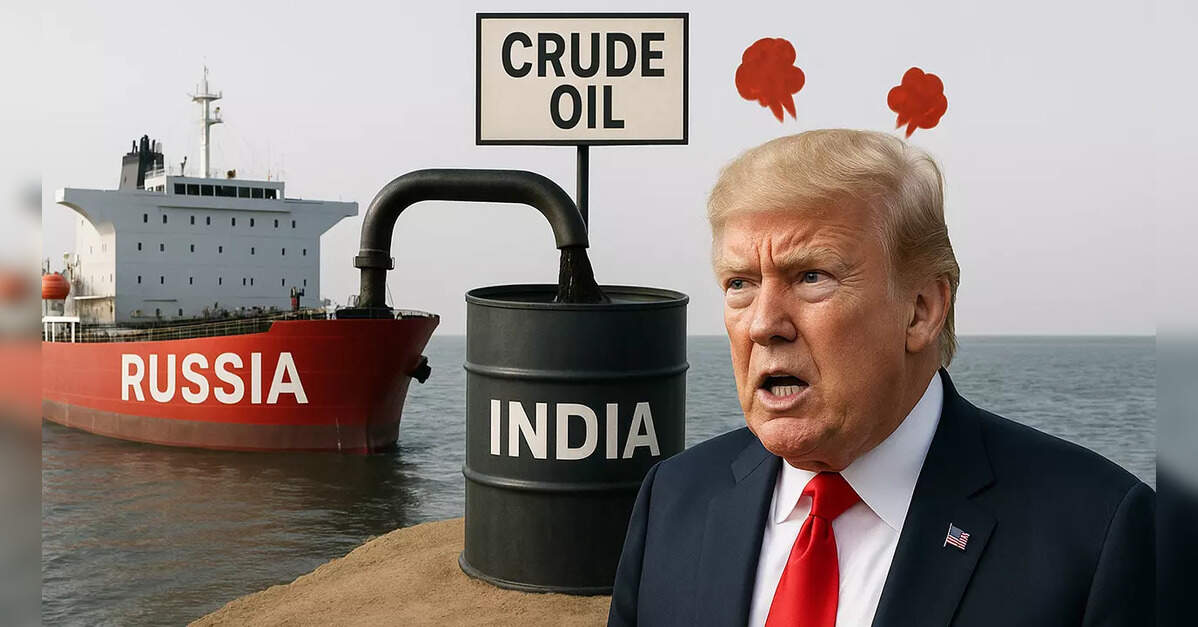
India’s critical position in global energy markets is once again under the spotlight as geopolitical tensions threaten to upend its primary crude oil supply lines. For the past three years, heavily discounted Russian crude has been a cornerstone of India’s energy strategy, helping to stabilize its economy amidst global turbulence. This pivot came after Western sanctions on Russia following the 2022 invasion of Ukraine, shifting India’s import reliance significantly from its historical Middle Eastern suppliers. However, new threats of secondary sanctions from the United States and NATO now cast a long shadow over India’s access to this vital, cost-effective supply, forcing the nation to rapidly re-evaluate its diversification strategies and creating significant uncertainty for global energy investors.
Geopolitical Pressures Mount on India’s Energy Security
The landscape for India’s energy imports shifted dramatically this week with US President Donald Trump announcing a 50-day grace period for imposing severe tariffs on buyers of Russian oil, contingent on Russia agreeing to a peace deal in Ukraine. These proposed “secondary tariffs” could reach 100%, effectively penalizing countries that continue to engage in trade with Russia by making their exports to the US prohibitively expensive. NATO Secretary General Mark Rutte echoed this sentiment, directly threatening India, China, and Brazil with similar sanctions. Further complicating matters, Senator Lindsey Graham is championing the Sanctioning Russia Act of 2025, a bipartisan legislative proposal that envisions an unprecedented 500% tariff on all US imports from nations purchasing Russian oil, gas, petrochemicals, or uranium. This represents a significant escalation, recalling India’s forced cessation of Iranian oil imports in 2019 under similar US secondary sanction threats. Given India’s reliance on imports for over 85% of its crude oil needs, the potential disruption to its largest supplier poses an existential challenge to its energy and economic stability.
Market Dynamics Amidst Sanction Threats
Despite the looming geopolitical storm, crude oil markets have shown a degree of resilience, though volatility remains a constant factor. As of today, Brent crude is trading at $94.56 per barrel, reflecting a modest daily dip of 0.39% within a range of $94.56-$94.91. Similarly, WTI crude stands at $90.92, down 0.41% for the day. This current price point sits notably lower than the $102.22 seen just three weeks ago on March 25th, marking an 8.8% decline over that period to $93.22 as of April 14th. This recent trend suggests that the market has, for now, absorbed the initial shock of the potential sanctions, perhaps due to the 50-day grace period offering a temporary reprieve. India’s Petroleum and Natural Gas Minister, Hardeep Singh Puri, reiterated India’s steadfastness, asserting that oil markets remain well supplied and prices are expected to stabilize. He emphasized that Russia accounts for 10% of global production, and without its inclusion, prices could have surged to $130 per barrel or more, highlighting India’s role in global price stability through its continued purchases.
Investor Focus on Price Trajectories and Supply Diversification
The evolving situation in India has naturally captivated the attention of energy investors globally. We’ve observed a significant uptick in inquiries regarding crude oil price forecasts, with many investors actively seeking a base-case Brent price forecast for the next quarter and consensus 2026 Brent outlooks. The central question revolves around how the potential loss of discounted Russian crude for major buyers like India and China would rebalance global supply-demand dynamics. Should the sanctions materialize and India be forced to significantly reduce its Russian imports, the immediate impact would likely be an increase in competition for non-Russian crude from the Middle East, Africa, and the Americas. This shift would inevitably drive up freight costs and potentially push Brent prices upward, directly contrasting with Minister Puri’s current outlook. Investors are therefore weighing the likelihood of India successfully navigating alternative supply channels against the immediate inflationary pressure on crude prices that such a significant market realignment would trigger.
Upcoming Events to Watch for Market Signals
The next two weeks present several critical junctures that could significantly impact crude oil markets, particularly as the 50-day sanction grace period begins to tick down. Investors should closely monitor the upcoming OPEC+ meetings: the Joint Ministerial Monitoring Committee (JMMC) on April 18th, followed by the Full Ministerial meeting on April 20th. These gatherings will offer crucial insights into the cartel’s production strategy and their reaction to the heightened geopolitical risk surrounding Russian supply. Any indication of quota adjustments or a firm stance on market stability could either soothe or exacerbate price volatility. Furthermore, the weekly API and EIA Crude Inventory reports (due April 21st/22nd and April 28th/29th) will provide vital data on current US supply levels and demand indicators, offering a snapshot of market tightness before any potential sanction-induced disruptions. While the Baker Hughes Rig Count on April 17th and 24th provides a longer-term view of drilling activity, the immediate focus will undoubtedly be on OPEC+ decisions and inventory data to gauge the market’s resilience in the face of India’s looming supply challenge.


