Saudi Arabia, the undisputed heavyweight of global crude exports, is making an $8.3 billion strategic pivot into renewable energy, a move that demands the attention of every serious oil and gas investor. This monumental investment, spearheaded by a consortium led by ACWA Power and including Aramco Power, will finance 15 gigawatts (GW) of solar and wind projects across the kingdom. Far from a peripheral diversification, this initiative is a core component of Crown Prince Mohammed bin Salman’s Vision 2030, designed to transform Saudi Arabia’s domestic energy landscape, free up valuable hydrocarbons for export, and ultimately, diversify an economy historically dependent on oil revenues. For investors, understanding this shift is crucial for navigating future energy market dynamics, particularly as it impacts global crude supply and long-term price trajectories.
The Saudi Paradox: More Export Capacity, Less Domestic Burn
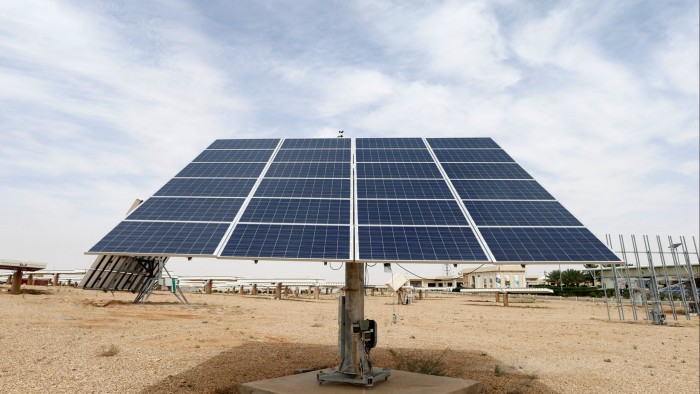
Saudi Arabia’s aggressive push into renewables directly impacts the global oil and gas supply picture. The kingdom currently powers almost all of its electricity needs with oil and gas-fired plants. By developing 15 GW of new solar and wind capacity, set to be operational by 2028, and aiming for an ambitious 130 GW by the end of the decade, Saudi Arabia is effectively creating more headroom for crude and natural gas exports. This is a game-changer for a nation that aims to generate half of its electricity from renewable sources by 2030, a substantial leap from the 4.34 GW of solar capacity reported at the end of 2024.
Consider the immediate market context: As of today, Brent crude trades around $94.93, having seen an almost 9% decline from $102.22 in late March to $93.22 just yesterday. This recent softening in prices underscores the sensitivity of the market to supply expectations. While 15 GW represents long-term potential, the strategic intent to displace domestic oil consumption is clear. Freeing up even a fraction of the crude currently used for domestic power generation could add significant barrels to the global market, potentially influencing price stability in a world still balancing demand growth against uncertain supply. For oil and gas investors, this signifies a subtle but powerful long-term shift in the supply curve, particularly from the world’s swing producer.
Vision 2030: A Diversification Imperative and Cost Advantage
This $8.3 billion investment is not merely an environmental gesture; it’s a hard-nosed economic strategy. The overarching goal of Vision 2030 is to diversify the Saudi economy away from its reliance on oil, creating new industries and revenue streams. By committing to net-zero carbon dioxide emissions by 2060, the kingdom is aligning with global energy transition trends, albeit on its own terms. The government has hailed these agreements as “among the world’s largest” with prices that are “the lowest globally,” a testament to the efficiency of the kingdom’s financing models and growing investor confidence. This cost-effectiveness is critical, ensuring the economic viability of these massive projects.
The scale of ambition is staggering: moving from just over 4 GW of solar capacity to a target of 130 GW of solar and wind within six years demonstrates an unparalleled commitment. This rapid expansion positions Saudi Arabia not just as an oil exporter but as a future clean energy powerhouse. The consortium’s projects, including five solar and two wind farms across Riyadh, Mecca, Medina, and Aseer provinces, are tangible steps towards this future. For investors eyeing the broader energy transition, Saudi Arabia’s demonstrated ability to execute large-scale, cost-efficient renewable projects makes it a compelling, if complex, market to watch.
Navigating the Shifting Sands of Supply: Investor Implications
Our proprietary reader intent data reveals a keen interest in base-case Brent price forecasts for the next quarter and consensus 2026 projections. Saudi Arabia’s renewable pivot is a significant, albeit long-term, factor in this equation. While the immediate impact on global crude supply might be marginal, the strategic direction is undeniable. Over time, as more domestic power shifts to renewables, the kingdom’s ability to export a larger share of its crude production will increase. This could have a dampening effect on future oil prices, assuming all other supply and demand factors remain constant, by adding a structural component to global supply.
Looking ahead, the upcoming OPEC+ Joint Ministerial Monitoring Committee (JMMC) meeting on April 18th, followed by the Full Ministerial meeting on April 20th, will be critical. While these meetings typically focus on immediate market conditions and production quotas, Saudi Arabia’s evolving domestic energy strategy could subtly influence their long-term position within OPEC+. If the kingdom can consistently free up more crude for export through domestic renewable deployment, it might gain greater flexibility in future quota discussions, potentially increasing total global supply from the cartel. Investors should closely monitor any signals from Riyadh regarding how this domestic energy shift might translate into a revised export strategy within the OPEC+ framework, impacting both the short-term market dynamics and the consensus 2026 Brent forecast.
The ACWA Power & Aramco Synergy: A Regional and Global Force
The consortium driving this initiative, led by Saudi utilities giant ACWA Power and joined by Aramco Power, a subsidiary of Saudi Aramco, underscores the strategic importance and national backing of these projects. ACWA Power is a formidable player in the Middle East’s renewable energy landscape, with operations spanning 14 countries. Its recent entry into China, despite geopolitical tensions, highlights its ambition to expand its global footprint and leverage its expertise. This regional leadership is particularly relevant given that the Middle East is the fastest-growing region outside of China in terms of adding new renewable electricity capacity.
The involvement of Aramco Power is equally significant. It signals a clear commitment from the world’s largest oil producer to embrace the energy transition, not just through carbon capture or efficiency, but through direct investment in utility-scale renewables. This synergy between a dedicated renewable energy developer and the national oil champion ensures robust execution and access to significant financial and technical resources. For investors, this partnership mitigates development risk and provides a strong foundation for the projects to be “up and running by 2028” as planned, ensuring Saudi Arabia maintains its competitive edge in the evolving global energy matrix.