Trump Tariffs Ignite Copper, Signaling a Broader Commodity Rebalancing
The recent imposition of U.S. tariffs on critical minerals has sent shockwaves through global markets, catapulting copper futures over 20% in mere minutes and pushing the red metal into uncharted territory. This dramatic surge is more than just a momentary blip; it signals a fundamental re-evaluation of industrial metals and could herald one of the most significant commodity shifts of the decade. For oil and gas investors, this isn’t just a story about another commodity; it’s a critical indicator of shifting capital flows, evolving geopolitical priorities, and the burgeoning energy demands of the future economy. While our focus remains firmly on crude, natural gas, and refined products, the copper phenomenon demands attention as it underscores the accelerating drive towards a highly electrified, data-intensive world, profoundly impacting the energy mix and investment landscape.
The AI-Defense Nexus: Copper’s Strategic Ascent and New Energy Demands
Copper’s newfound status as a strategic weapon is undeniable, driven by its indispensability across the AI, defense, and clean energy sectors. It is the literal conductor of the 21st-century economy, powering everything from advanced semiconductors and missile systems to electric vehicles and the vast server farms underpinning artificial intelligence. Projections indicate AI infrastructure alone will command a staggering $1.8 trillion in global investment by 2030, with copper as its irreplaceable backbone due to unmatched conductivity and scalability. Each hyperscale data center, the engine room of the AI revolution, consumes up to 30,000 tons of copper. This demand is not theoretical; it’s being solidified by tangible projects like the recently announced $3 trillion AI infrastructure pact between the U.S. and Gulf nations, including Saudi Arabia, UAE, and Qatar. This alliance aims to construct mega data centers, advanced chip fabrication plants, and robotics hubs across North America and the Middle East, all requiring industrial metals on an unprecedented scale. For oil and gas investors, this signifies not only a potential draw of investment capital towards critical minerals but also a colossal new source of energy demand. These data centers and fabrication plants will require immense, reliable power, much of which will continue to be supplied by natural gas and refined products in many regions, creating a complex interplay between traditional energy and the new economy’s mineral needs.
Oil’s Resilience Amidst Shifting Commodity Spotlight and Investor Questions
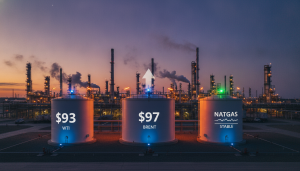
While copper captures headlines, the traditional energy complex continues its dynamic dance, offering both stability and volatility. As of today, Brent Crude trades at $94.93 per barrel, showing a modest increase of 0.15% within a day range of $91 to $96.89. WTI Crude holds at $91.39, up 0.12%, spanning a day range of $86.96 to $93.3. Gasoline prices are at $3, up 1.01%. However, the recent trend for Brent tells a different story, having declined by 8.8% from $102.22 on March 25th to $93.22 on April 14th. This recent softening contrasts sharply with the copper surge, prompting investors to ask critical questions we’ve observed in our reader intent data. Many are seeking a base-case Brent price forecast for the next quarter and the consensus 2026 Brent forecast. Our analysis suggests that while the spotlight may temporarily shift to copper, the underlying demand for oil remains robust, supported by ongoing industrial activity and the energy-intensive nature of global growth, including the very AI build-out driving copper. The shift in commodity focus, however, does raise questions about capital allocation and the potential for a broader inflationary environment that could ultimately support all hard assets, including crude.
Upcoming Events and the Supercycle Conundrum for Energy Investors
The copper surge is widely being framed as the beginning of a multi-year supercycle, driven by structural deficits. The International Energy Agency (IEA) warns of a looming 30% global copper shortfall by 2035, with demand projected to jump from 27 million tonnes in 2024 to over 37 million by 2050. Compounding this, supply remains highly concentrated, with China controlling 45% of global refining capacity and Chile, Peru, and the Democratic Republic of Congo accounting for nearly half of all mined output. This scarcity and geopolitical risk amplify copper’s strategic value. For oil and gas investors, this broader commodity supercycle narrative is crucial. While copper and crude are distinct, a rising tide of commodity demand, driven by industrialization and energy transition efforts, could lift all boats. We are closely monitoring several key upcoming energy events that will provide further insight into the market’s direction. The Baker Hughes Rig Count, scheduled for April 17th and April 24th, will indicate drilling activity and future supply trends amidst current price levels. More critically, the OPEC+ JMMC meeting on April 18th and the Full Ministerial OPEC+ Meeting on April 20th will reveal whether major producers will adjust output quotas in response to evolving global demand dynamics and the broader commodity landscape. Any decision here could significantly impact crude price stability. Furthermore, API Weekly Crude Inventory reports on April 21st and April 28th, followed by EIA Weekly Petroleum Status Reports on April 22nd and April 29th, will offer granular data on U.S. supply and demand, influencing short-term market sentiment. These events, against the backdrop of a burgeoning copper supercycle, provide critical data points for investors assessing the future of their oil and gas holdings.
Navigating the Evolving Commodity Landscape: Opportunities and Risks for Oil & Gas
The dramatic rise of copper underscores a fundamental shift in the global economy – one that is increasingly electrified, digitized, and mineral-intensive. For investors primarily focused on oil and gas, this presents a nuanced landscape of both challenges and opportunities. While the immediate capital flows might gravitate towards critical minerals, the underlying energy demand generated by the AI build-out and the broader energy transition will be immense. The construction of mega data centers, electric vehicle infrastructure, and advanced manufacturing hubs will require vast amounts of power, much of which will continue to be supplied by natural gas and, in some regions, oil. This indirect demand could provide a significant long-term tailwind for conventional energy sources, even as the world transitions. Moreover, the inflationary pressures created by a broad commodity supercycle, including copper, could support higher price decks for all raw materials, including crude. Investors should consider how their existing oil and gas portfolios are positioned to benefit from or mitigate the risks associated with this evolving commodity hierarchy. Diversification into companies with exposure to critical mineral extraction or processing, or those developing cleaner energy solutions for industrial applications, might become increasingly attractive. Ultimately, while copper may be grabbing the headlines today, a holistic understanding of energy demand across all sectors remains paramount for successful long-term investing in the dynamic commodity markets.