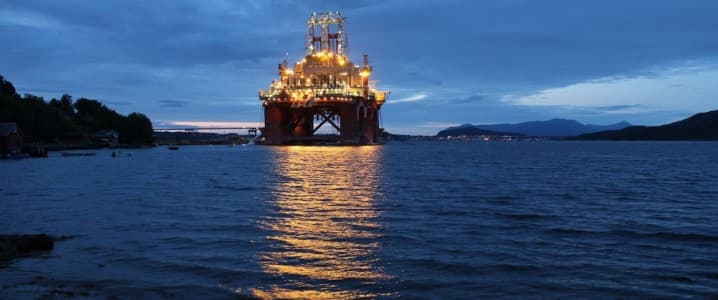
Equinor’s latest gas discovery at the Skred prospect in the Barents Sea marks a strategic advancement for both the Norwegian energy giant and European energy security. Located just 23 kilometers north of the now fully operational Johan Castberg oilfield, this find, estimated at 1.9 to 3.1 million barrels of oil equivalent (boe) of recoverable gas, is being immediately assessed for a potential tie-in. Such a move would leverage existing infrastructure, accelerate time to market for new volumes, and crucially bolster Norway’s position as Europe’s largest and most reliable gas supplier, particularly as the continent seeks sustained alternatives to Russian supply. This development underscores Equinor’s commitment to maximizing value from its Arctic assets and maintaining Norway’s long-term production trajectory.
Arctic Gas Discovery Amidst Dynamic Crude Markets
The discovery at Skred, while a gas find, arrives in a crude market currently showing nuanced movements. As of today, Brent Crude trades at $94.94 per barrel, reflecting a modest daily gain of 0.16% within a $91-$96.89 range. This is against a backdrop where Brent has seen a notable dip recently, falling from $102.22 just weeks ago to $93.22. This volatility in crude pricing highlights the ongoing need for stable, predictable energy supplies globally, a role Norway increasingly fulfills for Europe. The Skred gas discovery, if fast-tracked via a tie-in to Johan Castberg, presents a compelling economic proposition. By utilizing the existing infrastructure of a field already producing at its peak capacity of 220,000 barrels per day of crude oil, Equinor significantly reduces development costs and accelerates the monetization of these new gas volumes. This capital-efficient approach is particularly attractive in the current investment climate, where operators are scrutinizing project economics more than ever. The added gas, though modest in scale, contributes to the overall supply picture, offering incremental stability to European gas markets.
Strategic Timing and Upcoming Market Catalysts
The announcement of this discovery and the focus on rapid tie-in comes at a pertinent time for global energy markets, particularly with critical industry events on the immediate horizon. Investors will be closely watching the OPEC+ Joint Ministerial Monitoring Committee (JMMC) meeting scheduled for April 18, followed by the full Ministerial meeting on April 20. While these discussions primarily focus on crude oil production quotas and market balance, they invariably set the tone for broader energy market sentiment. Any new, quickly deployable supply from a reliable, non-OPEC+ producer like Norway can subtly influence market perceptions of overall supply security and dampen extreme price volatility. For Europe, which has seen Norway replace Russia as its single largest gas supplier since 2022, additional volumes, especially those that can be brought online efficiently, are always welcome. The Skred discovery, coupled with Johan Castberg’s swift ramp-up to peak oil production just three months after coming on stream, reinforces Norway’s commitment and capability to be a long-term, stable energy partner.
Addressing Investor Queries: Long-Term Value and Supply Resilience
Our first-party data indicates that investors are keenly focused on building a base-case Brent price forecast for the next quarter and understanding the consensus 2026 Brent outlook. This emphasis on future pricing naturally extends to the long-term viability and growth prospects of major energy producers like Equinor. The Skred discovery directly addresses investor concerns about maintaining production longevity and asset value in a transitional energy landscape. Johan Castberg is projected to produce crude for 30 years, bolstering Norway’s oil exports and securing its role as a significant energy producer. However, Norwegian authorities have openly stated that further exploration efforts and new discoveries are crucial to slowing the expected decline in the nation’s oil and gas production in the 2030s. Equinor’s strategy of drilling one to two exploration wells annually near Johan Castberg demonstrates a proactive approach to continually replenishing reserves and extending the productive life of its Arctic assets. This continuous investment in exploration around existing infrastructure provides a clear pathway to sustaining output and delivering long-term value, directly responding to investor demand for resilient growth strategies.
The Power of Infrastructure Synergies and Arctic Potential
The true power of the Skred discovery lies in its potential for infrastructure synergies with Johan Castberg. A tie-in not only minimizes capital expenditure for developing the new gas field but also enhances the overall economic efficiency and utilization of the multi-billion-dollar Johan Castberg facility. This approach maximizes the return on investment for the existing infrastructure, making marginal discoveries economically viable. Johan Castberg’s rapid ascent to peak production capacity of 220,000 bpd has already positioned it as a cornerstone of Norway’s energy future, contributing significantly to the nation’s forecast 5.2% rise in oil liquids production in 2025 from 2024 levels. The Barents Sea remains a region of high strategic importance for Norway, and successful, capital-efficient tie-ins like the one proposed for Skred de-risk future exploration in this frontier area. By demonstrating the ability to integrate new finds seamlessly into established operations, Equinor not only boosts its own reserves but also solidifies the long-term potential of Norway’s Arctic shelf as a reliable source of energy for decades to come, ensuring sustained energy security for key European markets.


