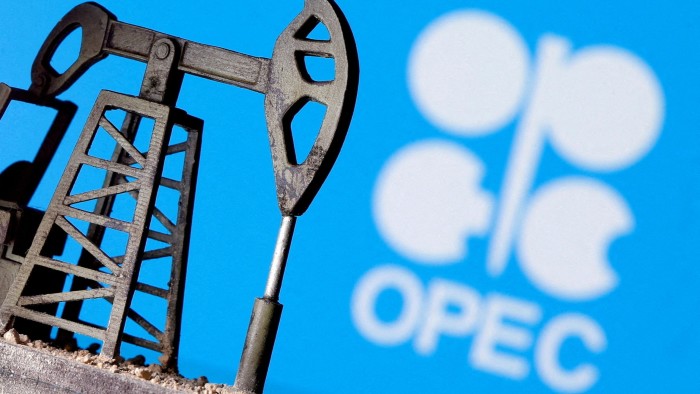
The global oil market is bracing for a significant strategic pivot as OPEC+, the alliance of oil-producing nations, accelerates its production increases. This move signals a definitive shift from its multi-year strategy of propping up crude prices through supply cuts towards aggressively reclaiming market share. Investors must now recalibrate their outlook for the energy sector, as this policy change promises to reshape supply dynamics and potentially introduce a new era of price volatility.
OPEC+’s Accelerated Shift: A Market Share Mandate
OPEC+ has confirmed plans to boost headline production by an additional 548,000 barrels per day in August, building on a 411,000 b/d increase scheduled for July. This accelerated pace is rapidly unwinding the significant production cuts that have been in place since 2022, with the group now on track to restore all idled supply by the end of September – a full year ahead of its original 18-month schedule. This decisive action underscores a clear message: the cartel is firmly prioritizing market share over price support.
The rationale behind this strategic shift is multifaceted. Analysts point to generally stronger oil demand during the northern hemisphere’s summer, driven by increased refinery activity and peak driving seasons in key consumer markets like the US and Europe. However, a deeper driver appears to be internal dynamics within the alliance. Saudi Arabia, a principal architect of the previous cuts, reportedly felt the burden was not being equitably shared among members. For instance, Saudi Arabia had reduced its output by one-fifth over three years to approximately 9 million b/d, while some other members, such as Kazakhstan, were consistently pumping above their agreed quotas. This perceived lack of compliance eroded the effectiveness of the cuts in supporting prices, making the strategy unsustainable for major producers like Saudi Arabia and the UAE. Reasserting market discipline and ensuring fairer distribution of production volume appears to be a key objective behind this aggressive unwinding.
Current Market Realities and Heightened Price Volatility
The implications of this accelerated supply injection are already reverberating through the market. As of today, Brent Crude trades at $90.38 per barrel, marking a significant 9.07% decline within the day, with a range between $86.08 and $98.97. West Texas Intermediate (WTI) follows a similar trajectory, currently at $82.59, down 9.41%. This immediate downturn highlights the market’s sensitivity to supply-side announcements. Our proprietary data shows Brent crude has experienced a substantial drop over the past two weeks, sliding from $112.78 on March 30th to $91.87 on April 17th, an 18.5% decrease. This downward trend, combined with the OPEC+ decision, reinforces concerns about future price stability.
The market’s reaction extends beyond crude. Gasoline prices, a direct proxy for consumer demand and refining margins, are also feeling the pressure, currently at $2.93 per gallon, down 5.18% today. While the source article noted Brent at $68 a barrel at its time of writing, our live data confirms that crude has seen a rally since then, only to be met with renewed selling pressure from this OPEC+ announcement. This indicates that while underlying demand might have offered some support, the prospect of increased supply is a powerful counter-force. The rapid unwinding of production cuts threatens to contribute to what many traders now anticipate will be a significant supply surplus by the end of the year, potentially pushing prices into levels below $60 a barrel.
Navigating Future Supply Dynamics: An Investor’s Outlook
Investors are keenly watching how these supply dynamics will unfold, and our reader intent data shows a clear focus on future price trajectory and OPEC+ policy. A recurring question from our readers is, “What do you predict the price of oil per barrel will be by end of 2026?” Given the current market shift, the prospect of a significant supply surplus by year-end, as indicated by many analysts, aligns with predictions that oil prices could dip below $60 a barrel. This accelerated unwinding of cuts suggests that the downside risk to prices has increased significantly, challenging previous assumptions of tight markets.
Forward-looking analysis must also consider upcoming calendar events. The market will be closely scrutinizing the OPEC+ Joint Ministerial Monitoring Committee (JMMC) meeting on April 18th, followed by the full Ministerial meeting on April 19th. While these meetings typically review market conditions and compliance, their proximity to the production increase announcement means any further commentary or subtle policy shifts will be dissected for additional clues on the group’s long-term strategy. Moreover, weekly data points like the API and EIA inventory reports (scheduled for April 21st, 22nd, 28th, and 29th) and the Baker Hughes Rig Count (April 24th and May 1st) will provide crucial real-time insights into US supply and demand, influencing short-term sentiment. Investors are also asking about “OPEC+ current production quotas,” reflecting a persistent concern about compliance and the equitable distribution of production responsibilities, which was a key driver for Saudi Arabia’s recent policy change. Monitoring these events and data will be critical for assessing the true impact of OPEC+’s strategic shift.
Strategic Implications for E&P and Refining Stocks
This aggressive push for market share by OPEC+ carries profound implications across the oil and gas value chain. For upstream exploration and production (E&P) companies, a sustained period of lower crude prices, especially if they fall below $60 a barrel, will inevitably squeeze profit margins. While some producers are well-hedged or have lower breakeven costs, others operating in higher-cost basins may face significant financial headwinds. Investors in E&P stocks should be evaluating companies based on their balance sheet strength, operational efficiency, and ability to navigate a potentially prolonged downturn in crude prices.
Conversely, the downstream sector, particularly refining and petrochemical companies, could benefit from lower feedstock costs. Cheaper crude translates to improved margins for refiners, provided that product demand remains robust. While summer driving season typically boosts demand for refined products like gasoline, the overall economic health and consumer spending patterns will be crucial determinants. The surge in supply also presents opportunities for traders and storage operators who can capitalize on contango market structures. This strategic shift by OPEC+ reshapes the entire investment landscape, demanding a diligent re-evaluation of portfolios for both short-term tactical plays and long-term strategic positioning within the energy sector.