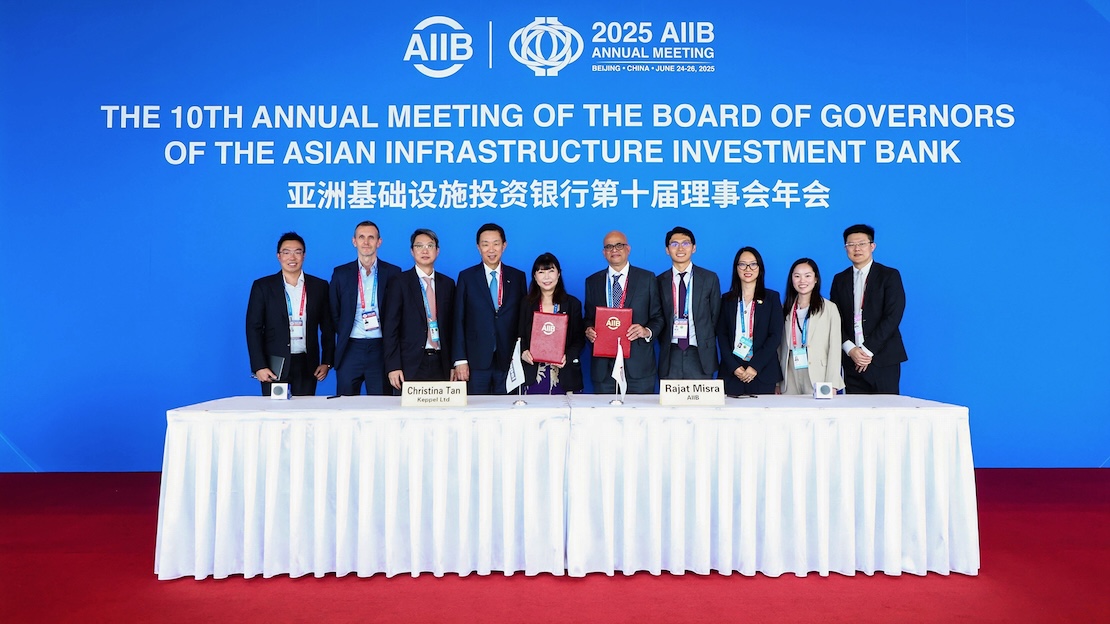
Driving Asia’s Green Future: A $1.5 Billion Catalyst for Sustainable Infrastructure
In a strategic move poised to significantly impact Asia-Pacific’s infrastructure landscape, the Asian Infrastructure Investment Bank (AIIB) and Keppel Ltd. have forged a formidable partnership, committing to mobilize up to $1.5 billion for sustainable infrastructure projects through December 2030. This collaboration is far more than a capital injection; it represents a powerful synergy between a multilateral development bank’s financial might and a seasoned conglomerate’s operational expertise. Focused on critical sectors such as renewable energy, digital infrastructure, transport, and urban services, this initiative directly addresses the region’s persistent infrastructure gap while accelerating its transition towards a greener, more resilient future. For investors navigating complex energy markets, this partnership signals a compelling opportunity in a sector ripe for long-term growth and stable returns, offering a distinct counterpoint to the inherent volatility often seen in traditional energy plays.
Market Dynamics and the Enduring Appeal of Sustainable Investments
The timing of this significant commitment is particularly noteworthy, set against a backdrop of fluctuating commodity markets. As of today, Brent Crude trades at $94.79 per barrel, showing a modest daily dip of 0.72% within a range of $93.98 to $95.69. This current stability, however, follows a pronounced downturn; Brent has shed nearly 20% over the last 14 days, falling from $118.35 on March 31 to its current levels. This sharp correction underscores the inherent volatility that can characterize traditional oil and gas markets, driven by geopolitical events, supply decisions, and evolving demand forecasts.
In contrast, the AIIB-Keppel partnership targets sustainable infrastructure – a segment often characterized by more predictable, long-term cash flows and a strong alignment with global ESG mandates. This initiative offers institutional investors a crucial diversification strategy away from the immediate price swings of Brent or WTI. While gasoline prices currently sit at $3.02, reflecting broader energy market trends, the appeal of infrastructure projects focused on renewable energy generation, efficient power transmission, and robust digital networks lies in their ability to provide essential services with less exposure to commodity price shocks. The $1.5 billion allocation through Keppel’s private funds specifically targets green infrastructure, emphasizing climate resilience and inclusive growth, making it an attractive proposition for capital seeking stability and ethical investment opportunities in a dynamic global economy.
Forward-Looking Catalysts: Upcoming Events and Their Indirect Influence
The coming weeks hold several critical events that, while primarily centered on traditional oil and gas, will undoubtedly shape the broader investment climate and indirectly influence sentiment towards initiatives like the AIIB-Keppel partnership. Tomorrow, April 21, the OPEC+ JMMC Meeting is scheduled, a key determinant of future crude production policy. Any decisions around supply cuts or increases will directly impact oil prices, affecting the profitability and capital allocation strategies of major energy players. This is followed closely by the EIA Weekly Petroleum Status Reports on April 22 and April 29, which provide crucial insights into U.S. crude inventories, refining activity, and demand trends – metrics that dictate market sentiment.
Further down the calendar, the Baker Hughes Rig Counts on April 24 and May 1 will offer a snapshot of drilling activity, indicating future supply potential. Perhaps most impactful for long-term planning is the EIA Short-Term Energy Outlook on May 2. This comprehensive forecast will provide updated projections for supply, demand, and prices across various energy commodities. While these events directly pertain to the fossil fuel sector, their outcomes can influence the cost of capital, investor confidence, and the overall economic outlook for Asia-Pacific. If traditional energy prices remain volatile or face sustained pressure, the relative stability and long-term growth potential of sustainable infrastructure projects may become even more attractive, reinforcing the strategic importance of partnerships like that between AIIB and Keppel.
Addressing Investor Queries: Stability Amidst Uncertainty
Our proprietary reader intent data reveals a clear and consistent theme among investors this week: a palpable desire for clarity on market direction. Questions like “is WTI going up or down?” and “what do you predict the price of oil per barrel will be by end of 2026?” underscore a pervasive uncertainty regarding the future trajectory of commodity prices. Furthermore, specific queries about individual company performance, such as “How well do you think Repsol will end in April 2026,” highlight a focus on tangible, near-term returns within the traditional energy sector. In this environment of short-term price fixation and demand for predictive insights, the $1.5 billion commitment by AIIB and Keppel offers a powerful counter-narrative.
This initiative directly addresses a different facet of investor interest – the pursuit of long-term, stable growth in a region with undeniable demand for infrastructure development. While many are grappling with the day-to-day volatility of crude, this partnership provides a blueprint for capital deployment into assets that are less susceptible to immediate commodity price swings and more aligned with global sustainability mandates. By focusing on renewable energy, digital connectivity, and urban services, AIIB and Keppel are tapping into fundamental societal needs, offering a compelling investment thesis for those looking beyond speculative short-term plays towards foundational, impactful growth. This long-term vision, blending financial strength with proven expertise, offers a compelling answer to the underlying investor question of where to find durable value in a transitioning energy landscape.


