The global oil market is once again navigating a complex web of macroeconomic shifts, geopolitical tensions, and policy decisions, creating a volatile landscape for energy investors. While broader market indices like the DAX react to immediate sentiment, the underlying currents of central bank policy, international trade, and regional stability cast a long shadow over crude fundamentals. For oil and gas investors, understanding these interconnected drivers is paramount to forecasting future price trajectories and positioning portfolios effectively.
The Fed’s Shadow: Monetary Policy and Oil Demand Dynamics
The Federal Reserve’s monetary policy stance continues to be a dominant force shaping global economic activity and, by extension, crude oil demand. Recent US economic indicators suggest a more dovish lean, with the Conference Board Consumer Confidence Index notably sliding to 93 in June from 98.4 in May. This decline signals weakening sentiment, particularly concerning the labor market and a softer inflation outlook. Such data points fuel expectations for potential interest rate adjustments.
Investors are closely scrutinizing Fed Chair Powell’s statements, watching for any deviation from previous scripts. A more compelling argument for rate cuts, potentially in September, could bolster economic sentiment and global growth prospects, thereby providing a tailwind for oil demand. Conversely, any hint of greater caution regarding rate reductions could cool growth expectations and exert downward pressure on crude prices. Our internal models show a direct correlation between projected global GDP growth and base-case Brent price forecasts for the next quarter, underscoring the critical influence of central bank actions. Many of our readers are currently asking for a base-case Brent price forecast for the next quarter, and the Fed’s path is arguably the single most influential variable in that equation.
Geopolitical Risk Premium: The Middle East Factor
While monetary policy dictates the demand side, geopolitical events remain a potent and often unpredictable determinant of supply-side risk premium in crude markets. The current situation in the Middle East, particularly progress toward an Iran-Israel ceasefire, directly impacts global supply stability. An upheld ceasefire could ease supply concerns, potentially dampening the geopolitical risk premium embedded in crude prices. Conversely, renewed tensions would almost certainly trigger an immediate upward spike in prices as traders price in disruption risks.
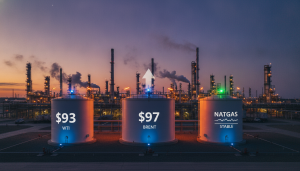
As of today, Brent Crude trades at $95.19, reflecting a modest gain of 0.42% on the day, with a daily range between $91 and $96.89. West Texas Intermediate (WTI) Crude is also firmer at $92.36, up 1.18%, after touching lows of $86.96 earlier. This daily resilience, however, follows a challenging two weeks where Brent shed nearly 8.8%, dropping from $102.22 on March 25 to $93.22 by April 14, largely on de-escalation hopes. This recent retreat highlights how quickly market sentiment can shift based on perceived changes in regional stability, underscoring the fragility of the current price environment.
Trade Policy: Tariffs and Their Demand Implications
Beyond central banks and geopolitics, international trade dynamics present another significant variable for the oil market. The looming July 9 deadline for the 90-day tariff pause between the US and EU is a key concern. Should trade talks stall and tariffs be reimposed, key German sectors such as autos, healthcare, and technology would face increased uncertainty and potential economic headwinds. Europe represents a substantial component of global oil demand, and any significant slowdown in its industrial output or consumer spending due to trade friction would inevitably translate into weaker demand for crude and refined products.
The ripple effects of such trade disputes extend globally. Weakened European demand could impact refining margins and trade flows worldwide, including in Asia. Our reader intent data shows significant interest in the operational status of Chinese teapot refineries this quarter, indicating that investors are keenly observing global refining activity as a proxy for underlying demand strength. A robust global trade environment is essential for sustained oil demand growth, making the outcome of US-EU trade negotiations a critical watch item for energy investors.
Upcoming Catalysts: OPEC+, Inventory, and the Forward Outlook
Looking ahead, the next two weeks are packed with crucial energy-specific events that will undoubtedly shape the near-term trajectory of crude prices and provide vital inputs for our base-case Brent forecasts. On April 18, the OPEC+ Joint Ministerial Monitoring Committee (JMMC) convenes, followed by the full OPEC+ Ministerial Meeting on April 20. These gatherings are paramount as members deliberate on production quotas and market strategy. Any signals regarding extended cuts, adjustments to current targets, or a shift in market philosophy will have an immediate and profound impact on global supply expectations and, consequently, prices.
In parallel, market participants will be closely monitoring weekly inventory data from the US. The American Petroleum Institute (API) is scheduled to release its weekly crude inventory report on April 21 and again on April 28. These will be followed by the official data from the Energy Information Administration (EIA) on April 22 and April 29. These reports offer a granular view of US supply and demand balances, providing critical insights into storage levels, refinery utilization, and product demand. Furthermore, the Baker Hughes Rig Count, set for release on April 17 and April 24, will offer a real-time pulse on US drilling activity and future production potential. For investors seeking to build a robust Brent price forecast for the next quarter, these upcoming data points and policy decisions are non-negotiable considerations, offering concrete indicators of the market’s underlying health.