The global energy landscape remains a complex interplay of geopolitical tensions, shifting supply-demand dynamics, and central bank policy, all of which continue to drive significant volatility in crude oil markets. While broader risk assets like cryptocurrencies and equity indices may react to immediate headlines, the fundamental drivers for oil are often deeper and more enduring. Investors in the oil and gas sector must navigate these intricate forces, particularly as regional conflicts threaten supply and major producers prepare to recalibrate output. Our proprietary data reveals a market currently grappling with recent price declines, even as critical calendar events loom that could define the sector’s trajectory for weeks to come.
Geopolitical Dynamics and Shifting Risk Premiums
The specter of geopolitical conflict continues to cast a long shadow over energy markets. Recall the acute market reaction on June 17, when an escalation in the Iran-Israel conflict, fueled by reports of US fighter jets relocating to the Middle East, sent WTI crude surging by 5.17% to close at $73.455. At that time, fears of a broader regional conflict and potential oil supply disruption dominated the narrative, pushing a significant risk premium into crude prices. Indeed, the probability of US military action against Iran before July, as gauged by prediction markets, surged to 76% from 38% just days prior, reflecting the market’s heightened anxiety.
However, the current market picture presents a notable divergence from that immediate surge. Despite persistent underlying tensions, the direct, immediate threat of massive supply disruption appears to have been re-evaluated by the market. This re-evaluation is critical, as it suggests investors are weighing the likelihood of actual physical supply constraints against other demand-side factors. The nuanced interpretation of geopolitical events, moving beyond initial shock to a more considered assessment of probabilities, dictates how much risk premium remains embedded in crude prices.
Current Market Snapshot: A Deeper Look at Crude Volatility
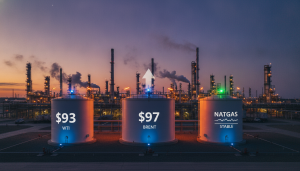
As of today, the crude oil market reflects a significant shift from the geopolitical surge observed earlier. Brent Crude currently trades at $90.38, marking a substantial 9.07% decline within the day, with its range spanning from $86.08 to $98.97. Similarly, WTI Crude stands at $82.59, down 9.41%, having traded between $78.97 and $90.34. This sharp daily correction follows a broader trend: over the past 14 days, Brent crude has plummeted by $20.91, representing an 18.5% drop from $112.78 on March 30 to $91.87 on April 17.
This considerable downturn, contrasting sharply with the June 17 surge, suggests that while geopolitical risks remain an underlying concern, other factors are currently exerting more immediate downward pressure. A prolonged period of higher oil prices, fueled by conflict, invariably contributes to inflationary pressures, which in turn could force central banks to delay policy easing. The market’s current trajectory could be interpreting this as a potential dampener on future demand, as tighter monetary conditions typically curb economic activity. Furthermore, global growth concerns, coupled with reports of potential inventory builds, may be outweighing the geopolitical risk premium that was so prominent just a few weeks prior, leading to the current significant price corrections across the board.
Navigating the Calendar: Critical Events for Oil Investors
The immediate future for oil prices is heavily tied to a series of critical upcoming events that will provide fresh insights into supply and demand dynamics. Investors are keenly awaiting the OPEC+ Joint Ministerial Monitoring Committee (JMMC) meeting on April 18, followed by the full OPEC+ Ministerial Meeting on April 19. These gatherings are paramount, as they will determine future production quotas and offer clarity on the cartel’s strategy in a volatile market. Our proprietary data indicates that a key question for investors right now revolves around “What are OPEC+ current production quotas?” The upcoming meetings will directly address this, potentially setting the tone for crude prices through the second quarter and beyond.
Beyond OPEC+, weekly data from the US will provide crucial supply-side signals. The API Weekly Crude Inventory reports on April 21 and April 28, along with the EIA Weekly Petroleum Status Reports on April 22 and April 29, will offer a snapshot of US crude stockpiles and refinery activity. Significant builds could signal weakening demand or ample supply, putting further pressure on prices, while draws might offer support. Furthermore, the Baker Hughes Rig Count reports on April 24 and May 1 will illustrate the pace of drilling activity, indicating future production capacity. These scheduled events are not merely data points; they are pivotal catalysts that require close monitoring for any investor looking to position themselves strategically in the energy sector.
Investor Focus: Addressing Key Concerns and Forward Outlook
Our analysis of investor intent data reveals a strong focus on long-term price predictions and the performance of specific energy companies in the current environment. A recurring question is, “What do you predict the price of oil per barrel will be by end of 2026?” While precise predictions are challenging in such a dynamic market, the factors influencing this outlook are clear: the duration and intensity of geopolitical conflicts, the consistency of OPEC+ production policies, the pace of global economic growth, and the speed of the energy transition. A prolonged period of conflict, coupled with sustained production cuts, could see prices rebound significantly. Conversely, a resolution of tensions and weaker global demand could keep prices subdued.
For investors asking about the performance of individual companies, such as “How well do you think Repsol will end in April 2026?”, the answer is inextricably linked to these broader market trends. Energy producers’ profitability is directly correlated with crude prices. Companies with strong balance sheets, diversified operations, and efficient production will be better positioned to navigate price volatility. The ability of companies to manage capital expenditures, pursue sustainable growth, and adapt to evolving market conditions—including the potential for delayed policy easing due to inflation—will be critical. Investors should scrutinize companies’ exposure to specific geopolitical risks, their hedging strategies, and their long-term growth initiatives in a market characterized by both immediate volatility and evolving structural shifts.