Carbon Capture: A New Paradigm for Energy Investors
The global energy landscape is undergoing a profound transformation, with decarbonization at the forefront of strategic priorities for major oil and gas players. Central to this shift is the advancement of carbon capture, utilization, and storage (CCUS) technologies. For years, a fundamental hurdle has plagued the efficiency of carbon capture systems: the inherent trade-off between effectively capturing carbon dioxide and then efficiently releasing it for storage or repurposing. Optimizing one phase often compromised the other, limiting the economic viability and scalability of these crucial solutions.
Now, a significant breakthrough from researchers at MIT promises to redefine this challenge, offering a potential six-fold increase in the efficiency of electrochemical carbon dioxide capture and release, alongside a projected cost reduction of at least 20 percent. This development represents a critical inflection point for investors eyeing the burgeoning carbon management market.
Addressing the Core Challenge in Carbon Capture Technology
Traditional carbon capture methods frequently grapple with a dilemma rooted in chemical kinetics. Many systems rely on hydroxide-based solutions which readily absorb carbon dioxide from the air, transforming it into carbonate. This carbonate then enters an electrochemical cell, where an acidic environment facilitates its conversion back into water and pure carbon dioxide. The goal is to isolate a concentrated stream of CO2, suitable for industrial applications or secure geological storage, from ambient air containing merely 400 parts per million of the gas.
The operational conflict arises because the initial capture phase performs best in a solution rich in hydroxide ions, while the subsequent release phase requires a high concentration of carbonate ions for optimal performance. Historically, these two chemically distinct processes have occurred within the same aqueous medium, forcing a compromise. As Professor Kripa Varanasi, a leader of the MIT research team, emphasized, the need for differing chemical environments for each step made it impossible to achieve peak efficiency for both simultaneously within a single, circulating sorbent system. This fundamental incompatibility has been a major bottleneck, hindering the widespread deployment of carbon capture technologies at the scale required to impact global emissions.
The MIT Innovation: Decoupling for Enhanced Efficiency
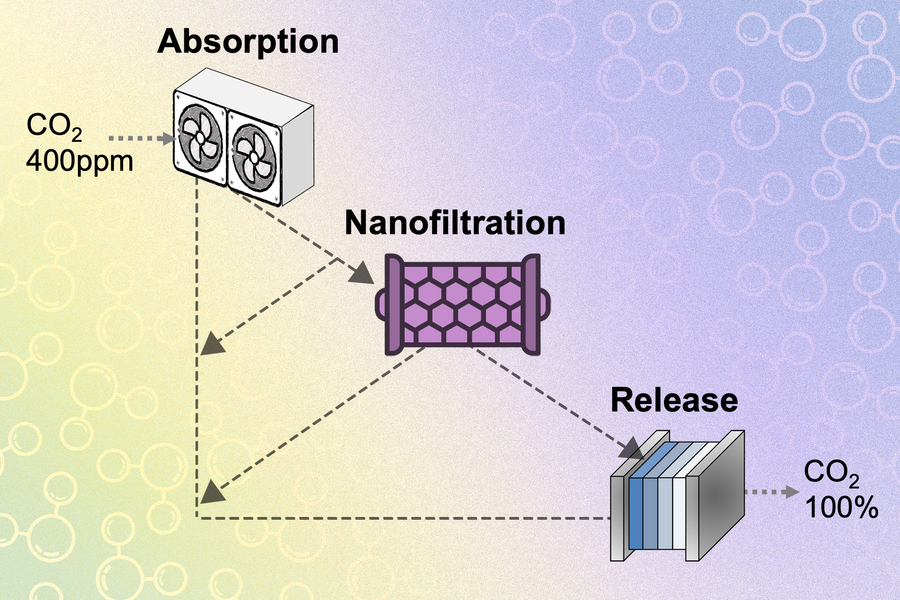
The MIT team, comprising doctoral students Simon Rufer, Tal Joseph, and Zara Aamer, alongside Professor Varanasi, engineered an ingenious solution to this long-standing problem. Their breakthrough, detailed in the prestigious journal *ACS Energy Letters*, involves strategically decoupling the capture and release stages by introducing a novel intermediate step. This innovative approach leverages advanced nanoscale filtering membranes.
After the initial capture phase where hydroxides convert into carbonates, these specialized membranes are employed to precisely separate the ions within the solution based on their electrical charge. Crucially, carbonate ions carry a charge of 2, distinct from hydroxide ions, which have a charge of 1. This difference in charge allows the nanofiltration membranes to effectively sort the ions. By segregating the carbonate ions destined for the release cell from the hydroxide ions required for the next capture cycle, the system can ensure that each operational stage receives its optimally configured chemical environment. This separation ensures that both the capture and release processes can proceed with maximum efficiency, overcoming the previous inherent conflict and allowing for a continuous, highly productive cycle.
Financial Implications and Market Potential
For investors, the implications of a six-fold boost in efficiency and a minimum 20 percent cost reduction are profound. These figures dramatically improve the economic viability and scalability of carbon capture projects, moving them closer to widespread commercial deployment. Professor Varanasi’s assertion that “making a meaningful impact requires processing gigatons of CO2” underscores the immense scale needed for effective climate action. This new technology brings that gigaton-scale ambition significantly closer to reality by making the process far more energy-efficient and cost-effective.
The ability to generate a 100 percent pure carbon dioxide stream from ordinary air, coupled with reduced operational expenditures, unlocks substantial market potential. This purified CO2 can be monetized in several ways: as a feedstock for producing synthetic fuels, for manufacturing chemicals and building materials, or for enhanced oil recovery operations. Furthermore, the improved economics could accelerate the development of direct air capture (DAC) facilities, which are essential for addressing legacy emissions and hard-to-abate sectors. The reduced financial burden makes carbon capture a more attractive proposition for industrial emitters, potentially expanding the addressable market for CCUS solutions exponentially.
Investment Outlook: Decarbonization and the Oil & Gas Sector
This technological leap positions carbon capture as an even more compelling area for investment within the broader energy transition. For the oil and gas sector, which faces immense pressure to decarbonize operations and reduce its carbon footprint, such innovations are critical. Companies can integrate this enhanced capture technology into existing industrial facilities, such as power plants, refineries, and petrochemical complexes, to significantly reduce their Scope 1 and Scope 2 emissions.
Beyond operational decarbonization, the breakthrough opens avenues for oil and gas firms to diversify their portfolios into new energy services and products. Investing in and deploying advanced carbon capture systems could position these companies as leaders in sustainable energy solutions, mitigating regulatory risks and enhancing their environmental, social, and governance (ESG) credentials. The long-term trajectory for carbon management involves significant capital deployment, driven by government incentives, evolving carbon pricing mechanisms, and corporate sustainability targets. Early adopters and investors in these cutting-edge technologies are poised to capture substantial market share in what is projected to be a multi-trillion-dollar industry.
The competitive landscape for carbon capture is heating up, but this MIT innovation offers a distinct advantage by fundamentally improving the core process. Investors should closely monitor pilot projects and commercialization efforts stemming from this research, as they could signal the next wave of disruptive growth in the decarbonization sector.
Conclusion
The challenges of climate change demand innovative solutions, and the latest breakthrough from MIT represents a pivotal moment for carbon capture technology. By effectively resolving the long-standing conflict between CO2 capture and release efficiency through nanoscale membrane separation, researchers have opened the door to systems that are not only significantly more effective but also substantially more economical. For energy investors, this development underscores the growing maturity and investment potential within the carbon management space. As the world pushes towards net-zero emissions, technologies that can process gigatons of CO2 at reduced costs will be indispensable, making advanced carbon capture a cornerstone of future energy portfolios.