

As industries seek innovative solutions for carbon capture, scientists have turned to advanced materials that efficiently trap and store carbon dioxide from industrial emissions. A recent study of a team from the Helmholtz-Zentrum Dresden-Rossendorf (HZDR), Dresden University of Technology (TUD), and Maria Curie-Sklodowska University in Lublin (Poland) sheds light on the gas adsorption physics of so-called Calgary Framework 20 (CALF-20), a zinc-based metal-organic framework (MOF).
While applying a combination of advanced techniques, the scientists reveal the material’s unique adaptability under varying conditions.
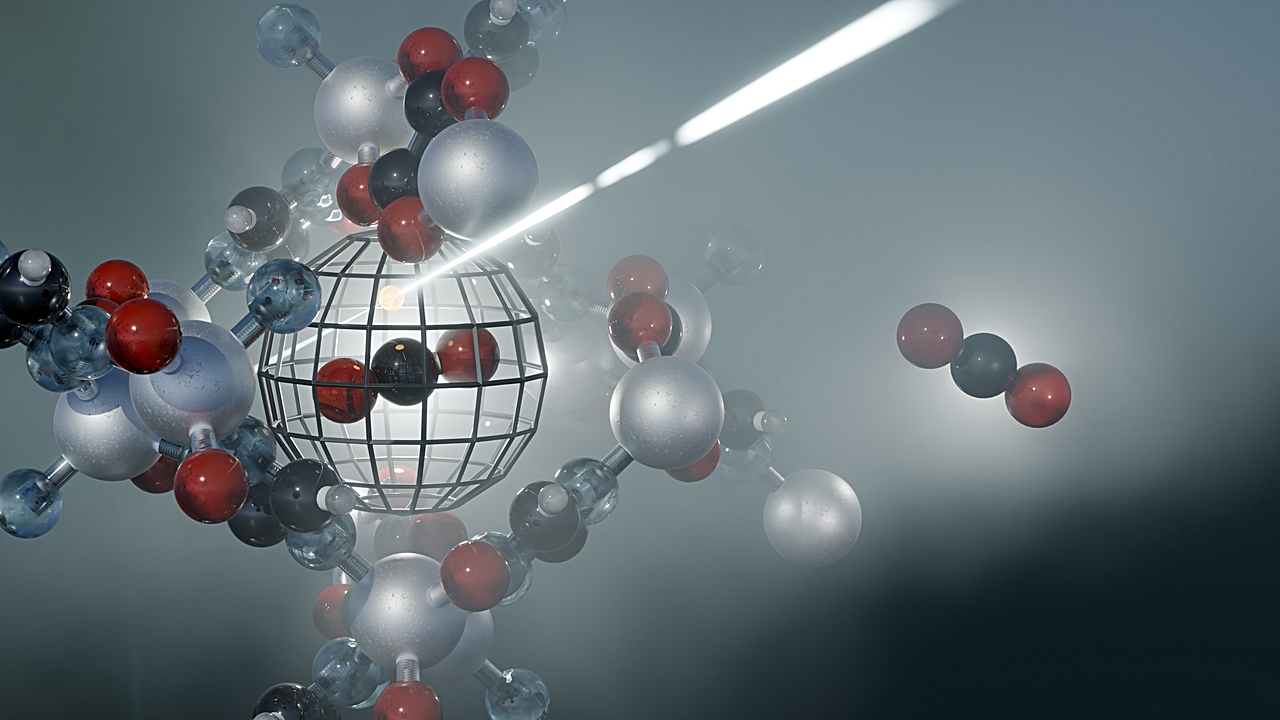
Artistic representation of CO2 capture from a moisture-laden gas stream using CALF-20, a zinc-based metal-organic framework. Also shown: The decay of positronium, which is used to probing the void of the MOF. In this process, an electron and a positron annihilate each other to produce characteristic gamma rays which can be detected. Source: B. Schröder/HZDR
CO2 capture technologies rely on materials that can selectively trap the greenhouse gas from gas streams while minimizing energy consumption. Traditional adsorbents, such as activated carbons and zeolites, often suffer from high-energy demands or poor selectivity in humid environments. In contrast, CALF-20 stands out due to its high CO2 uptake and its mild heat of adsorption and regeneration. It maintains a high selectivity by preferentially adsorbing CO2 over water in moderately humid conditions.
CALF-20 captures CO2 more effectively and absorbs less water in such conditions, when compared to other widely studied similar compounds. All those MOFs are highly porous and made of metal-oxygen clusters, which are connected in a structured manner by pillars of organic chemicals. This three-dimensional arrangement leads to networks of cavities reminiscent of the pores of a kitchen sponge.
“In this study, we employed a multifaceted approach to investigate CALF-20’s CO2 adsorption behavior. Using a combination of positron annihilation lifetime spectroscopy (PALS), in situ powder X-ray diffraction (PXRD), as well as gas adsorption experiments, we were able to visualize the interaction between CO2 molecules and the material’s internal structure under different temperatures and humidity levels. These insights provide important information for optimizing CO2 capture technologies in real-world industrial settings”, explained Dr. Ahmed Attallah from the Institute of Radiation Physics at HZDR.
A deep dive into adsorption mechanisms
“PALS plays a critical role in analyzing how gases interact with porous materials. This technique measures the lifetime of positronium, a bound state of an electron and a positron, which is sensitive to local free volumes. In porous materials like CALF-20, positronium lifetimes indicate empty spaces, their size, and how they change when gas molecules start to fill the pores”, Prof. Radoslaw Zaleski from the Maria Curie-Sklodowska University Lublin says.
Through PALS, researchers observed that CO2 initially gathers at the center of CALF-20’s nanopores, forming a structured arrangement before adhering to the pore walls. This progression correlates with increasing CO2 pressure, confirming that PALS can track molecular adsorption steps in real time. The method also revealed that even after CO2 fills the pores, small free volumes persist, which may be critical for enhancing adsorption efficiency.
PALS was particularly useful in distinguishing how CO2 and water interact within the material. Under humid conditions, PALS data showed that water forms isolated clusters at low humidity, but at higher humidity levels, it forms interconnected networks. “These structural changes affect pore accessibility, yet CALF-20 maintains its significant CO2 adsorption capacity at a relative humidity below 40 per cent. Conventional gas adsorption methods alone would struggle to resolve these fine structural variations, demonstrating the unique value of PALS in analyzing dynamic gas-material interactions”, TUD’s Prof. Stefan Kaskel resumes.
The impact of humidity: A key challenge in CO2 capture
In industrial applications, CO2 is rarely captured from dry gas streams – moisture is almost always present. This poses a challenge for many materials, as water molecules often compete with CO2 for adsorption sites, reducing efficiency.
Through in situ humidity-controlled experiments, the team discovered that CALF-20 maintains a robust CO2 adsorption performance even in the presence of water, where the level of relative humidity defines this robustness. At low humidity, water molecules remain isolated within the framework. This network formation alters the material’s free volume, but CO2 still finds available adsorption sites, demonstrating CALF-20’s resilience under humid conditions. At increasingly higher humidity levels, they form interconnected hydrogen-bonded networks, allowing water uptake to dominate.
By integrating PALS with other characterisation techniques, this study provides a comprehensive understanding of how CALF-20 captures CO2 under diverse environmental conditions. The results suggest that CALF-20 could serve as a scalable and energy-efficient solution for industrial CO2 capture, particularly in settings where humidity poses a challenge. Developed by researchers at the University of Calgary, CALF-20 has already been scaled up to multi-kilogram production, making it a strong candidate for real-world applications
The implications extend beyond fundamental science – these insights could pave the way for optimizing next-generation MOFs for large-scale deployment in carbon capture and storage (CCS) applications. Further research will focus on long-term stability and process integration, moving closer to the implementation of CALF-20 in industrial CO2 mitigation strategies.
The study was supported by DFG (Deutsche Forschungsgemeinschaft) under contract 464857745 (AT 289/1-1 and KA1698/41-1).
