

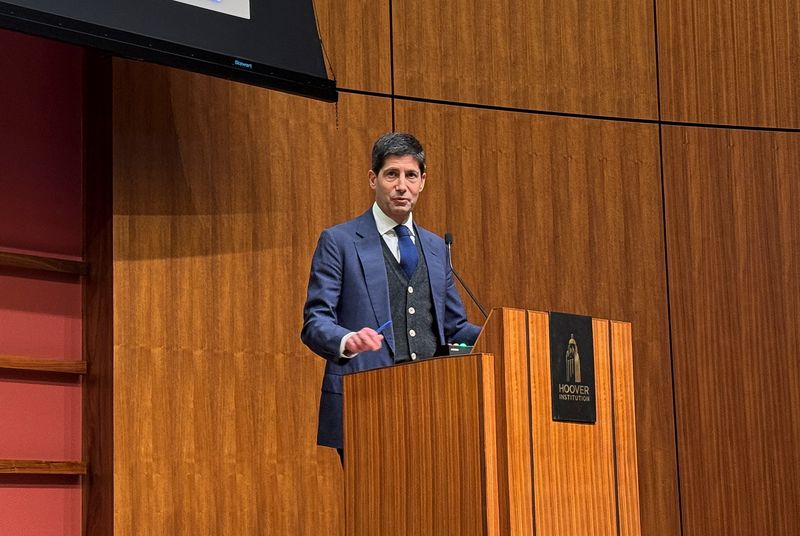
A significant shift in Federal Reserve policy could be on the horizon, with prominent economic figures openly discussing new pathways to lower interest rates. Kevin Warsh, widely considered a leading candidate for the next Chair of the Federal Reserve under a potential future administration, recently articulated a compelling vision for monetary policy. His remarks offer crucial insights for energy sector investors, hinting at potential changes in capital costs, commodity demand dynamics, and the broader economic environment shaping the oil and gas landscape.
Rethinking the Fed’s Balance Sheet and Rate Strategy
Warsh, a former Fed Governor who served from 2006 to 2011, presented a sharp critique of the central bank’s operational framework. He contended that a large and continuously expanding Fed balance sheet can directly conflict with the effectiveness of setting short-term borrowing rates, which is the institution’s primary policy lever. He succinctly stated, “if the printing press could be quiet, we could have lower policy rates.” This perspective suggests a desire to return to a more traditional monetary toolkit, where the central bank’s balance sheet is not a perpetual instrument of intervention but rather a carefully managed asset. The Fed is currently in the process of reducing its balance sheet, a move Warsh’s commentary implicitly endorses, potentially advocating for a more aggressive or sustained unwinding.
For oil and gas investors, such a policy shift carries significant implications. Lower policy rates directly translate into reduced financing costs for capital-intensive energy projects. Exploration and production (E&P) companies could secure cheaper debt for drilling campaigns, midstream operators might find it more economical to fund pipeline expansions and infrastructure upgrades, and refiners could benefit from lower working capital costs. A more conventional and less expansive Fed balance sheet, focusing on interest rates, could foster a more predictable financial environment, vital for long-term investment planning in the energy sector where project horizons often span years, if not decades.
Debunking the “Cruel Choice” in Inflation and Employment
Perhaps one of Warsh’s most impactful arguments was his direct challenge to the long-standing economic dogma of a “cruel choice” between stable prices and full employment. This traditional view posits that bringing down inflation inherently requires a detrimental impact on the job market. Warsh vehemently rejected this notion, labeling it “nonsense.” He explicitly stated, “What it means is, we don’t have to push the unemployment rate up to get the inflation rate to fall.” He criticized the embedded thinking within central banking circles that suggests “throwing people out of work to get the inflation rate to come down.”
This reinterpretation of the inflation-employment dynamic is highly significant for energy markets. If inflation can be effectively managed without triggering a substantial economic downturn or widespread job losses, it implies sustained robust demand for energy commodities. A healthy employment picture underpins consumer spending, fuels industrial activity, and ensures consistent demand for crude oil, natural gas, and refined products like gasoline and jet fuel. Conversely, a central bank actively seeking to cool the labor market to combat inflation would signal a tougher demand environment for energy. Notably, current Fed Chair Jerome Powell has also expressed skepticism that the present labor market is a primary driver of inflation, suggesting that severely impacting employment would likely yield minimal results in price reduction.
Historical Context and Future Leadership Signals
Warsh’s insights are not merely academic; they are rooted in his direct experience and ideological convictions. His departure from the Federal Reserve in 2011 was precisely because he opposed the central bank’s continued balance sheet expansion, viewing it as overreach that exacerbated national debt. This consistent stance underscores the depth of his commitment to a more restrained monetary policy. His recent remarks were delivered at Stanford University’s Hoover Institution, a bastion known for its Bush-Reagan Republican economic philosophy, further cementing the ideological framework behind his proposals.
Adding to the political and policy intrigue, Warsh, a Bush appointee to the Fed, maintains close family ties to former President Donald Trump through his wife, the daughter of Trump’s former donor Ronald Lauder. He shared the stage with Fed Governor Christopher Waller, a Trump appointee himself, who is also frequently mentioned as a potential Fed Chair candidate. Waller has indicated his readiness to swiftly lower rates should tariffs precipitate an economic slowdown. This convergence of conservative economic thought, potential political alignment, and a shared platform suggests a powerful intellectual current that could significantly influence future monetary policy direction, particularly if a Trump administration were to appoint Warsh to lead the Federal Reserve.
Strategic Implications for Energy Investors
For investors navigating the complexities of the energy sector, Warsh’s articulation of a pathway to lower interest rates, coupled with his belief in maintaining economic stability without sacrificing employment, carries profound strategic implications:
- Enhanced Capital Allocation: Cheaper borrowing costs directly empower oil and gas companies to pursue more aggressive capital expenditure programs, develop new projects, and potentially achieve higher returns on invested capital. This could stimulate drilling activity, accelerate technological adoption, and support expansion across the energy value chain.
- Robust Demand Outlook: The premise that inflation can be tamed without significant economic contraction or job losses paints a more optimistic picture for long-term energy demand. Stable employment and consumer confidence are critical drivers of consistent consumption for transportation fuels, industrial energy, and petrochemical feedstocks.
- Commodity Price Dynamics: A global environment of lower interest rates often correlates with a weaker U.S. dollar. Since crude oil and natural gas are dollar-denominated commodities, a weaker dollar makes them more affordable for international buyers, potentially providing upward support for commodity prices. Reduced financing costs can also lower the hurdle rate for speculative capital entering commodity markets, further influencing price action.
- Market Stability and Planning: A Federal Reserve that adheres to a more predictable and less interventionist monetary policy, as Warsh advocates, could potentially reduce overall market volatility. This stability would enable energy companies, which often operate with long investment cycles, to plan with greater certainty, mitigating some of the risks associated with macroeconomic fluctuations.
The prospect of a Federal Reserve guided by Warsh’s philosophy signals a potential pivot towards a more streamlined monetary policy, prioritizing lower rates by controlling the balance sheet and rejecting the need for an inflation-employment trade-off. This vision, if implemented, could forge a more favorable financial landscape for the energy industry, potentially unlocking new investment, bolstering demand, and shaping commodity price trajectories for years to come. Savvy oil and gas investors must diligently monitor these evolving discussions within monetary policy circles, as the future direction of the Federal Reserve could profoundly impact profitability and strategic decisions across the entire energy complex.
