Navigating the Crude Crossroads: Why Oil Prices Defy Geopolitical Turmoil
The global oil market presents a paradox for investors: escalating geopolitical tensions in the Middle East, particularly around Iran and the crucial Strait of Hormuz, typically signal higher crude prices. Yet, as many investors have observed with a mix of confusion and frustration, oil futures remain firmly below the $100 per barrel mark, trading in the mid-$90s. This perplexing disconnect between heightened risk and deflated prices represents a critical challenge for energy sector participants and a key question for those with long positions in crude.
In May, the market witnessed one of its most significant monthly drops in crude prices, an outcome that appears counterintuitive given the persistent friction. Iran asserts that an existing ceasefire has been breached, its military continues missile activity targeting U.S. forces, and the Houthi terror group in Yemen has threatened to disrupt maritime shipping in the region. Each day brings a new headline that, in isolation, might be expected to propel oil prices skyward. However, a confluence of powerful factors is currently anchoring crude firmly below its recent peaks.
Three Pillars Underpinning Oil’s Recent Decline
Several key dynamics are converging to suppress crude oil prices, offering a clearer perspective for investors trying to decipher the market’s behavior.
The first factor is a growing, albeit cautious, optimism regarding a potential resolution to the Iran conflict. Iran’s economy is intrinsically linked to its vast oil and natural gas resources; it is a quintessential petro-economy. Without the ability to export its primary commodities, the nation faces severe economic hardship, impacting its populace significantly. This powerful economic incentive for Iran to normalize its situation and resume exports is a driving force behind the perceived possibility of de-escalation. While an internal power vacuum at the highest levels of Iranian leadership may lead to contradictory statements and actions in the near term, the fundamental need for revenue remains. Investors must recognize that while a peaceful resolution is hoped for, the presence of rogue elements within the IRGC still poses a risk of renewed conflict, which would undoubtedly trigger a price spike. The market, however, is currently pricing in a scenario leaning towards de-escalation.
Secondly, a significant contraction in Chinese oil demand is exerting downward pressure. Insights from a recent visit to China by JPMorgan’s prominent analyst, Natasha Kaneva, revealed a surprisingly sharp reduction in the nation’s oil consumption. Kaneva reported an abrupt and unexpected drop of as much as 9%, or 1.5 million barrels per day, with remarkably minimal visible disruption. This volume is particularly significant when considering China’s substantial crude oil reserves, exceeding 1 billion barrels, as it slows the drawdown of these vast inventories. The demand erosion is partly attributed to a consumer and corporate shift towards electrified transport options, such as electric vehicles and expanded subway systems, reducing reliance on gasoline-powered cars and trucks.
The third critical element is a global market that is increasingly “awash in oil,” with further supply expansions on the horizon. Despite persistent questions about future price trajectories, the case for lower oil prices, perhaps even as low as $50 per barrel, appears more compelling than a return to $150. Beyond China’s decreasing demand and massive storage, Saudi Arabia is actively increasing its crude exports via the East-West pipeline to the Red Sea. The United Arab Emirates is also fast-tracking a second pipeline to bypass the Strait of Hormuz and, having exited OPEC, is expected to aggressively ramp up its own oil production. Concurrently, Venezuelan oil flows are on the rise, and both Brazil and Guyana continue to boost their output. While global oil demand still exhibits growth, its pace is noticeably slowing, even as worldwide production figures climb. Domestically, U.S. production continues its steady, albeit gradual, ascent, adding more barrels to an already well-supplied market.
Adding to this abundant supply picture are the ongoing sales from the U.S. Strategic Petroleum Reserve (SPR). Emergency reserve drawdowns are occurring at an astonishing rate of 8-9 million barrels per week. This aggressive release, coupled with previous Biden administration sales, is projected to bring the SPR to its lowest level since its inception in 1983, effectively injecting significant volumes into the market and dampening price upside.
Market sentiment, perhaps influenced by these supply-side factors, also appears predisposed to pushing prices lower. Any upward price momentum often faces rapid reversals, indicating a collective leaning towards bearish outcomes. Even former President Donald Trump recently weighed in, predicting that oil prices would “drop like a rock” due to the immense volume of oil currently loaded on 1,700 vessels. While such pronouncements might not inherently soothe market anxieties, especially concerning the Iran situation, they highlight a prevailing perception of impending oversupply. However, investors must remain vigilant; optimism should not be mistaken for a definitive strategy, as the underlying geopolitical risks involving Iran remain a potent, if currently sidelined, threat to market stability.
Wall Street’s Strategic Plays Amidst Volatile Energy Markets
For investors focused on U.S. oil and gas companies, the current market dynamics present both challenges and selective opportunities. Leading financial institutions are recalibrating their outlooks and identifying compelling plays.
Barclays analysts underscore the enduring importance of U.S. energy security. They contend that the memory of Iran’s capacity to weaponize the Strait of Hormuz and disrupt global trade will persist, irrespective of any near-term peace. Consequently, energy-importing nations are expected to maintain a cautious stance on Middle Eastern supply, consistently favoring the inherent security and stability offered by U.S. production.
Mizuho’s team advises a highly selective approach within the energy sector, even amidst “elevated” commodity prices. They identify “dislocated valuations” among certain large-cap, oil-focused companies, suggesting investors might find superior opportunities in smaller, specialized names. Mizuho highlights Devon Energy (DVN), EQT Corp (EQT), and Permian Resources (PR) as top picks within this smaller-cap category. For investors preferring larger-cap exposure, Chevron (CVX) receives a favorable nod, while Phillips 66 (PSX) stands out as a preferred choice among refiners.
Permian Resources (PR) particularly warrants investor attention. This Midland, Texas-based midcap company, with a market capitalization of approximately $16 billion, has delivered an impressive performance, gaining 40% year-to-date and 55% over the past 12 months. Analyst sentiment is overwhelmingly positive, with 17 out of 19 FactSet-listed analysts issuing buy ratings and only two holding. The average target price sits at $25.60, implying nearly 30% further upside from current levels, with Raymond James analyst John Freeman setting an even more bullish $29 target. The company also offers an attractive 3.33% dividend yield. Permian Resources’ unique leadership structure features co-CEOs who co-founded Colgate Energy, which merged four years ago to form the current entity.
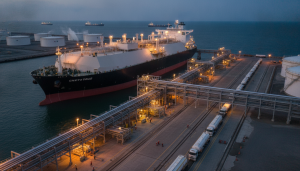
Beyond crude, the Middle East holds immense strategic importance for natural gas and Liquefied Natural Gas (LNG) markets. Following reported Iranian attacks on QatarEnergy’s massive Ras Laffan production complex in March, the spotlight has intensified on U.S. companies to help bridge potential production gaps. In this context, Wolfe Research has named Cheniere Energy (LNG) as a new top pick, projecting approximately 30% upside for the stock. The firm notes that Cheniere has added ‘$5-10/share of cash value’ this year alone, driven by robust natural gas spreads. Intriguingly, Wolfe’s Keith Stanley also posits that any resolution to the Iran conflict, counterintuitively, would be a positive catalyst, allowing investors to refocus on Cheniere’s long-term contract value. This perspective is particularly noteworthy given that Cheniere’s shares have recently tumbled about $70 per share from their late-March highs. Analysts widely support Cheniere, with an average target price of $303.45.
Broader Energy Sector Performance
The broader energy landscape has been a rewarding domain for astute investors this year. The top-performing energy and energy-related stocks with market caps exceeding $1 billion showcase a diverse range of opportunities, spanning from LNG pure-plays to companies involved in AI power generation, advanced battery technologies, and fuel cells. This performance highlights the dynamic and multifaceted nature of the energy transition and the myriad ways investors can gain exposure to this critical sector.