SpaceX Accelerates AI Strategy Ahead of Monumental IPO: A Trillion-Dollar Bet on Innovation
In a strategic move poised to redefine the intersection of aerospace and artificial intelligence, Elon Musk’s xAI is undergoing an extensive engineering overhaul, signaling an intensified push for market leadership as its parent company, SpaceX, marches toward a highly anticipated initial public offering. This profound restructuring underscores a determined effort to not only integrate advanced AI capabilities but also to secure a dominant position in a fiercely competitive technological landscape, all while targeting a valuation that could eclipse two trillion dollars for SpaceX.
Internal communications reveal a frank assessment from SpaceX executive Michael Nicholls, who now assumes the role of xAI president. Nicholls acknowledges that xAI has lagged behind its rivals, declaring the company “clearly behind” in the race for AI supremacy. This candid admission has triggered an immediate and aggressive course correction, aiming to accelerate development and close the competitive gap with industry heavyweights such as OpenAI, Anthropic, and Google.
The imperative for this rapid transformation is clear. SpaceX, already a titan in the private space sector, is on the cusp of a public market debut that could see it command an astronomical valuation. Integrating a high-performing AI subsidiary like xAI is not merely an operational enhancement; it is a critical component of SpaceX’s long-term market strategy, designed to bolster its comprehensive technology ecosystem and appeal to a broad spectrum of institutional investors.
Engineering Dominance: A New Blueprint for AI Development
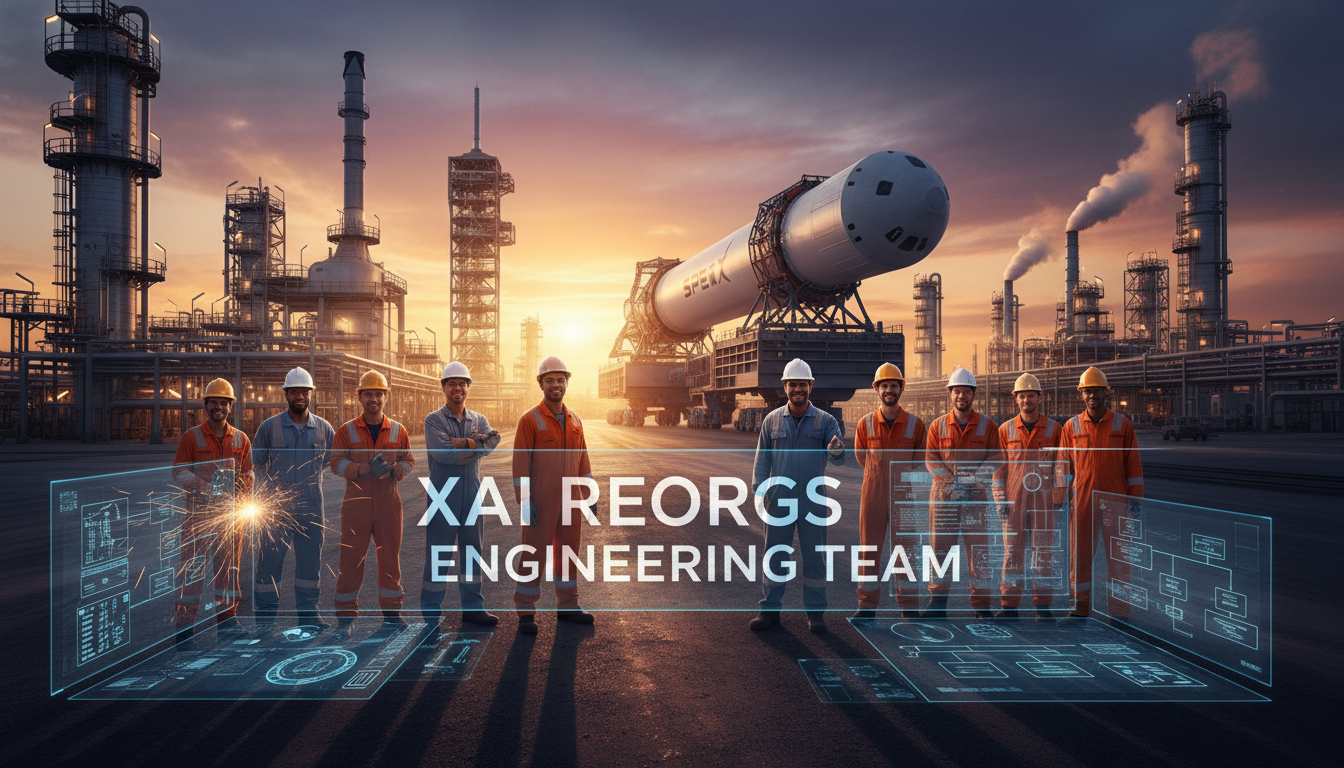
The core of xAI’s revitalization lies in a meticulously redesigned engineering structure, drawing heavily on Elon Musk’s proven “Tesla playbook” of relentless iteration and foundational rebuilding. This strategic pivot comes amidst a period of significant flux, marked by the departure of several co-founders and senior personnel, including Ross Nordeen, a former close associate of Musk. The new organizational chart emphasizes specialized leadership across key AI development phases:
Devendra Chaplot, an alumnus of Facebook and Thinking Machines Labs, will now steer pre-training initiatives. This foundational stage is where AI models absorb vast quantities of data—text, images, and code—to develop their core understanding and general patterns. Further enhancing development, Aman Madaan is tasked with overseeing the “model factory” and tooling, a critical function encompassing the infrastructure, data pipelines, and training workflows essential for the continuous development and refinement of AI models.
Aditya Gupta will lead the crucial post-training phase and reinforcement learning, fine-tuning models to align with human preferences and optimizing them for real-world applications such as conversational AI or coding assistance. For specialized AI development, Beibin Li, with a background at Microsoft and Meta, will head post-training efforts specifically for Grok Code, focusing on AI’s application in programming. Xuhui Jia, formerly of Google DeepMind, along with Yukun Zhu, will drive video and image training, expanding xAI’s multimodal capabilities.
Infrastructure and Product Prowess: Fueling Growth
Beyond core AI development, xAI is fortifying its product and infrastructure teams, critical for translating advanced models into market-ready applications and ensuring robust operational support. Andrew Milich and Jason Ginsburg, both engineers from AI coding giant Cursor, are now at the helm of the product team. Their mandate includes the development and deployment of key offerings like Grok Main, Grok Voice, and Grok Imagine.
The physical backbone of xAI’s operations will be overseen by Jake Palmer, while Daniel Dueri, a director of software engineering at SpaceX, takes charge of compute infrastructure. This synergy with SpaceX extends further, with Matt Monson, Starlink’s director of software, also joining to lead data initiatives at xAI. These appointments underscore the strategic integration of talent and resources from across Musk’s empire.
However, the journey is not without its challenges. Nicholls candidly noted in an internal memo that xAI’s compute training performance is “embarrassingly low,” underscoring an urgent need for improvement within the next two months. Addressing this bottleneck is paramount for accelerating model development and maintaining a competitive edge in a capital-intensive industry. These changes are effective immediately, as the company works to refine job titles to better reflect evolving responsibilities.
Navigating Turbulence: A Path to Unprecedented Valuation
The current restructuring is not xAI’s first. The company has experienced continuous organizational shifts since its acquisition by SpaceX earlier this year. Since January, eight of the founding engineers, including co-founders Guodong Zhang and Manuel Kroiss (who previously led Grok Code), as well as Toby Pohlen (instrumental in the Macrohard AI agent project), have departed. This period of high turnover, coupled with reported layoffs impacting teams focused on Grok Imagine and Macrohard, suggests a lean and agile approach to talent management, even extending to cuts within the recruiting team.
Musk himself has been vocal about the necessity of this radical overhaul. In a public statement, he asserted that “xAI was not built right first time around, so is being rebuilt from the foundations up.” This philosophy mirrors the iterative, high-stakes development cycles seen in his other ventures, where foundational issues are ruthlessly addressed to unlock future potential. The company is actively revisiting past candidates and seeking new talent, recognizing that “many talented people over the past few years were declined an offer or even an interview @xAI.” Tesla and SpaceX engineers have also been brought in to assist with these transformative changes.
For investors monitoring the broader technology and capital markets, xAI’s aggressive pivot and deep integration with SpaceX represent a compelling, albeit high-risk, play. The potential for SpaceX to achieve a two-trillion-dollar valuation post-IPO would not only be a landmark event for the space industry but also a powerful indicator of how transformative AI integration can amplify market capitalization across diverse sectors. As xAI retools its engineering might, it’s a stark reminder that the pursuit of market dominance in emerging technologies often demands radical restructuring and an unwavering commitment to innovation.
The coming months will be critical in assessing whether this bold, top-down overhaul can catapult xAI to the forefront of the AI race and solidify SpaceX’s position as an unparalleled multi-trillion-dollar enterprise shaping the future of technology and global investment.