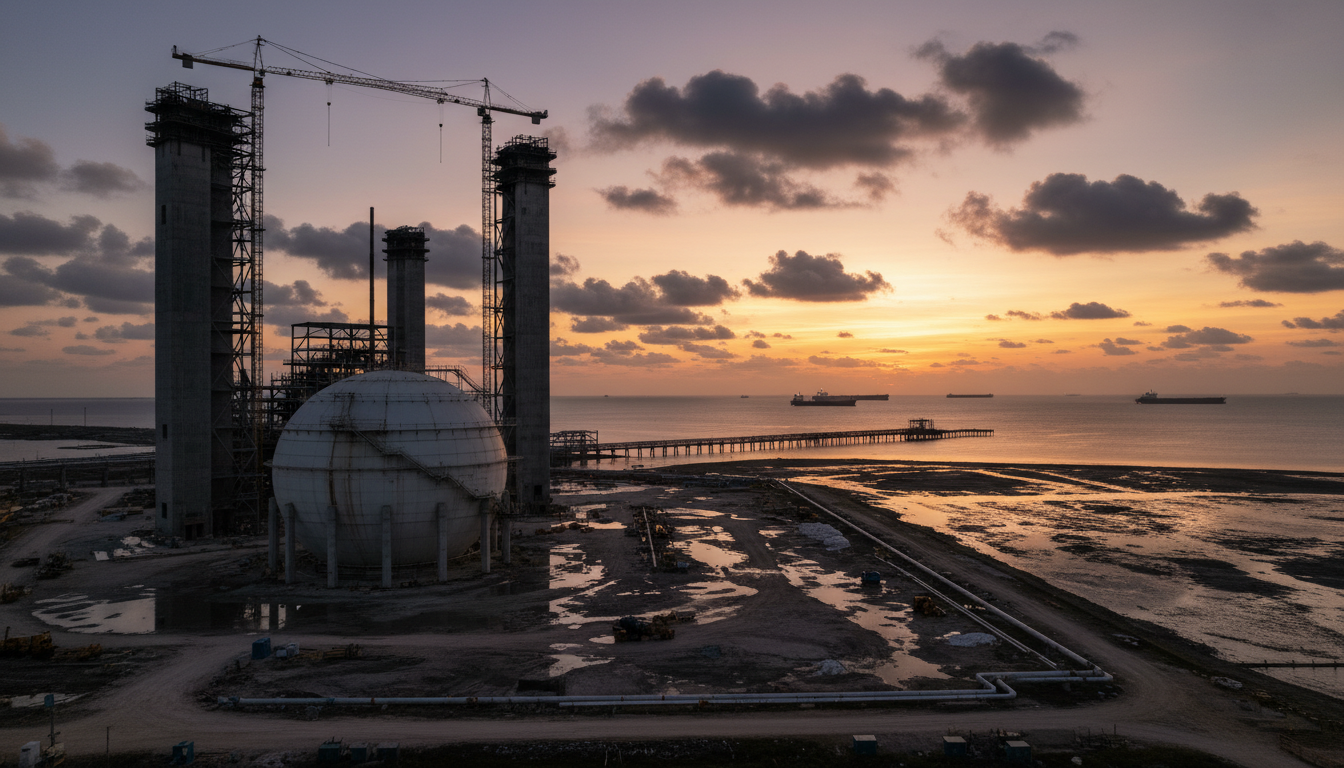
Woodside Energy, a prominent Australian energy major, is reportedly encountering headwinds in securing long-term buyers for the liquefied natural gas (LNG) slated for production at its Louisiana facility. Industry sources indicate that the primary sticking point revolves around the company’s ask for liquefaction fees, which have been positioned at a premium compared to prevailing rates within the highly competitive U.S. LNG export market. This challenge presents a critical focus area for investors monitoring the global natural gas sector and Woodside’s strategic trajectory.
The Pricing Predicament in a Competitive Market
The core of Woodside’s sales struggle, according to market intelligence, lies in its ambitious pricing strategy. The company has reportedly sought liquefaction fees exceeding $2.80 per million British thermal units (mmBtu). This figure stands noticeably above the current U.S. market average, which typically ranges between $2.40 and $2.50 per mmBtu. For comparison, Cheniere Energy, the largest U.S. LNG exporter, commands fees around $2.60 per mmBtu, while Venture Global, another significant player, offers more competitive rates at $2.30 per mmBtu.
This differential highlights Woodside’s attempt to position its offering at the higher end of the market, potentially aiming for superior margin capture. However, in a market driven by supply-demand dynamics and cost efficiency, such a premium can deter potential off-takers. The energy sector’s long-term contracts are often negotiated with tight margins, making every cent per mmBtu a critical factor in a buyer’s decision-making process. For investors, this signals a potential delay in realizing revenue streams from this significant asset, impacting projected returns on the substantial capital expenditure.
Recognizing the market resistance, Woodside appears to be recalibrating its approach. Reports suggest the company has adjusted its liquefaction fee offer downwards to $2.60 per mmBtu. While this aligns with Cheniere’s pricing, it still positions Woodside at the upper end of the spectrum relative to the broader market average. This price adjustment, though necessary, underscores the intense competition and the importance of pricing flexibility in securing crucial long-term agreements for substantial LNG volumes.
Securing Future Supply: Limited Offtake Agreements
The impact of this pricing strategy is evident in Woodside’s current progress in securing long-term buyers. To date, the company has managed to finalize only one significant long-term agreement for its Louisiana output. This sole buyer is Germany’s Uniper, a key European energy player focused on diversifying its energy supply. The terms with Uniper involve an annual volume of 2 million tons, which represents merely a quarter of the Louisiana facility’s designated capacity for external sale.
This limited long-term commitment raises questions for investors about the predictability of future cash flows and the market’s appetite for Woodside’s specific offering. The company is reportedly offering 10-year contracts, a duration generally considered attractive for buyers seeking supply stability and for sellers aiming to de-risk investments. Despite this favorable contract length, the initial pricing demands proved to be a hurdle. Furthermore, Woodside has opted to retain control over a substantial 8 million tons annually from the Louisiana plant, intending to market these volumes itself. This decision could be a strategic play to capitalize on spot market fluctuations or to bundle supply with other assets, but it also places a greater burden on Woodside’s internal trading capabilities and exposes it to direct market volatility.
Strategic Context: The Louisiana LNG Project’s Vision
The Louisiana LNG project represents a cornerstone of Woodside’s long-term growth strategy in the global gas market. The final investment decision (FID) for the project was formally reached last year, signaling a robust commitment to expanding its liquefaction footprint. Production commencement is targeted for 2029, making the current sales challenges a critical precursor to the project’s operational phase and the realization of its full financial potential.
Woodside’s entry into this U.S. facility was part of a broader strategic maneuver. The Australian energy giant secured the assets pertaining to this Louisiana facility through a significant $1.2 billion transaction linked to Tellurian in 2024. This acquisition underscored Woodside’s intent to become a major player in the Atlantic Basin LNG market, leveraging the abundant and cost-effective natural gas supplies from the U.S. shale plays.
Ambitious Capacity Expansion and Future Outlook
The Louisiana facility is designed with an impressive initial capacity, featuring three liquefaction trains capable of producing a combined 16.5 million tons of LNG annually. This expansion is projected to significantly bolster Woodside’s overall LNG capacity, with the company having stated in 2025 its aim to reach a total of 24 million tons annually by the next decade. This ambitious target highlights Woodside’s long-term vision for leadership in the global LNG trade.
Adding to this potential, Woodside also possesses regulatory permits for the development of two additional liquefaction trains at the Louisiana site. Should these expansions materialize, the facility’s total capacity could surge to an extraordinary 27.6 million tons annually. Such a scale would cement Woodside’s position as a dominant force in the global LNG landscape, offering substantial volumes to meet growing international demand for cleaner energy. However, the current difficulties in securing off-take agreements for even the initial phase underscore the importance of competitive pricing and strong market relationships in translating these ambitious capacity plans into tangible investor returns. As the global energy transition unfolds, successful execution in securing future sales will be paramount for Woodside’s continued growth and shareholder value in the oil and gas sector.


