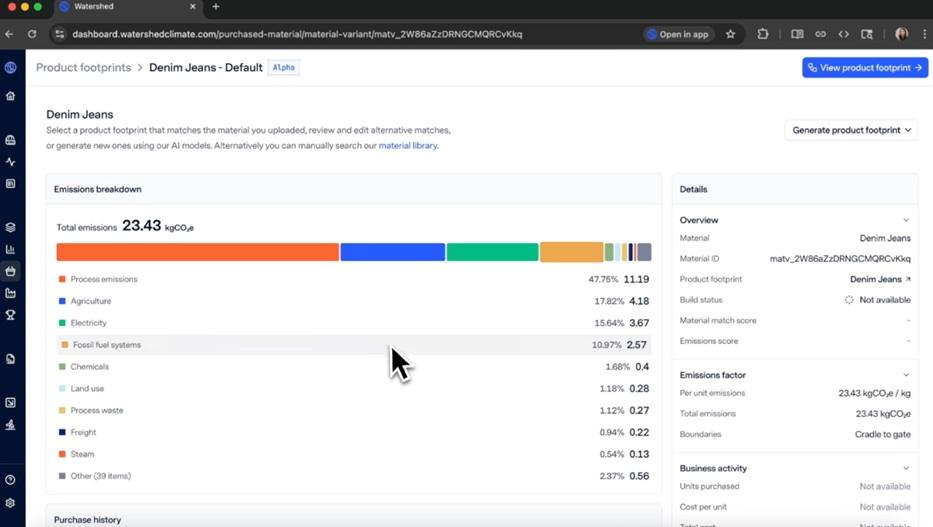
The oil and gas investment landscape is continually evolving, driven by both market fundamentals and an accelerating push towards sustainability. A recent announcement by climate solutions provider Watershed introduces an AI-powered solution, Product Footprints, designed to streamline the measurement and management of product-level carbon emissions. While seemingly focused on general industry, this innovation carries profound implications for oil and gas companies and their investors. For an industry grappling with intense scrutiny over its environmental footprint, a tool that provides rapid, accurate, and actionable insights into upstream purchasing emissions – which can constitute upwards of 70% of a company’s total carbon footprint – is not merely a compliance aid but a potential differentiator in attracting capital and demonstrating long-term viability.
Market Volatility Underscores ESG Imperatives
The current market snapshot for crude oil highlights a period of significant volatility, making the long-term strategic pivot towards sustainability even more critical for investor confidence. As of today, Brent Crude trades at $90.38, marking a sharp 9.07% decline within the day, with its range fluctuating between $86.08 and $98.97. Similarly, WTI Crude has fallen to $82.59, down 9.41%, trading between $78.97 and $90.34. Gasoline prices have also dipped to $2.93, a 5.18% decrease. This daily turmoil follows a broader downward trend, with Brent crude having shed $20.91, or 18.5%, over the past 14 days, falling from $112.78 on March 30, 2026, to $91.87 just yesterday. Such pronounced price movements underscore the inherent risks in commodity markets. In this environment, oil and gas companies that can demonstrate superior operational efficiency and robust ESG performance, bolstered by verifiable carbon tracking, are better positioned to weather price shocks and attract capital from increasingly discerning investors who view sustainability as a key indicator of future resilience.
AI-Powered Transparency for the Upstream Supply Chain
Watershed’s Product Footprints solution leverages AI to deconstruct everything a company purchases into its constituent materials and processes, meticulously tracing upstream emissions from sub-materials, production processes, and transport. This level of granular detail, previously prohibitively expensive and slow to achieve, is now available in minutes. For the oil and gas sector, this capability is revolutionary. The industry’s supply chains are notoriously complex, involving vast networks of suppliers for exploration, drilling, production, and refining equipment, as well as specialized services and materials. Accurately assessing the carbon footprint of steel pipes, drilling fluids, pumps, or transportation logistics has been a monumental challenge. With AI, companies can now gain unprecedented clarity into the embedded emissions of their procurements, allowing them to identify high-impact areas, negotiate with suppliers for lower-carbon alternatives, and ultimately reduce their overall Scope 3 emissions. This shifts the paradigm from generalized spend-based estimates to precise, actionable data, transforming sustainability intelligence into a strategic asset.
Investor Focus: Beyond Short-Term Swings to Long-Term Value
Our proprietary reader intent data reveals a keen investor focus on both immediate market dynamics and the long-term trajectory of the energy sector. Questions like “What do you predict the price of oil per barrel will be by end of 2026?” and “What are OPEC+ current production quotas?” reflect a natural preoccupation with near-term supply-demand balances. Indeed, upcoming events such as the OPEC+ JMMC and Full Ministerial meetings on April 18th and 19th, respectively, alongside the API and EIA Weekly Crude Inventory reports on April 21st and 22nd, will undoubtedly influence short-term price movements and shape trading strategies. However, the emergence of advanced carbon tracking tools like Watershed’s points to a more profound, structural shift that investors cannot afford to ignore. For a company like Repsol, which readers are asking about specifically for April 2026 performance, embracing such technologies becomes crucial. Companies that proactively integrate these solutions demonstrate a commitment to decarbonization that transcends quarterly results, potentially securing a “green premium” in their valuation and appealing to a growing pool of ESG-mandated capital, thereby impacting their long-term value creation.
Strategic Implications for Oil & Gas Portfolios
The introduction of AI-driven carbon tracking is not merely an incremental improvement; it represents a strategic imperative for oil and gas companies seeking to future-proof their operations and investment appeal. Beyond meeting regulatory pressures, accurate product carbon footprints enable O&G firms to identify efficiencies within their supply chains, optimize procurement decisions, and ultimately reduce operational costs while improving their environmental profile. For investors, this translates into a powerful new lens for evaluating companies. Those that proactively adopt and effectively utilize such technologies will likely outperform peers struggling with opaque emissions data. As Baker Hughes Rig Count reports on April 24th and May 1st continue to signal drilling activity, and inventory data provides weekly trading signals, investors must also consider the underlying shift towards verifiable, comprehensive carbon accounting. Companies that can demonstrate a lower carbon intensity across their product lifecycle, from upstream inputs to final delivery, will be better positioned to attract long-term capital, navigate evolving climate policies, and ultimately deliver sustainable returns in an energy transition economy.