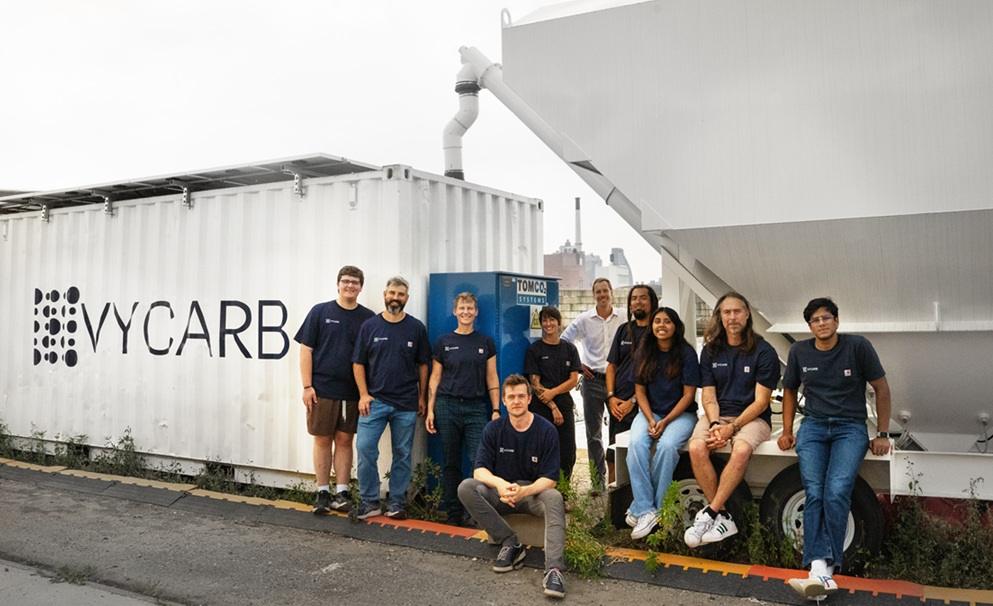
Investing in the Carbon Frontier: Vycarb’s $5 Million Seed Round Signals a New Era for CO2 Sequestration
The energy transition continues to accelerate, and with it, the investment landscape for innovative climate technologies. While traditional oil and gas markets navigate their inherent volatility, a distinct and growing stream of capital is flowing into solutions that address the industry’s carbon footprint. The recent announcement of Vycarb securing $5 million in seed funding for its unique water-based CO2 sequestration system underscores this trend, highlighting a strategic shift towards scalable, verifiable, and economically viable carbon capture and storage (CCS) methods. For investors eyeing long-term growth and environmental impact, Vycarb’s development offers a compelling case study in the evolving decarbonization sector.
Disrupting Traditional CCS: The Appeal of Modular, Water-Based Solutions
Vycarb, established in 2022, is spearheading a novel approach to carbon capture that promises to overcome many of the cost and infrastructure challenges inherent in conventional CCS. Their system leverages ocean-based chemistry to convert captured CO2 into dissolved bicarbonate within natural waters, employing readily available minerals and real-time sensor technology for continuous monitoring. This modular design means the technology can be integrated directly at industrial emission sources such as cement plants, steel facilities, power plants, and coastal ports, transforming existing water infrastructure into a powerful climate solution. Unlike systems reliant on extensive pipeline networks or high-pressure gas compression, Vycarb’s method emphasizes low-cost deployment and scalability. This focus on “breakthrough unit economics,” as highlighted by lead investor Twynam, is precisely what the market demands for widespread adoption and represents a significant draw for investors seeking efficient capital deployment in the climate tech space.
Navigating Market Swings: Why Decarbonization Remains a Core Investment Thesis
While the long-term imperative for decarbonization is clear, investors must constantly balance this with the immediate realities of commodity markets. As of today, Brent Crude trades at $90.38, reflecting a significant -9.07% daily drop, within a day range of $86.08-$98.97. WTI Crude shows a similar trend, currently at $82.59, down -9.41% for the day. This current market snapshot, following a broader decline from $112.78 just two weeks prior, underscores the inherent volatility in the oil sector. However, for sophisticated investors, these short-term price fluctuations, while impactful for upstream producers, do not diminish the strategic importance of investing in energy transition technologies. We frequently see investor questions about what the price of oil per barrel will be by the end of 2026; our analysis suggests that regardless of short-term price movements, the global push for emissions reduction will only intensify, making investments in verifiable carbon solutions like Vycarb’s a critical component of a diversified, future-proof portfolio.
Strategic Integration and Upcoming Catalysts for Energy Transition
Vycarb’s technology presents substantial strategic integration opportunities for incumbent energy players and heavy industries looking to meet decarbonization targets. Its applicability at existing industrial sites makes it a natural fit for companies seeking to abate their own emissions or diversify into carbon management services. Major integrated energy companies are actively exploring various pathways to reduce their carbon intensity, and solutions that avoid high-cost, bespoke infrastructure are particularly attractive. For instance, the very question of how well companies like Repsol will perform in the coming periods often hinges on their strategic foresight in embracing such innovative solutions.
Looking ahead, the broader energy market will be shaped by several key events. The upcoming OPEC+ Joint Ministerial Monitoring Committee (JMMC) Meeting on April 19 and the subsequent OPEC+ Ministerial Meeting on April 20 will be crucial in setting the tone for global oil supply, directly impacting crude prices and indirectly influencing the pace of energy transition investments. Furthermore, the API Weekly Crude Inventory reports, scheduled for April 21 and April 28, along with the EIA Weekly Petroleum Status Reports on April 22 and April 29, will provide vital insights into demand dynamics. While these events directly concern traditional hydrocarbon markets, their outcomes collectively inform the macroeconomic environment in which energy transition technologies are valued and deployed. A market signaling continued demand for traditional fuels might increase pressure on producers to invest more aggressively in carbon mitigation, making Vycarb’s modular and cost-effective solution even more compelling.
The Investor’s Mandate: Verifiability, Scalability, and Impact
A critical factor driving investor confidence in climate tech is the assurance of permanence and verifiability. Vycarb’s commitment to ensuring captured carbon is “permanently stored and verifiable” through real-time monitoring directly addresses this demand. In the burgeoning carbon credit markets, the integrity of sequestration data is paramount, and systems that can demonstrate robust measurement and validation are poised for significant advantage. The modular nature of Vycarb’s system further enhances its investment appeal by promising scalability across a diverse range of industrial applications, from bioenergy facilities to steel production. This scalability, coupled with its ability to counter ocean acidification, positions Vycarb not just as a carbon removal solution but as a multi-benefit environmental technology. Investors are increasingly demanding transparency and robust data, echoing the inquiries we receive about the data sources powering our own market intelligence platforms; this same scrutiny applies to the verifiable impact of climate investments.
Conclusion: A Glimpse into the Future of Carbon Management Investment
Vycarb’s successful $5 million seed funding round is more than just a capital raise; it’s a testament to the growing investor appetite for innovative, scalable, and economically sound solutions in the carbon capture and storage landscape. In a world balancing short-term commodity market volatility with long-term climate imperatives, technologies that offer modularity, verifiability, and cost-effectiveness stand to capture significant investor interest. As the energy transition matures, we anticipate continued capital flow into companies like Vycarb that are not just incrementally improving existing methods but fundamentally rethinking how we manage industrial emissions and achieve genuine decarbonization.


