The United States is witnessing an unprecedented surge in battery energy storage system (BESS) deployments, signaling a profound shift in energy infrastructure and investment priorities. Recent announcements detailing an additional 1.2 GWh of capacity coming online or changing hands within days underscore the accelerating momentum. This rapid expansion is not merely a technological advancement; it represents a burgeoning investment frontier, attracting significant institutional capital and reshaping the landscape for energy investors seeking growth and stability beyond the traditional fossil fuel markets. For savvy investors, understanding the drivers behind this BESS boom, the key players, and its interaction with broader energy market dynamics is crucial.
The Rapid Ascent of US Battery Storage Capacity
The pace of BESS development across the United States is accelerating, with multiple significant projects recently reaching operational status or securing key development milestones. In Michigan, Jupiter Power, backed by New York-based BlackRock, has inaugurated its 100 MW/400 MWh Tibbitts Energy Storage Facility in Coldwater township. This project, which began supplying Consumers Energy earlier this summer, is touted as the state’s first utility-scale energy storage system and is just the beginning of Consumers Energy’s decade-long plan to integrate large-scale battery projects. Jupiter Power itself boasts an impressive portfolio, with nearly 3 GWh of operational or under-construction batteries and a formidable 12 GW-plus development pipeline, including the 100 MW Voyager Battery Storage Project in Saline Township, also with Consumers Energy.
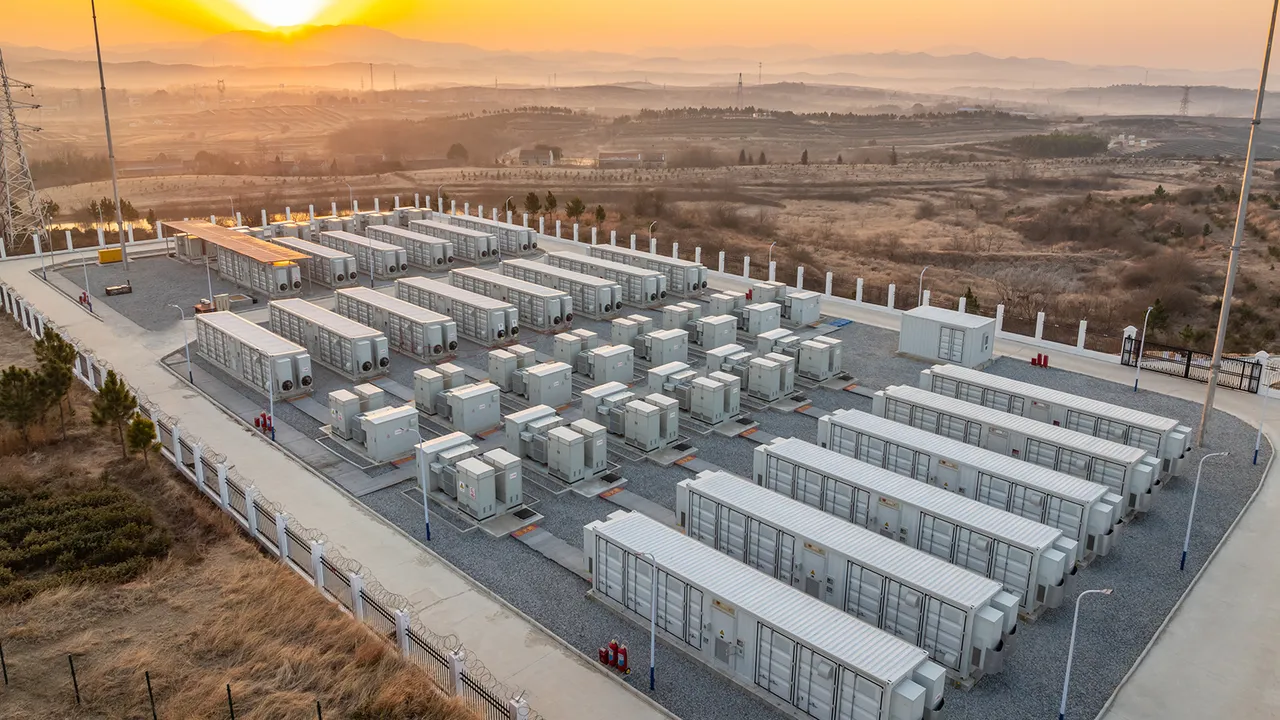
On the West Coast, North Carolina-based LS Energy Solutions announced the operational commencement of the 200 MW/400 MWh Big Rock site in Imperial County, California. This facility, acquired by a unit of London-based Gore Street Capital in February 2023, is now delivering critical resource adequacy services to the California Independent System Operator (CAISO) grid under a robust 12-year contract. Featuring 137 containers of LS-ES AiON-ESS batteries, Big Rock marks Gore Street’s inaugural CAISO project and contributes to its 753.4 MW/924.1 MWh operational portfolio spanning the U.S., Ireland, Great Britain, and Germany. LS Energy Solutions has installed over 1 GW of energy storage across 250 projects globally, highlighting their technical prowess.
Further west, Oregon-based renewables business GridStor, funded by New York investment bank Goldman Sachs, recently acquired the 100 MW/400 MWh White Tank project in Maricopa County, Arizona, from Strata Clean Energy. This project is slated to come online in the first half of 2027 and will operate under a 20-year tolling agreement with Arizona Public Service (APS), a key state utility. This acquisition represents GridStor’s fourth project purchase in 12 months and its second in Arizona, adding to its reported 5 GW of BESS in late-stage development or under construction, demonstrating aggressive expansion.
Institutional Capital Fuels the Energy Transition
The substantial capital flowing into the BESS sector from prominent institutional investors is a clear indicator of its growing maturity and perceived stability. The backing of BlackRock for Jupiter Power, Goldman Sachs for GridStor, and Gore Street Capital for the LS Energy site underscores a strategic pivot by major financial players towards resilient, long-term infrastructure assets. These institutions are not merely speculative investors; they are providing the foundational capital necessary to scale these projects, recognizing the critical role BESS plays in grid modernization and renewable energy integration. The prevalence of long-term contracts, such as the 12-year agreement with CAISO for Big Rock and the 20-year tolling agreement with APS for White Tank, significantly de-risk these investments, providing predictable revenue streams that appeal to large institutional funds. This de-risking mechanism, coupled with the essential service BESS provides to grid stability, makes these assets particularly attractive in a volatile energy market. The commitment from these financial giants validates BESS as a core component of future energy portfolios, moving beyond niche renewable plays to mainstream infrastructure investment.
Navigating Market Volatility: A Strategic Shift for Investors
Amidst the accelerating build-out of battery storage, the traditional energy markets present a stark contrast in volatility. As of today, Brent crude trades at $90.38, marking a significant 9.07% decline for the day, with its range fluctuating widely between $86.08 and $98.97. Similarly, WTI crude has fallen by 9.41% to $82.59, moving within a daily band of $78.97 to $90.34. This acute downturn continues a broader trend, with Brent having shed $20.91, or 18.5%, over the past 14 days, falling from $112.78 to $91.87. This kind of price fluctuation highlights the inherent unpredictability of oil markets, driven by geopolitical tensions, supply-demand imbalances, and global economic shifts. Gasoline prices have followed suit, currently at $2.93, down 5.18% today.
Our proprietary reader intent data reveals that while investors remain deeply engaged with these traditional energy dynamics, seeking answers to questions like “what do you predict the price of oil per barrel will be by end of 2026?” and “What are OPEC+ current production quotas?”, there’s an increasing recognition of the need for diversification. The stability offered by contracted revenue streams in the BESS sector, largely decoupled from the daily swings of crude benchmarks, presents a compelling alternative. For investors grappling with the unpredictable nature of commodity markets, the BESS frontier offers a tangible pathway to invest in the future of energy infrastructure with a degree of predictability that traditional oil and gas often lacks. This strategic shift is becoming imperative for balanced portfolios.
Forward Outlook: BESS Resilience Amidst Global Energy Shifts
Looking ahead, the resilience and continued growth of the BESS sector appear robust, even as the broader energy landscape faces critical junctures. The coming days will see significant events in the traditional oil markets, including the OPEC+ Joint Ministerial Monitoring Committee (JMMC) meeting today, April 18th, followed by the full OPEC+ Ministerial Meeting tomorrow, April 19th. These gatherings are pivotal, as their decisions on production quotas could significantly impact crude prices and investor sentiment, as evidenced by the consistent reader interest in “What are OPEC+ current production quotas?”. Furthermore, the API and EIA Weekly Crude Inventory reports on April 21st, 22nd, 28th, and 29th, alongside the Baker Hughes Rig Count reports on April 24th and May 1st, will offer fresh insights into supply dynamics and drilling activity.
However, regardless of the outcomes of these traditional energy events, the fundamental drivers for BESS expansion remain strong. The increasing penetration of intermittent renewable energy sources like solar and wind necessitates advanced storage solutions for grid stability and reliability. Utilities like Consumers Energy and APS are actively integrating BESS into their long-term infrastructure plans, recognizing its essential role in meeting peak demand, managing energy fluctuations, and enhancing overall grid resilience. The White Tank project’s planned online date in the first half of 2027 further underscores the forward-looking nature of these investments. As global energy markets continue their complex transition, BESS offers a growth vector driven by technological advancement, environmental imperatives, and essential grid services, providing a more insulated and predictable investment profile compared to the often-turbulent oil and gas sector.