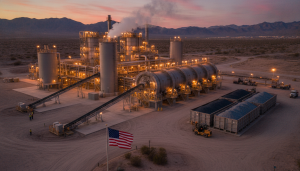
The United States energy landscape is undergoing a profound transformation, with battery energy storage emerging as a central pillar of grid modernization and energy security. A recent analysis reveals an unprecedented surge in this critical sector, reporting a remarkable 32% year-over-year expansion in the U.S. battery market during the first quarter. This exponential growth trajectory necessitates a re-evaluation of investment strategies for all stakeholders, including those deeply entrenched in traditional oil and gas ventures, as the shift impacts power market dynamics and future energy infrastructure.
The first quarter of 2026 shattered previous records, witnessing the deployment of nearly 10 GWh of new energy storage capacity. Specifically, 9.7 GWh came online, marking the strongest opening quarter ever recorded for the nation’s energy storage sector. This impressive deployment pushes the U.S. towards a projected cumulative storage capacity of 613 GWh by 2030, signaling a clear and accelerating commitment to flexible grid solutions. For investors, this data underscores a robust and expanding market, positioning energy storage as a crucial asset class capable of insulating against commodity price volatility, stabilizing electricity costs, and fortifying grid resilience.
Navigating the Policy Headwinds Amidst Unprecedented Demand
Despite the undeniable market momentum, the energy storage industry faces significant political and regulatory hurdles. The current policy environment presents a complex challenge, with federal permitting processes creating bottlenecks that threaten to impede deployment schedules. Industry analysis indicates that 467 solar and storage projects are currently entangled in permit queues, rendering them susceptible to politically motivated delays or outright cancellations. This situation introduces a layer of regulatory risk that astute investors must factor into their capital allocation decisions, even as fundamental demand signals remain exceptionally strong.
The market’s architecture continues to be predominantly shaped by large-scale utility deployments, which represent the lion’s share of new capacity. In the first quarter, utility-scale projects contributed a substantial 7.8 GWh. However, the distributed energy sectors also maintained a steady growth baseline, with commercial and industrial (C&I) applications adding 648 MWh and the residential segment deploying 515 MWh of behind-the-meter storage. This diversified growth across various scales offers multiple entry points for investors seeking exposure to different segments of the energy storage value chain.
The Five Pivotal Trends Redefining Energy Storage Investments
A deeper dive into the updated market data reveals five transformative trends that will dictate investment success and strategic positioning in the energy storage sector over the next 12 months:
1. Data Centers Drive Unprecedented “Speed-to-Power” Demand
The burgeoning demands of generative AI and hyperscale computing are rapidly outstripping the grid’s conventional interconnection capabilities. Tech giants such as Google and Meta have already committed to massive procurement deals, securing tens of thousands of megawatt-hours of energy storage capacity this year alone. To mitigate utility bottlenecks and manage the colossal millisecond training loads inherent in advanced computing, data center developers are increasingly co-locating large-scale battery energy storage systems (BESS). This trend creates a powerful new demand driver for energy storage, offering significant opportunities for infrastructure developers and technology providers.
2. The “Red State” Boom in Utility-Scale Deployments
While California, Texas, and Arizona remain the titans of utility-scale energy storage, a striking shift in geographical deployment patterns has emerged. A notable 71% of all utility-scale capacity installed during the first quarter was constructed in states that supported former President Donald Trump in the 2024 election. Emerging markets like Georgia, Iowa, and Mississippi have recorded significant capacity gains. This phenomenon demonstrates that localized economic imperatives and critical grid reliability requirements are transcending traditional partisan divides, signaling a broader, more national acceptance and integration of energy storage solutions driven by pragmatic energy needs, not just environmental policy.
3. Dramatic Cost Deflation Reshapes Project Economics
Rapid advancements in manufacturing scale and substantial improvements in battery supply chain efficiencies have fundamentally altered the financial viability of energy storage projects. The average price for utility-scale energy storage has plummeted by an astonishing 55% since 2022. This steep deflationary curve has effectively counteracted rising capital costs in other segments of the supply chain, enabling the standard battery duration for new projects to stabilize at an average of three hours. For investors, this translates into improved project internal rates of return (IRRs) and enhanced competitiveness against traditional power generation assets, including gas-fired peaker plants.
4. Standalone Storage Claims Majority Share
A significant strategic pivot is underway within the market: standalone energy storage installations have officially surpassed solar-plus-storage configurations, now accounting for 51% of all utility-scale storage capacity. Paired solar-plus-storage projects represent 48% of the market, with wind-paired systems holding a nominal 1%. This shift highlights a growing developer preference for deploying batteries independently, thereby maximizing revenue generation through sophisticated energy arbitrage strategies and the provision of essential ancillary grid services. This trend unlocks new avenues for profit maximization and grid optimization.
5. Robust Domestic Manufacturing Bolsters Supply Chain Security
Spurred by robust domestic content incentives, the United States has solidified its position as the world’s second-largest battery manufacturer. Twenty-three states across the nation now boast dedicated energy storage factories, either operational or actively under construction. The U.S. domestic supply chain currently features 22 GWh of operational battery cell manufacturing capacity, with an additional 131 GWh actively under construction, alongside 68 GWh of active battery pack assembly capacity. This strategic buildout enhances supply chain resilience, reduces geopolitical risks, and presents substantial investment opportunities in manufacturing and industrial infrastructure.
Strategic Long-Term Investment Horizon
Despite the existing regulatory friction, the medium-term outlook for the energy storage sector remains aggressively bullish. Front-of-the-meter utility deployment is projected to experience an astounding 256% surge in cumulative capacity by 2030, while the residential market is forecasted to expand by 108% over the same timeframe. This sustained growth trajectory signals a robust and enduring investment opportunity for patient capital.
As the energy transition gains further momentum, energy storage is increasingly recognized not merely as a backup solution but as essential energy security infrastructure. A supportive and consistent policy landscape for battery energy storage systems (BESS) will prove paramount in enabling the widespread rollout of AI and data centers, while simultaneously mitigating adverse cost impacts on energy consumers. For oil and gas investors, understanding these dynamics is crucial, as the evolving power market creates both competitive pressures and novel opportunities for diversification, strategic partnerships, and leveraging existing expertise in large-scale energy infrastructure development.