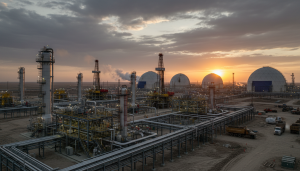
The global oil market witnessed a significant uplift in crude futures on Tuesday, with prices climbing over a dollar per barrel, primarily driven by a landmark announcement from the White House regarding a substantial $600 billion investment pledge from Saudi Arabia into the United States. This development injected a fresh wave of optimism into energy markets, building on momentum from previous sessions.
By 1417 GMT, international benchmark Brent crude futures advanced by 88 cents, marking an approximate 1.35% increase to settle at $65.84 a barrel. Concurrently, U.S. West Texas Intermediate (WTI) crude futures saw an even more robust rise, gaining $1.13, or about 1.82%, to reach $63.08. These gains underscore a renewed confidence among market participants, following a period of fluctuating sentiment.
Geopolitical Dynamics Fueling Market Confidence
The latest surge in crude prices follows a strong performance in the preceding session, where both benchmarks posted gains of 4% or more. This earlier rally was ignited by a crucial agreement between the United States and China to implement significant reductions in tariffs for at least 90 days. The trade truce not only provided a substantial boost to crude oil but also propelled Wall Street equities and strengthened the dollar, signaling improved global economic prospects and, by extension, energy demand.
The broader context for Tuesday’s market movement included U.S. President Donald Trump’s diplomatic visit to Saudi Arabia as part of a wider tour of the Middle East. During this visit, the U.S. administration unveiled a substantial defense sales agreement with the Kingdom, valued at an impressive $142 billion. These high-level engagements and strategic partnerships between two major global players invariably send ripple effects across commodity markets, particularly energy.
Saudi Investment: A Strategic Play for Energy Infrastructure
The announced $600 billion Saudi investment is poised to have a tangible impact on the U.S. economy and its energy infrastructure. A notable portion of this capital infusion is earmarked for Saudi Aramco’s Motiva refining and petrochemical complex located in Port Arthur, Texas. For investors, this signifies a deepening of Saudi Arabia’s strategic footprint in the U.S. downstream sector, potentially enhancing refining capabilities and strengthening the integration of global energy supply chains. Such investments can also be seen as a long-term commitment to the stability and growth of the energy market.
While the immediate market reaction to the trade truce and Saudi investment has been positive, analysts advise a cautious outlook. Tamas Varga, an analyst at PVM, noted that market participants are currently assessing the full implications of the U.S.-China trade agreement. However, he cautioned that “Coupled with the scheduled steep increase in OPEC+ supply in May and June, the upside might prove limited.” This highlights the ongoing tension between demand-side catalysts and supply-side adjustments orchestrated by major producers.
OPEC+ Strategy and Global Supply Dynamics
The Organization of the Petroleum Exporting Countries (OPEC) and its allies, collectively known as OPEC+, have been actively managing global oil supply. Data indicates that OPEC has raised its oil output more than initially projected since April. For May, the consortium is expected to increase production by a significant 411,000 barrels per day. This strategic increase in supply is a crucial factor for investors to monitor, as it directly impacts the delicate balance between global supply and demand.
Further insights into supply dynamics reveal that Saudi Arabia, a cornerstone of OPEC+, plans to maintain a steady crude oil supply to China in June. This follows a previous month where Saudi exports to China hit their highest level in over a year, a direct consequence of the OPEC+ decision to boost output. For investors tracking global energy trade flows, it’s important to remember that Saudi Arabia stands as the second-largest crude supplier to China, trailing only Russia, underscoring the Kingdom’s pivotal role in Asian energy security and market stability.
Resilient Refined Fuel Demand and Refining Margins
Despite some broader concerns about crude demand, the market for refined fuels continues to display robust signals. JPMorgan analysts, in a recent note, emphasized that “positive signals from the fuel markets cannot be overlooked.” This observation points to a divergence in performance between crude oil prices and refined product prices, which presents unique opportunities and challenges for energy investors.
A key takeaway for those invested in the energy sector is the notable disparity: international crude prices have fallen by 22% since their peak on January 15. Yet, refined product prices and, consequently, refining margins have remained remarkably stable. This resilience in the downstream sector is primarily attributed to a reduction in refining capacity, particularly in the United States and Europe. Such capacity constraints are tightening gasoline and diesel balances across these regions, leading to an increased reliance on imports. This scenario makes these markets more susceptible to price spikes during periods of scheduled maintenance or unplanned outages, creating a favorable environment for refining companies even amidst a softer crude price landscape.
For investors, this complex interplay of geopolitical developments, strategic investments, OPEC+ supply adjustments, and resilient downstream demand necessitates a nuanced approach. While the immediate boost from the Saudi investment and trade truce is positive, the underlying dynamics of increasing crude supply and tightening refining capacity paint a picture of ongoing market rebalancing. Monitoring these factors will be crucial for navigating the evolving landscape of global oil and gas investments.