The United Kingdom has taken a decisive step to cement its position as a global leader in sustainable finance, formally adopting sustainability reporting standards aligned with the International Sustainability Standards Board (ISSB) framework. This move, which includes the publication of the final UK Sustainability Reporting Standards (UK SRS) S1 and S2, signals a profound shift for the investment landscape, particularly for the oil and gas sector. While initially available for voluntary adoption, the Financial Conduct Authority (FCA) is actively consulting on amendments to the UK Listing Rules, with a pivotal deadline of March 20, 2026, that could usher in mandatory reporting for a significant number of UK-listed entities. For energy investors, this development is not merely a bureaucratic update; it represents a fundamental recalibration of how environmental, social, and governance (ESG) factors will be integrated into financial disclosures, driving capital allocation decisions and reshaping long-term valuations across the industry.
The New UK Sustainability Reporting Standards: A Closer Look
The UK’s commitment to a world-leading sustainable finance framework, first articulated in the Chancellor’s Mansion House speech in November 2024, is now taking concrete form. By publishing UK SRS S1 and S2, London has integrated the ISSB’s globally recognized IFRS Sustainability Disclosure Standards into its domestic regulatory environment. IFRS S1 establishes general requirements for sustainability-related financial information, while IFRS S2 specifically addresses climate-related disclosures. The overarching goal, as set out by the ISSB since its inception at COP26 in Glasgow in 2021, is to provide comparable and decision-useful information that empowers investors to efficiently allocate capital and foster robust, transparent capital markets. The standards, now available for voluntary application, reflect technical recommendations from the independent UK Sustainability Disclosure Technical Advisory Committee, ensuring a rigorous domestic adaptation. This strategic alignment positions the UK at the forefront of jurisdictions embracing a global baseline for sustainability reporting, a critical factor for international investors evaluating energy companies with UK listings or significant operations.
Navigating Market Volatility Amidst ESG Evolution
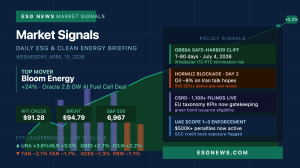
The introduction of enhanced ESG reporting requirements comes against a backdrop of notable market volatility, which investors must carefully consider. As of today, Brent crude trades at $93.72 per barrel, showing a modest daily increase of 0.51%. However, this current price point marks a significant shift from just three weeks ago, when Brent commanded $118.35 on March 31. This represents a substantial 19.8% decline in the benchmark price over a mere 14 days, settling at $94.86 yesterday, April 20. Such sharp fluctuations in crude prices directly impact the financial health and strategic planning of oil and gas companies. While stronger prices might offer more flexibility for investing in ESG initiatives and reporting infrastructure, a downward trend could constrain budgets and force difficult trade-offs. The mandate for more detailed climate-related disclosures, even during periods of market stress, will force companies to demonstrate resilience and a clear path toward sustainability. This dynamic interplay between market realities and increasing regulatory pressure will undoubtedly influence how quickly and effectively O&G firms adapt to the new reporting regime.
Future Implications for Oil & Gas: Compliance, Capital, and Calendar Catalysts
The path forward for oil and gas companies under these new UK SRS standards will be defined by compliance, access to capital, and the broader energy market’s evolution. Mandatory adoption, if confirmed post-FCA consultation by March 20, 2026, will require significant investment in data collection, governance, and assurance processes. This isn’t just about reporting; it’s about embedding sustainability into core business strategy. The energy calendar over the next few weeks provides crucial context for these strategic shifts. Tomorrow, April 21, the OPEC+ Joint Ministerial Monitoring Committee (JMMC) meeting could signal shifts in production policy, directly impacting global supply and price stability. Subsequent EIA Weekly Petroleum Status Reports on April 22 and April 29, along with Baker Hughes Rig Count updates on April 24 and May 1, will offer real-time insights into supply-demand dynamics and drilling activity. Crucially, the EIA Short-Term Energy Outlook on May 2 will provide a forward-looking perspective on market fundamentals, which companies will need to factor into their climate transition plans and financial projections as they prepare for more rigorous sustainability disclosures. These events, combined with the looming regulatory changes, underscore a period of heightened scrutiny and strategic re-evaluation for the sector.
Addressing Investor Concerns: Transparency and Valuation in a Changing Landscape
Our proprietary reader intent data reveals a consistent theme among investors: a keen focus on market direction and long-term valuation. Questions like “is WTI going up or down?” and “what do you predict the price of oil per barrel will be by end of 2026?” highlight the demand for clarity amidst uncertainty. The UK’s new sustainability reporting standards directly address this by mandating enhanced transparency. For investors evaluating oil and gas companies, including European majors like Repsol, these disclosures will provide a richer dataset to assess climate-related risks, transition pathways, and the true cost of operations beyond traditional financial metrics. This improved data will enable more informed comparisons between companies, distinguishing those genuinely advancing their sustainability agenda from those merely paying lip service. Consequently, companies that proactively embrace the UK SRS and demonstrate robust, verifiable ESG performance are likely to attract more capital, potentially seeing higher valuations and a lower cost of capital in a market increasingly prioritizing sustainable investments. This framework is designed to empower investors with the information needed to make more sophisticated predictions about future oil prices and the long-term viability of energy assets.