Geopolitical Tensions Ignite Oil Market Volatility as Hormuz Standoff Intensifies
Global energy markets are on high alert following an unprecedented escalation in rhetoric and military action directed at Iran by U.S. President Donald Trump on Tuesday, April 6, 2026. The President issued dire warnings regarding the fate of an entire civilization unless a resolution is reached to reopen the critically important Strait of Hormuz, pushing an already volatile crude oil landscape into uncharted territory.
The intensifying geopolitical drama comes hot on the heels of confirmed U.S. military strikes on Kharg Island, Iran’s primary oil export terminal. Overnight operations targeted strategic military assets on the island, a move that signals a significant broadening of the conflict and injects substantial risk into the global energy supply chain. While Iran has largely curtailed its oil exports due to the ongoing conflict initiated in late February by U.S. and Israeli forces, targeting this vital infrastructure point sends a clear message about potential future capacities.
President Trump’s Escalation Stokes Market Uncertainty
President Trump conveyed his stark ultimatum through social media platforms, declaring, “A whole civilization will die tonight, never to be brought back again. I don’t want that to happen, but it probably will.” This highly charged statement underscores the extreme stakes involved for international stability and, by extension, the energy sector. He further speculated on the possibility of a “revolutionarily wonderful” outcome if “different, smarter, and less radicalized minds prevail” under a “Complete and Total Regime Change.” Such pronouncements immediately factor into the geopolitical risk premium embedded in crude oil futures, signaling a period of profound uncertainty for energy investors.
The President’s rhetoric has been consistently aggressive. On Easter Sunday, he issued a fiery warning to Tehran, threatening the destruction of key Iranian infrastructure, including bridges and power plants, by Tuesday night unless the Strait of Hormuz was reopened. His deadline for compliance was set at 8 p.m. ET Tuesday. Despite boasting of the “obliteration” of Iran’s military capabilities, he concurrently acknowledged Iran’s continued strategic leverage over maritime traffic through the vital chokepoint.
The Critical Strait of Hormuz: A Global Energy Chokepoint
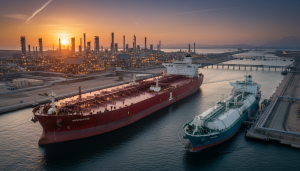
The ongoing closure of the Strait of Hormuz by Iran since late February, concurrent with the start of hostilities, has been the primary catalyst for a historic oil supply shock. This maritime bottleneck, through which a significant portion of the world’s seaborne crude oil and refined products passes daily, is indispensable for global energy security. Its prolonged closure has throttled international oil transit, causing global energy prices to soar to unprecedented levels. The financial implications for energy importers and consumers worldwide are staggering, directly impacting inflation, economic growth forecasts, and corporate earnings across various sectors.
For investors in the oil and gas space, the Strait of Hormuz represents an existential risk. Its blockage disrupts supply routes from major Middle Eastern producers to key demand centers in Asia, Europe, and North America. This forces tankers to undertake longer, more costly journeys, if alternative routes are even viable, exacerbating logistical challenges and pushing up shipping rates. The sustained disruption since February has already recalibrated supply-demand dynamics, making every barrel of available crude oil exceedingly valuable.
Investor Outlook: Navigating Extreme Volatility
In this rapidly evolving environment, investors must brace for extreme market volatility. The direct strike on Kharg Island, while Iran’s exports are already minimal, serves as a potent reminder of the fragility of the region’s oil infrastructure. Any further military actions or a complete shutdown of oil production in the Persian Gulf could trigger an even more catastrophic supply shock, sending crude benchmarks like Brent and WTI to new record highs.
Energy companies, particularly those with upstream assets outside the Middle East or with robust refining and marketing operations, might see varying impacts. Exploration and production firms could benefit from elevated commodity prices, while companies reliant on specific trade routes or Gulf-sourced crude could face significant operational headwinds. Tanker companies, paradoxically, might see increased demand for longer voyages, but the overarching risk to global trade could negate such gains.
The immediate focus for the markets is the 8 p.m. ET deadline. Failure to reach a resolution or a diplomatic breakthrough could herald further military engagements, potentially leading to an even more entrenched conflict. Investors are closely monitoring every development, weighing the potential for a diplomatic off-ramp against the very real threat of broader regional conflict. Prudent portfolio management in this climate dictates a keen eye on geopolitical developments, a reassessment of risk exposure, and consideration for hedging strategies against continued energy market instability.