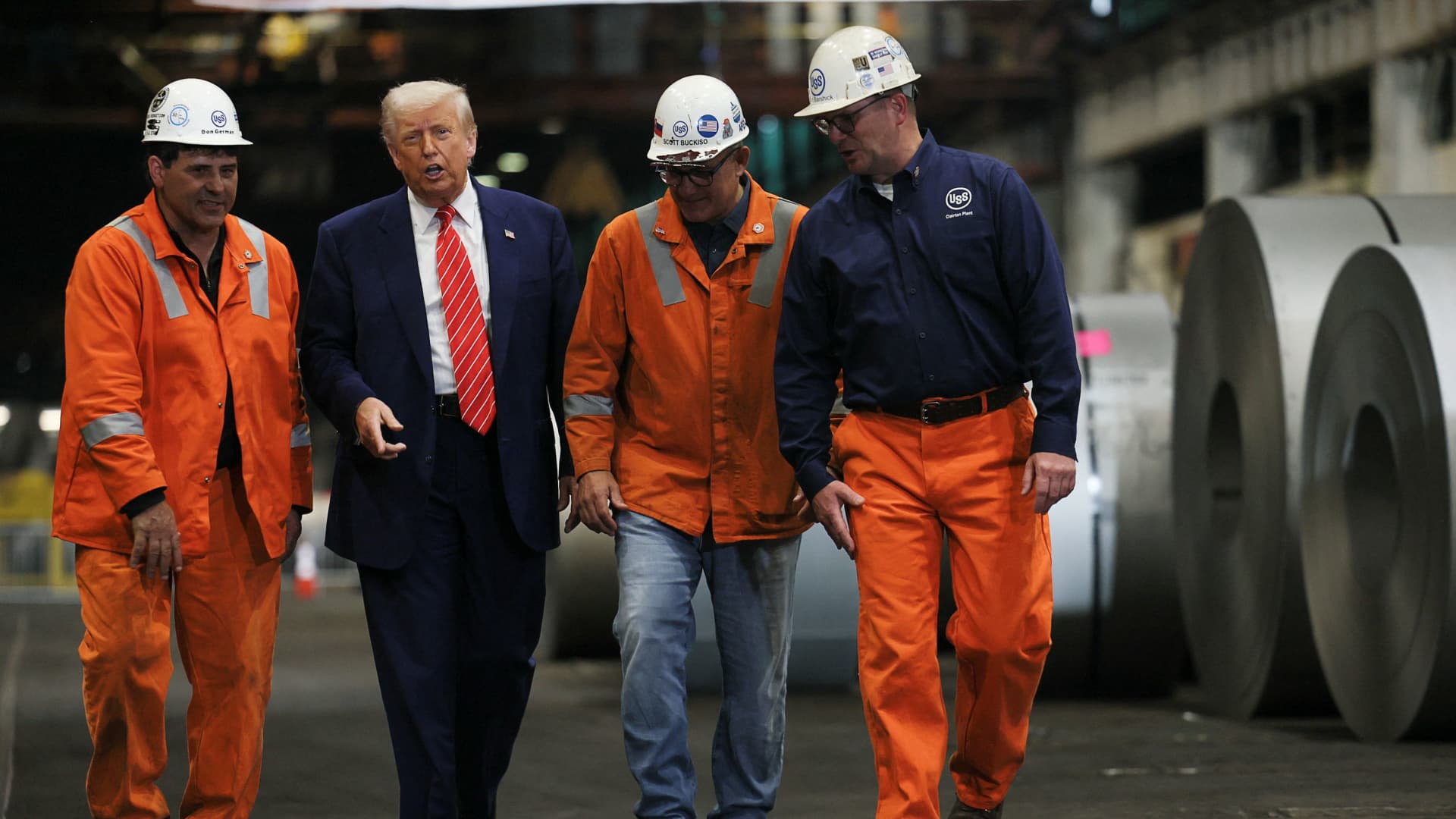
In a move poised to significantly reshape the landscape of major industrial acquisitions, former President Donald Trump declared last Thursday that the United States would retain a decisive “golden share” in U.S. Steel, granting it ultimate veto power following the proposed acquisition by Japan’s Nippon Steel. This announcement, made from the East Room of the White House, introduces a critical layer of government oversight into a deal already fraught with political and economic complexities, leaving investors and industry observers scrutinizing the precise implications for this venerable American industrial icon.
National Interest Takes Precedent: The “Golden Share” Explained
Trump emphasized the profound nature of this governmental stake, stating, “We have a golden stock. We have a golden share, which I control, or the president controls. That gives you total control.” He further asserted that American interests would effectively command a 51% ownership of U.S. Steel, though specifics on the structural mechanism for achieving this control remain undisclosed. This concept of a “golden share” is designed to safeguard national interests in strategically vital companies, often allowing governments to block specific decisions, even when holding a minority equity stake.
Elaborating on the practical applications, Pennsylvania Senator Dave McCormick previously indicated that such a “golden share” would empower the U.S. government to influence a predetermined number of U.S. Steel board positions. The primary objective, according to McCormick, is to ensure that domestic production levels are maintained and not diminished. “It’s a national security agreement that will be signed with the U.S. government,” McCormick informed CNBC’s “Squawk Box” on May 27, underlining the strategic importance attributed to U.S. Steel’s operations within the broader national security framework.
A Shroud of Uncertainty for Stakeholders
Despite these pronouncements, a tangible lack of definitive information continues to plague the deal, leaving investors, union members, and market analysts in a state of prolonged uncertainty. Key stakeholders, including the White House, U.S. Steel, and Nippon Steel, have provided scant details regarding the final structure or expected timeline for the transaction’s completion. This opacity has been a consistent theme since Trump initially announced what he termed a “planned partnership” between the two industrial behemoths on May 23.
The President’s characterization of a “partnership” immediately introduced confusion, as U.S. Steel has consistently communicated since December 2023 its intention to become a wholly owned subsidiary of Nippon North America. This fundamental divergence in terminology – “partnership” versus “wholly owned subsidiary” – raises critical questions about the nature of the future relationship and the extent of autonomy U.S. Steel would retain, a vital consideration for its long-term operational and strategic direction.
Navigating the Regulatory Labyrinth and Lapsed Deadlines
The path to this potential deal has been anything but straightforward, marked by significant regulatory and political interventions. Former President Joe Biden had initially moved to block the transaction in January, citing concerns over national security and domestic manufacturing. Subsequently, in April, Trump ordered a fresh review of the proposed acquisition, injecting a new dynamic into the regulatory process. The Committee on Foreign Investment in the United States (CFIUS), the inter-agency body responsible for assessing the national security risks of foreign investments in U.S. companies, submitted its recommendation to Trump on May 21.
Under standard CFIUS protocols, the President typically has a 15-day window to render a decision following the committee’s recommendation. However, that crucial 15-day period concluded last week, and yet, no official update on the deal’s status has emerged from the White House, U.S. Steel, or Nippon Steel. This regulatory vacuum only amplifies the prevailing market anxiety, leaving investors to speculate on the reasons for the delay and the potential outcomes.
Labor Unions Demand Clarity
Adding another layer of pressure, the United Steelworkers (USW) union dispatched a formal letter to U.S. Steel last Friday, urgently requesting comprehensive details about the proposed agreement. The union articulated its frustration in a statement to its members, asserting, “We have seen nothing credible regarding the nature of this so-called partnership, including whether it meaningfully differs from Nippon’s initial proposal to acquire U.S Steel and make it a wholly owned subsidiary.” The USW’s demands underscore the significant human capital element in this acquisition and the profound impact any structural changes could have on American labor, a key political and economic consideration.
Presidential Statements: A Shifting Narrative
The narrative surrounding the deal has also been characterized by a degree of fluidity in presidential remarks. During a rally held at one of U.S. Steel’s facilities in West Mifflin, Pennsylvania, on May 30, Trump emphatically stated that U.S. Steel would be “controlled by the USA.” However, shortly after this forceful declaration, the President provided a crucial clarification, acknowledging that the deal remained unfinalized. “I have to approve the final deal with Nippon, and we haven’t seen that final deal yet,” Trump later conceded, indicating that the agreement’s precise terms and ultimate approval are still pending. This sequence of statements highlights the ongoing negotiations and the delicate balance between political rhetoric and the intricate realities of international corporate mergers.
Investment Outlook: Geopolitical Risk and Industrial M&A
For investors tracking industrial sector M&A, this saga offers a potent case study in geopolitical risk and governmental intervention. The U.S. Steel-Nippon Steel transaction, with its national security implications and direct presidential involvement, serves as a stark reminder that even well-structured corporate deals can be significantly influenced, if not entirely dictated, by broader political and strategic considerations. The concept of a “golden share” could set a precedent for future foreign acquisitions of U.S. strategic assets, introducing an additional layer of regulatory scrutiny and potential for governmental control.
Shareholders of U.S. Steel and other companies in critical industries must now factor in increased uncertainty regarding deal certainty and valuation, especially when national security is invoked. The lack of transparent communication, coupled with conflicting presidential statements and a lapsed regulatory timeline, creates an environment where market sentiment can quickly sour. As the industrial landscape continues to evolve, shaped by global supply chain dynamics and renewed focus on domestic manufacturing resilience, the outcome of this pivotal acquisition will undoubtedly inform future investment strategies in heavy industry, dictating how foreign capital interacts with American strategic assets and the role of government in shaping these vital sectors.