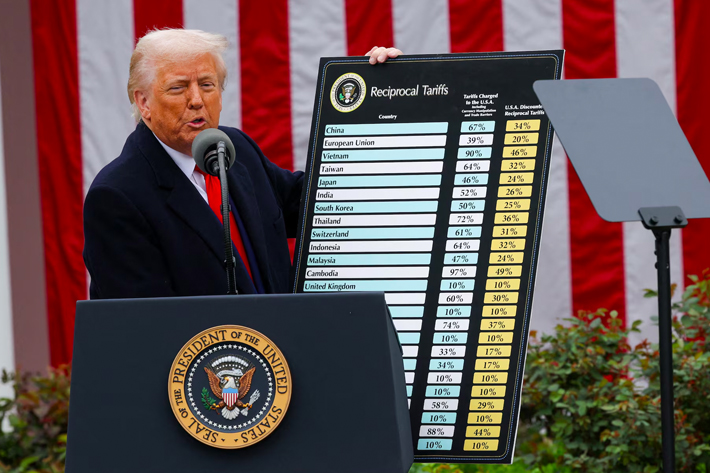
A recent significant legal decision by a U.S. trade court to block a substantial portion of President Donald Trump’s trade tariffs, issued on Wednesday, may offer only a fleeting reprieve. This is the prevailing sentiment among analysts at Golden Sachs, who suggest that the administration’s trade objectives could still be pursued through alternative levies and policy mechanisms.
A three-judge panel from the Court of International Trade delivered a decisive ruling, asserting that the President exceeded his constitutional authority by imposing broad duties on imports from various trading partners. The court underscored that the U.S. Constitution unequivocally vests Congress with the exclusive power to regulate international commerce, a prerogative that cannot be overridden by presidential emergency powers, even those invoked to safeguard the domestic economy.
The judicial panel clarified its stance in the decision to issue a permanent injunction against the blanket tariff orders initiated by Trump since January. “The court does not pass upon the wisdom or likely effectiveness of the President’s use of tariffs as leverage,” the judges stated. “That use is impermissible not because it is unwise or ineffective, but because [federal law] does not allow it.” This distinction is critical for investors understanding the legal, rather than economic, basis of the ruling.
Market Reaction: USD Rallies, Asian Equities Jump
Financial markets responded with immediate enthusiasm to the court’s verdict. The U.S. dollar experienced a robust rally, appreciating by 0.63% within 24 hours of the order. This surge was particularly pronounced against major global currencies such as the euro, yen, and Swiss franc, reflecting increased confidence in a more stable trade environment, at least temporarily. Wall Street futures also edged higher, signaling positive sentiment ahead of trading, while equities across Asia registered significant gains.
Investors in Asian markets saw a notable uplift. The Nikkei in Tokyo climbed by 1.9% on Thursday, indicating renewed optimism among Japanese businesses and investors. Hong Kong’s Hang Seng Index rose by 1.35%, while India’s BSE Sensex advanced by nearly 0.4%. These movements highlight the global interconnectedness of trade policy and its immediate impact on capital markets, influencing investment decisions across various sectors, including energy.
The court’s order mandated the Trump administration to issue new directives reflecting the permanent injunction within a tight 10-day timeframe. However, the White House wasted no time, filing a notice of appeal within minutes of the ruling and openly questioning the court’s jurisdiction and authority on such matters. This swift response immediately tempered the market’s initial jubilation, reminding investors of the ongoing legal and political battle.
Legal Battle and Implications for Trade Policy
With immediate effect, the court’s decision invalidated all tariff orders implemented by Trump since January, specifically those rooted in the International Emergency Economic Powers Act (IEEPA). This statute is designed to address “unusual and extraordinary” threats during a national emergency. The court’s interpretation suggests that the administration’s application of IEEPA for these broad tariff measures stretched the law beyond its intended scope.
It is crucial for investors to note that the court was not asked to address, and thus did not rule upon, certain industry-specific tariffs previously imposed by Trump on goods like automobiles, steel, and aluminum. These tariffs were enacted under different statutory authorities, meaning they remain in effect and continue to influence specific sectors of the economy. This distinction is vital for companies operating within or supplying these particular industries.
The legal process is far from over. Decisions from the Manhattan-based Court of International Trade, which specializes in disputes involving international trade and customs laws, can be appealed to the U.S. Court of Appeals for the Federal Circuit in Washington, D.C. Ultimately, these cases can reach the U.S. Supreme Court, ensuring a protracted legal battle that will likely maintain a cloud of uncertainty over future trade policy.
Blow to Trump’s Trade Strategy Creates Investor Uncertainty
The imposition of tariffs on goods from foreign countries has been a cornerstone of the Trump administration’s trade war strategy, a policy that has profoundly disrupted global trade flows and created significant volatility in financial markets. For the oil and gas sector, this disruption translates into tangible risks and opportunities. Global trade friction typically slows economic growth, which directly impacts energy demand forecasts and commodity prices.
Companies of all sizes, from multinational energy giants to smaller service providers, have been forced to navigate the unpredictable landscape created by the swift imposition and sudden reversals of tariffs. This unpredictability has complicated strategic planning, forcing firms to re-evaluate supply chains, adjust production schedules, manage staffing levels, and recalibrate pricing strategies. For energy investors, this environment demands heightened vigilance and agile portfolio management.
A White House spokesperson, commenting on Wednesday, reiterated the administration’s focus on addressing U.S. trade deficits with other countries. This indicates that despite legal setbacks, the underlying policy objective of rebalancing trade remains a priority. Investors should therefore anticipate continued efforts by the administration to use trade policy as leverage, potentially through means that circumvent judicial challenges.
The ongoing legal and political wrangling over tariffs introduces significant geopolitical risk. For the oil and gas industry, this uncertainty affects long-term investment decisions in exploration, production, and infrastructure projects. Trade tensions can exacerbate supply chain vulnerabilities for crucial equipment and services, potentially increasing operational costs and delaying project timelines. Furthermore, a slowdown in global manufacturing, often a consequence of trade disputes, directly reduces industrial energy consumption.
As the legal appeals process unfolds, investors in the oil and gas sector must closely monitor developments. The potential for renewed or reconfigured tariffs, even if not directly targeting energy commodities, can still impact global economic health, currency valuations, and overall market sentiment, all of which are critical drivers for energy demand and commodity prices. The relief from Wednesday’s ruling, while welcome, appears to be merely an intermission in a much longer, unpredictable trade saga.