High-Stakes Friday: Trump’s Sanctions Threat on Russia’s Shadow Fleet Poised to Roil Oil Markets
Investors are bracing for potential seismic shifts across global energy markets as reports indicate the Trump administration is poised to escalate its economic offensive against Russia. A new wave of sanctions, specifically targeting Moscow’s clandestine “shadow fleet” of oil tankers, is reportedly under consideration if President Vladimir Putin fails to agree to a ceasefire in Ukraine by Friday. This aggressive move, first reported by the Financial Times on Tuesday, aims to directly choke off a critical revenue stream funding the Kremlin’s military operations, a development that could send significant ripples through crude oil prices and the international shipping sector.
The looming Friday deadline establishes a high-stakes countdown, injecting fresh geopolitical volatility into an already complex landscape. This ultimatum aligns with former President Trump’s repeated pledges to swiftly conclude the conflict in Ukraine if reelected, now manifesting as tangible public pressure on Moscow to negotiate a resolution. Energy traders, analysts, and oil & gas investors are keenly monitoring developments, recognizing the profound implications such a policy shift could have on global oil supply and demand dynamics. Any imposition of these sanctions would represent a significant escalation in the U.S. strategy to curtail Russian oil exports, moving beyond existing financial restrictions to directly impede the physical flow of crude.
Unmasking the Shadow Fleet: Russia’s Lifeline for Oil Exports
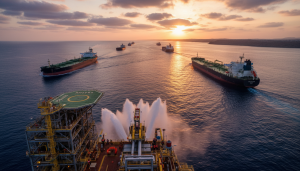
At the heart of this potential disruption lies Russia’s so-called “shadow fleet” – an informal, sprawling network of vessels that has become Moscow’s indispensable lifeline for maintaining oil export revenues. Comprised largely of aging tankers, many operating under flags of convenience and sidestepping standard international insurance protocols, these ships facilitate the discreet movement of Russian crude to buyers eager to acquire oil outside the purview of Western price caps and sanctions. Nations like India, China, and Turkey have emerged as significant recipients, absorbing vast quantities of Russian crude that would otherwise struggle to find a market.
This shadow armada has effectively circumvented prior Western efforts to control Russian oil flows, enabling Moscow to continue generating substantial revenue despite a tangled web of restrictions. The fleet’s operational opacity, coupled with its willingness to operate without the customary Western financial and insurance backing, has allowed it to transport millions of barrels of crude, frustrating U.S. and European policymakers. Targeting this fleet directly would be a tactical shift, moving beyond financial penalties on specific entities to impact the very infrastructure of Russian oil transportation, potentially forcing Moscow to scramble for costly and less efficient shipping alternatives.
Direct Impact on Global Oil Flows and Prices
Existing measures against Russian oil have focused on price caps, restrictions on Western insurance and financing services, and sanctions on specific shipping entities. However, directly sanctioning the shadow fleet would strike much closer to the physical movement of crude, threatening to disrupt a significant portion of Russia’s export capacity. Such a broad prohibition could severely constrain Russia’s ability to export its oil, potentially stranding significant volumes of crude and creating an immediate supply shock.
For global energy markets, this translates into a tangible risk of tighter supply. A reduction in available Russian crude, even if temporary, combined with a tightening in overall global tanker availability as these vessels are sidelined or rerouted, naturally exerts upward pressure on benchmark oil prices. Furthermore, the disruption to established trade routes and the need for alternative logistical solutions could create bottlenecks, increase shipping costs, and add premiums to delivered crude prices worldwide. The ripple effect could extend to refinery operations that have become reliant on Russian feedstocks, compelling them to seek alternative, potentially more expensive, supplies.
Political Imperatives and Market Sentiment
The political timing of this potential action is no coincidence. Former President Trump has consistently articulated a vision of rapidly concluding the conflict in Ukraine, often promising to achieve this “on day one” if reelected. The reported Friday deadline introduces a concrete, high-stakes moment for this political objective, leveraging Russia’s critical oil export revenues as a direct point of pressure. Intriguingly, former President Trump had earlier suggested that a further downward trend in energy prices might compel President Putin to seek a resolution to the conflict. This latest strategic maneuver, however, signals a more direct, coercive approach, using the oil market as a tool of diplomatic leverage.
This interplay between high-level geopolitics and energy policy is a crucial factor for oil & gas investors. The public pressure on Moscow, coupled with the explicit threat of sanctions, could lead to unpredictable market reactions. As of Tuesday afternoon, the Trump administration had not publicly confirmed the report, adding another layer of uncertainty. Investors must recognize how deeply political rhetoric and proposed actions can influence market psychology and real-world supply dynamics, demanding vigilance and adaptability in their strategies.
Navigating the Investment Landscape
The potential imposition of sanctions on Russia’s shadow fleet represents a significant new layer of geopolitical risk for oil and gas investors. Portfolio managers and commodity traders should closely monitor the outcome of the Friday deadline and any subsequent official confirmations from the U.S. administration regarding these proposed measures. The immediate impact on crude oil prices could be substantial, particularly if Russian export capacity is genuinely curtailed or if the global tanker fleet experiences significant dislocation.
Beyond immediate price movements, the long-term implications for the tanker industry, insurance markets, and the evolving landscape of global crude trade warrant careful consideration. Companies involved in shipping, refining, and exploration and production activities could all face indirect consequences, ranging from increased operational costs to shifts in regional supply-demand balances. In an environment already characterized by supply uncertainties, demand fluctuations, and persistent geopolitical tensions, this developing situation underscores the inherent and persistent volatility in international energy markets. Investors are advised to stay informed and assess how these potential sanctions could reshape the global energy chessboard.