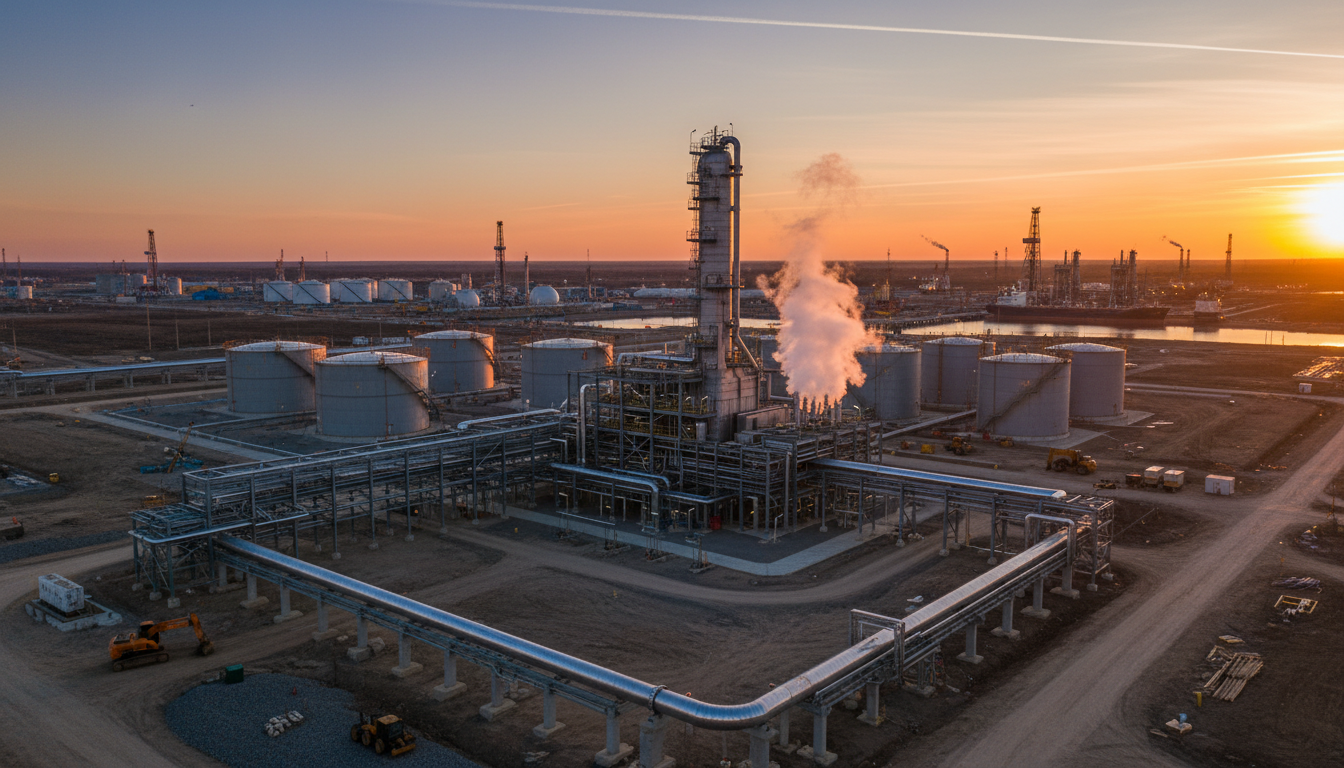
President Donald Trump’s invocation of the Defense Production Act (DPA) on April 20 marks a pivotal moment for the U.S. energy sector, signaling an unprecedented federal commitment to supercharge domestic oil and gas development. This decisive action, articulated through two presidential determinations, prioritizes the expansion of upstream production, refining capabilities, and critical energy infrastructure. For investors, this move is not merely a political statement but a strategic directive aimed at bolstering national energy security and de-risking substantial capital investment across the entire energy value chain, from exploration and production (E&P) to vital pipelines, storage facilities, and crucial export infrastructure. This analysis delves into the immediate and long-term implications, leveraging proprietary market data and forward-looking event calendars to uncover the actionable insights for those navigating the evolving energy landscape.
DPA as a Catalyst for Strategic Energy Investment
The administration’s explicit recognition that expanded U.S. energy capacity is an indispensable pillar of national defense underpins the DPA’s application to the sector. This framework empowers the federal government with robust tools designed to stimulate development, particularly in an environment characterized by mounting supply vulnerabilities and persistent infrastructure constraints. Investors should closely track the mechanisms now available: direct financial support, guaranteed purchase commitments, and other targeted incentives. These are specifically tailored to accelerate large-scale energy projects that have historically faced significant headwinds, including prolonged permitting delays, complex financing risks, and persistent supply chain bottlenecks. By mitigating these long-standing challenges, the DPA aims to fundamentally alter the risk-reward profile of these ventures, making them considerably more attractive to capital markets. This federal intervention builds upon a previously declared national energy emergency, reflecting escalating concerns over global supply chain stability and geopolitical flashpoints like the Middle East conflict and the critical Strait of Hormuz, which alone manages approximately one-fifth of the world’s total oil flows. The DPA aims to insulate domestic operations from such external shocks, fostering a more resilient and independent energy future for the United States.
Current Market Snapshot and Investor Sentiment Amidst DPA Activation
As of today, Brent Crude trades at $99.13, down 0.22% within a day range of $97.55-$101.32, while WTI Crude stands at $94.4, experiencing a more significant drop of 1.51% within a range of $92.68-$97.85. Gasoline prices are also slightly down at $3.33. This recent market behavior reflects a complex interplay of factors, where geopolitical tensions continue to provide underlying support, yet broader economic concerns or supply reassessments temper enthusiasm. Over the past 14 days, Brent has seen a notable decline, retreating from $109.27 on April 7 to $99.78 yesterday, marking an 8.7% decrease. This downward trend, despite the DPA’s activation and ongoing global instability, highlights the market’s sensitivity to both demand signals and perceived supply adjustments.
Many investors are actively pondering what factors could push Brent below $80 or above $120. The DPA’s strategic intent to boost domestic production and refining capacity could serve as a significant mitigating factor against extreme upward price spikes. By fostering a more robust and responsive U.S. supply chain, the DPA has the potential to add a “ceiling” to price volatility, making the domestic market less susceptible to external shocks. Conversely, while the DPA aims to increase supply, a global economic slowdown or a significant breakthrough in Middle East peace negotiations would be the primary drivers to push prices substantially lower. The DPA, therefore, positions the U.S. as a more stable and influential player, offering a degree of insulation from the wild swings driven by international events, thereby moderating the risk profile for domestic energy investments.
Forward-Looking Analysis: DPA’s Impact on Upcoming Data and Events
The DPA’s directive will not immediately translate into barrels flowing, but its influence will begin to manifest in key industry metrics over the coming weeks and months. Investors should pay close attention to the upcoming energy calendar. The API Weekly Crude Inventory report on April 28 and May 5, followed by the EIA Weekly Petroleum Status Report on April 29 and May 6, will provide crucial insights into immediate supply-demand dynamics. While these reports reflect current operational realities, any DPA-driven acceleration in project development, particularly in upstream E&P, could begin to influence future inventory trends, potentially leading to more robust stock builds as domestic production gains momentum.
Furthermore, the Baker Hughes Rig Count, scheduled for May 1 and May 8, will be a bellwether for increased drilling activity. DPA incentives, by de-risking projects and providing financial backing, are expected to encourage operators to deploy more rigs, particularly in proven basins. An uptick in active rigs would be an early indicator of the DPA’s direct impact on production capacity expansion. Finally, the EIA Short-Term Energy Outlook on May 2 will offer a comprehensive forecast, and any explicit mention or implicit adjustment in U.S. production projections due to the DPA would be a significant signal for the market. These calendar events, watched closely by the investment community, will serve as initial checkpoints to gauge the tangible progress and effectiveness of the DPA’s strategic imperative, allowing investors to track the federal government’s commitment translating into physical energy assets.
Investment Implications: De-Risking and Domestic Strength
The DPA’s application to the energy sector fundamentally alters the investment landscape by providing a powerful federal mandate and practical tools to overcome historical impediments. For investors, this translates into a significant reduction in project-specific risks, particularly for large-scale infrastructure and production ventures that typically entail substantial capital outlays and lengthy development timelines. The provision of direct financial support and guaranteed purchase commitments directly addresses the financing challenges that often plague such projects, making them more appealing to a broader range of institutional and private capital.
This federal backing also offers a crucial degree of insulation from the geopolitical volatility that frequently whipsaws international oil markets. By explicitly acknowledging that, without federal intervention, the industry might struggle to expand capacity in a timely manner, the administration highlights a strategic imperative to fortify domestic petroleum production and logistics. Companies involved in exploration and production (E&P), midstream infrastructure (pipelines, storage), and refining stand to benefit directly from this accelerated development. The DPA’s focus on critical export infrastructure also positions the U.S. as a more reliable and powerful force in global energy markets, indirectly buffering domestic producers from the full impact of global supply chain disruptions. Ultimately, the DPA creates a more stable, predictable, and federally supported environment for U.S. oil and gas investment, presenting a compelling thesis for long-term growth and enhanced national energy security.


