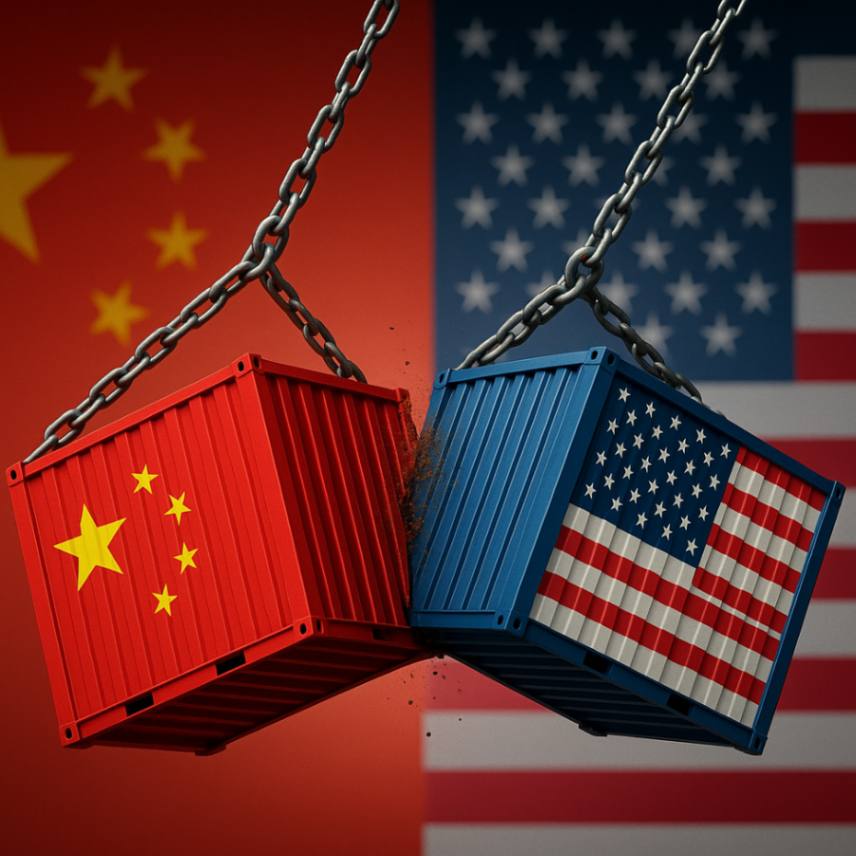
The global energy landscape finds itself once again under the long shadow of escalating trade tensions between the United States and China. For astute oil and gas investors, understanding the implications of renewed hostilities is not merely academic; it is critical for portfolio resilience. A prominent US leader famously asserted in 2018 that “Trade wars are good, and easy to win” when a nation faces significant trade imbalances. This aggressive stance has resurfaced, evidenced by the recent imposition of tariffs exceeding 145% on various Chinese imports by the current administration.
The strategic justification for this tariff surge was clearly articulated by the US Secretary of the Treasury. He dismissed Beijing’s potential retaliatory actions as a tactical miscalculation, contending that China’s economic position is inherently weaker. His memorable analogy, “they’re playing with a pair of twos,” underscored a belief in the US’s dominant hand. The rationale hinges on the stark disparity in bilateral trade: “What do we lose by the Chinese raising tariffs on us? We export one-fifth to them of what they export to us, so that is a losing hand for them.” This perspective is rooted in a theory of “escalation dominance,” where one party aims to control the narrative and intensity of conflict to their advantage. For energy market participants, comprehending this underlying geopolitical strategy is paramount, as it directly influences global economic stability, and by extension, the fundamental demand drivers for energy commodities.
The Flawed Premise of Zero-Sum Trade Conflicts
However, the foundational assumption that the United States can dictate terms through escalation dominance in trade may be fundamentally misguided. The administration’s framing of trade disputes as a poker game, where one player’s gain necessitates another’s loss, overlooks the inherently positive-sum nature of international commerce. Unlike a zero-sum contest, global trade typically generates mutual benefits. When nations exchange goods and services, both participants generally achieve a return on investment, gaining access to desired products, specialized resources, and competitive pricing. A trade war, therefore, functions as a destructive force, eroding these reciprocal benefits and inflicting damage on all sides, akin to a conventional conflict’s widespread collateral.
Energy investors must recognize that such trade confrontations inevitably lead to a deceleration in global economic activity. This slowdown directly translates into a diminished appetite for crude oil, natural gas, and refined petroleum products. Furthermore, tariffs imposed on vital industrial components can significantly elevate costs for upstream exploration and production projects, as well as midstream infrastructure development. This cost inflation directly compresses profit margins and can cause delays in crucial energy infrastructure expansion, impacting future supply and cash flows.
Unpacking Real Costs and Supply Chain Vulnerabilities for Energy Firms
The assertion that the United States holds an unassailable advantage in this trade showdown often overlooks critical economic realities embedded within global supply chains. China provides a vast array of essential goods to the US economy, many of which are not easily substituted by domestic production in the short to medium term, or only at prohibitively higher costs. While strategic objectives may include reducing reliance on certain foreign supply chains over the long term, a rapid and aggressive decoupling through tariffs carries immediate and tangible financial consequences.
For the oil and gas sector, this translates into increased operational expenditures. Manufacturers of drilling equipment, specialized components for refineries, and steel for pipelines often source materials or complete sub-assemblies from China. Tariffs on these inputs inflate the cost of doing business for energy companies across the value chain. Upstream operators face higher costs for everything from drill bits and casing to wellhead equipment. Midstream companies see increased expenditures for pipeline materials, compressor stations, and storage tanks. Downstream refiners and petrochemical producers encounter elevated costs for catalysts, machinery parts, and specialized chemicals. These rising input costs directly squeeze profit margins, forcing companies to absorb the difference, pass costs onto consumers (potentially dampening demand further), or delay capital-intensive projects.
Moreover, the disruption caused by trade disputes extends beyond direct tariffs. Uncertainty discourages foreign direct investment, potentially slowing the development of new energy projects. It can also lead to supply chain reconfigurations that are costly and time-consuming, forcing companies to seek alternative suppliers who may offer less competitive pricing or longer lead times. This inherent volatility and added complexity directly impact the predictability of cash flows and the overall financial health of energy companies, making investment decisions more challenging.
Savvy oil and gas investors must therefore scrutinize the financial health and supply chain resilience of their portfolio companies. Those with diversified sourcing strategies, strong balance sheets, and less direct exposure to the most heavily tariffed goods may prove more resilient. The ongoing trade war is not a simple game of poker; it’s a complex economic challenge that threatens to erode the profitability of even the most robust energy enterprises, demanding vigilant analysis and strategic adaptation from the investment community.