The global energy landscape is once again bracing for heightened volatility as bilateral tensions between China and the United States escalate. Washington’s recent move to launch wide-ranging unfair trade practice probes, targeting not only Beijing but dozens of other nations, signals a potential return to aggressive trade policies that could ripple through commodity markets, most notably crude oil. For oil and gas investors, understanding the nuanced implications of these renewed frictions is paramount, as they introduce significant uncertainty into global demand forecasts and supply chain stability. This analysis will delve into the latest developments, assess the immediate market reactions, and outline crucial future events that could shape energy investment strategies in the coming weeks and months.
Resurfacing Trade Frictions: A Broad Challenge to Global Trade
This week saw the US Trade Representative’s Office initiate Section 301 unfair trade practice investigations against 60 countries over alleged “failures to take action on forced labor,” alongside probes into 16 trading partners accused of “excess industrial overcapacity.” While China is a prominent target, the broad scope of these investigations, which include key allies such as Australia, Canada, the EU, Britain, India, Israel, Qatar, and Saudi Arabia, alongside Russia, highlights a comprehensive shift in US trade posture. Beijing has vehemently opposed these moves, with its commerce ministry claiming the US lacks the unilateral authority to determine industrial overcapacity and impose restrictive measures. China’s Foreign Ministry on Friday dismissed forced labor allegations as “a lie concocted by the US,” vowing to defend its interests with all necessary measures. These disputes are not entirely new; the US has previously cracked down on solar panels and other goods from China’s Xinjiang region under the Uyghur Forced Labour Prevention Act, and concerns over China’s industrial overcapacity have been echoed by the Biden Administration, the European Union, and even the IMF. The current escalation, however, suggests a more aggressive stance, potentially rebuilding tariff pressures following a US Supreme Court ruling last month that struck down a prior administration’s emergency law for global tariffs.
Immediate Market Reaction and Underlying Volatility
The specter of renewed trade wars injects a substantial dose of uncertainty into the global economic outlook, directly impacting energy demand projections. As of today, April 22nd, Brent crude trades at $92.99 per barrel, reflecting a slight dip of 0.27% within a day range of $92.57 to $94.21. Similarly, WTI crude is priced at $89.44, down 0.26%, fluctuating between $88.76 and $90.71. Gasoline prices also experienced a modest decline, settling at $3.11, down 0.64%. This current market stability, however, masks an underlying sensitivity to broader economic shifts. Our proprietary data indicates that Brent crude has experienced a notable decline over the past two weeks, falling from $101.16 on April 1st to $94.09 by April 21st, representing a significant $7.07 or 7% drop. This trend underscores how quickly market sentiment can shift in response to macroeconomic headwinds, such as the potential for trade-induced economic slowdowns. While geopolitical supply risks often drive prices up, the threat of diminished global demand due to tariff barriers can exert powerful downward pressure, creating a complex and volatile trading environment for crude oil and refined products.
Critical Junctures Ahead: Trade Talks and Energy Data
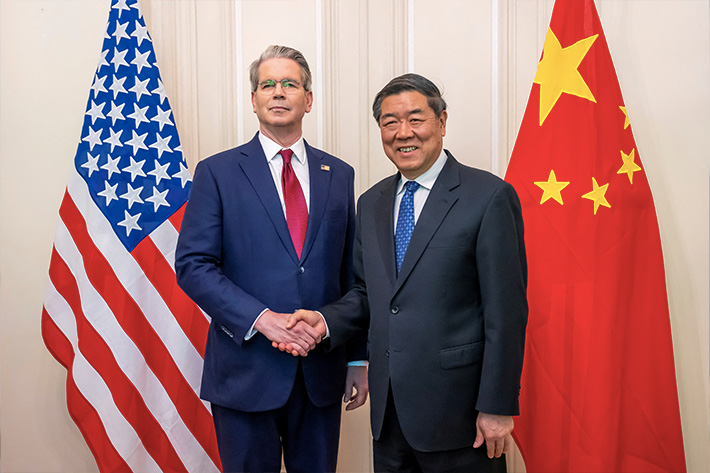
Investors must closely monitor several upcoming events that could either mitigate or exacerbate the current trade tensions, directly influencing energy markets. This weekend, trade representatives from the US and China are scheduled to meet in France for another round of talks, a crucial precursor to US President Donald Trump’s planned visit to Beijing at the end of this month. Treasury Secretary Scott Bessent and Trade Representative Jamieson Greer will engage with China’s Vice Premier He Lifeng, seeking to navigate these complex issues. These meetings are the sixth round of discussions since the US first announced tariffs last April, which were met with retaliatory measures from Beijing, including restrictions on critical mineral exports, before a truce was negotiated in late October. The outcomes of these discussions will be pivotal, determining whether the current trade probes lead to further escalation or a path towards de-escalation. Concurrently, the regular drumbeat of energy market data will provide essential insights into supply-demand dynamics. Investors should keep a close eye on the EIA Weekly Petroleum Status Reports on April 22nd and April 29th, the Baker Hughes Rig Counts on April 24th and May 1st, and especially the EIA Short-Term Energy Outlook on May 2nd. These reports, while providing fundamental market information, will be interpreted through the lens of potential trade disruption, making their demand forecasts particularly critical.
Investor Sentiment: Navigating Demand Uncertainty and Price Outlook
Our proprietary reader intent data reveals a strong preoccupation among investors with the directional movement of crude oil prices. A significant portion of inquiries this week centers on whether WTI will trend upwards or downwards, alongside broader questions about the predicted price of oil per barrel by the end of 2026. This focus on price trajectory underscores the anxiety generated by macroeconomic uncertainties like the brewing trade war. A prolonged trade dispute, characterized by tariffs and retaliatory measures, inevitably impacts global industrial activity and consumer spending, leading to reduced energy demand. This direct link between trade friction and demand outlook means that the trajectory of Brent and WTI will be heavily influenced by diplomatic progress or deterioration in US-China relations. Furthermore, while specific company inquiries, such as those concerning integrated energy majors, highlight investor interest in corporate resilience, the overarching sentiment is one of caution regarding systemic market risks. The market is effectively asking: “How much demand destruction can the global economy absorb before crude prices see a more significant downturn?” The answer hinges critically on the resolution, or lack thereof, of these trade disputes.
Strategic Portfolio Adjustments for a Turbulent Environment
Given the renewed trade tensions and the potential for a global economic slowdown, energy investors should consider strategic adjustments to their portfolios. The widespread nature of the US trade probes, extending beyond China to include many key trading partners and energy producers, introduces a multifaceted layer of risk. Tariffs on goods, especially those involving critical minerals or manufacturing components, can disrupt supply chains across various sectors, indirectly affecting energy consumption. For example, any impact on the manufacturing sector due to overcapacity concerns could translate into lower demand for industrial fuels. Investors should evaluate the exposure of their energy holdings to countries directly implicated in these probes, particularly those with significant trade ties to the US and China. Diversification across different energy sub-sectors, from upstream exploration and production to midstream infrastructure and downstream refining, could offer some insulation. Furthermore, monitoring the geopolitical implications of Russia, another nation on the US probe list, within the broader energy supply narrative will be crucial. In an environment where global demand forecasts are increasingly contingent on political negotiations, a defensive posture with an emphasis on companies with robust balance sheets and diversified geographic operations may be prudent for navigating the trade-induced turbulence ahead.