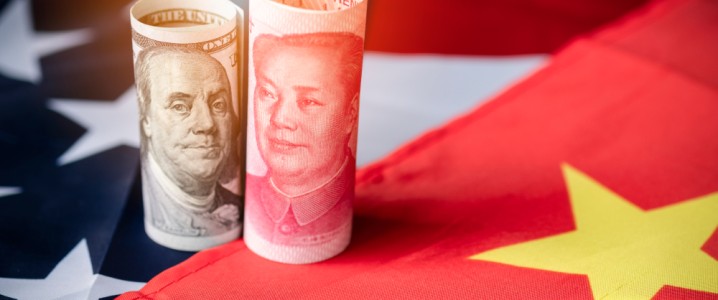
Global crude oil markets commenced the trading week with a significant upward momentum, as benchmark prices surged by approximately 3% on Monday morning. This robust rally was directly propelled by a pivotal development in international trade relations: an agreement between the United States and China to initiate a reduction in reciprocal tariffs. The breakthrough signaled a de-escalation of trade tensions, alleviating widespread concerns about a potential global economic slowdown and its subsequent dampening effect on energy demand.
Investors reacted swiftly and positively to the news. As of 6:52 a.m. on Monday, the West Texas Intermediate (WTI) crude futures contract, the primary U.S. benchmark, had climbed an impressive 3.13%, settling at $62.93 per barrel. Concurrently, the international benchmark, Brent Crude, also experienced a substantial gain, rising 2.93% to trade at $65.79 per barrel, comfortably moving back above the $65 threshold. This synchronized upward movement underscored the market’s immediate relief and renewed optimism regarding the health of the global economy and, by extension, future oil consumption.
Trade Breakthrough Ignites Market Optimism
The catalyst for Monday’s market exuberance stemmed from the outcome of initial U.S.-China trade discussions held in Geneva over the weekend. Early on Monday, the White House officially confirmed the agreement, outlining key concessions from both economic powerhouses. Under the terms of the accord, the United States and China committed to lowering a portion of their existing tariffs by 115%. Importantly, a baseline 10% tariff rate will remain in effect, and other pre-existing U.S. trade measures are set to continue without modification.
Furthermore, the agreement stipulated a temporary suspension of tariffs for a period of 90 days, with the notable exception of the aforementioned 10% baseline rate. This crucial step provides a much-needed reprieve for businesses and supply chains that have been grappling with the economic uncertainties posed by the prolonged trade dispute. In a joint statement released following the Geneva talks, both nations affirmed their intention to establish a dedicated mechanism for ongoing dialogue concerning economic and trade relations, signaling a commitment to sustained engagement rather than a one-off resolution.
Looking ahead, high-level officials are slated to continue these critical discussions. Vice Premier of the State Council of China, He Lifeng, along with U.S. Secretary of the Treasury, Scott Bessent, and United States Trade Representative, Jamieson Greer, have been designated to spearhead future negotiations. Their continued engagement will be closely watched by energy market participants, as the trajectory of global trade policy remains a significant determinant of demand forecasts for crude oil.
Benchmark Performance and Resistance Levels
The immediate impact on crude benchmarks was pronounced. WTI’s ascent past the $62 mark and Brent’s breach of $65 per barrel highlight a notable shift in market sentiment. The agreement has injected a fresh wave of confidence into the energy sector, as investors price in a potentially stronger global economic outlook. Reduced trade friction typically translates to increased industrial activity, higher transportation demand, and ultimately, greater consumption of refined petroleum products.
Ole Hansen, head of commodity strategy at Saxo Bank, offered insightful commentary on Monday’s developments. He observed that “crude oil jumps together with other pro-cyclical commodities on news the U.S. and China will temporarily lower tariffs on each other’s products, thereby reducing fears of a prolonged economic fallout hurting demand.” This perspective underscores the broader market reaction, where commodities sensitive to economic growth tend to perform well during periods of optimism. The easing of trade tensions directly mitigates the risk of demand destruction, a major concern that had suppressed oil prices for months.
However, Hansen also introduced a note of caution for investors. He suggested that “WTI and Brent may take a closer look at key resistance near $65 and $69, respectively.” This indicates that while the immediate rally is strong, these price points could present significant hurdles for further upward movement. For WTI, breaking decisively above $65 would signal continued bullish momentum, while Brent’s ability to surpass $69 would be an important technical indicator. The strategist also posed a critical question: “the key question is whether today’s news marks peak optimism, given the low likelihood of a full U.S. retreat from its stance on China.” This highlights the inherent fragility of the current optimism, reminding investors that underlying geopolitical and economic tensions may persist, potentially limiting the long-term upside unless more comprehensive resolutions are achieved.
Broader Market Implications and Investor Outlook
The positive sentiment emanating from the trade agreement was not confined to the oil markets alone. Equity markets mirrored the crude oil rally, with Dow futures soaring in the wake of the news. This broad-based market response underscores the interconnectedness of global financial markets and how significant geopolitical developments can ripple across asset classes. For oil and gas investors, this signifies a period where macro-economic factors, particularly international trade policy, will continue to exert a powerful influence on commodity prices.
While the initial tariff reduction represents a significant step forward, investors should remain vigilant. The 90-day suspension period offers a window for further negotiations, but the retention of a 10% baseline tariff and the continuation of other U.S. measures suggest that a complete resolution is still distant. The “peak optimism” concern raised by Saxo Bank’s strategist is a crucial consideration, implying that future price movements may be contingent on tangible progress beyond this initial agreement.
For those tracking energy investments, monitoring the ongoing discussions between He Lifeng, Scott Bessent, and Jamieson Greer will be paramount. Any further de-escalation or, conversely, any renewed hardening of stances could send fresh signals through the oil markets. The current environment presents both opportunities and risks, with the immediate surge reflecting relief, but the longer-term trajectory dependent on the sustained commitment of both nations to foster a more stable global trade environment. Prudent investors will balance the current positive momentum with a cautious eye on the complexities that still lie ahead in the U.S.-China trade relationship.