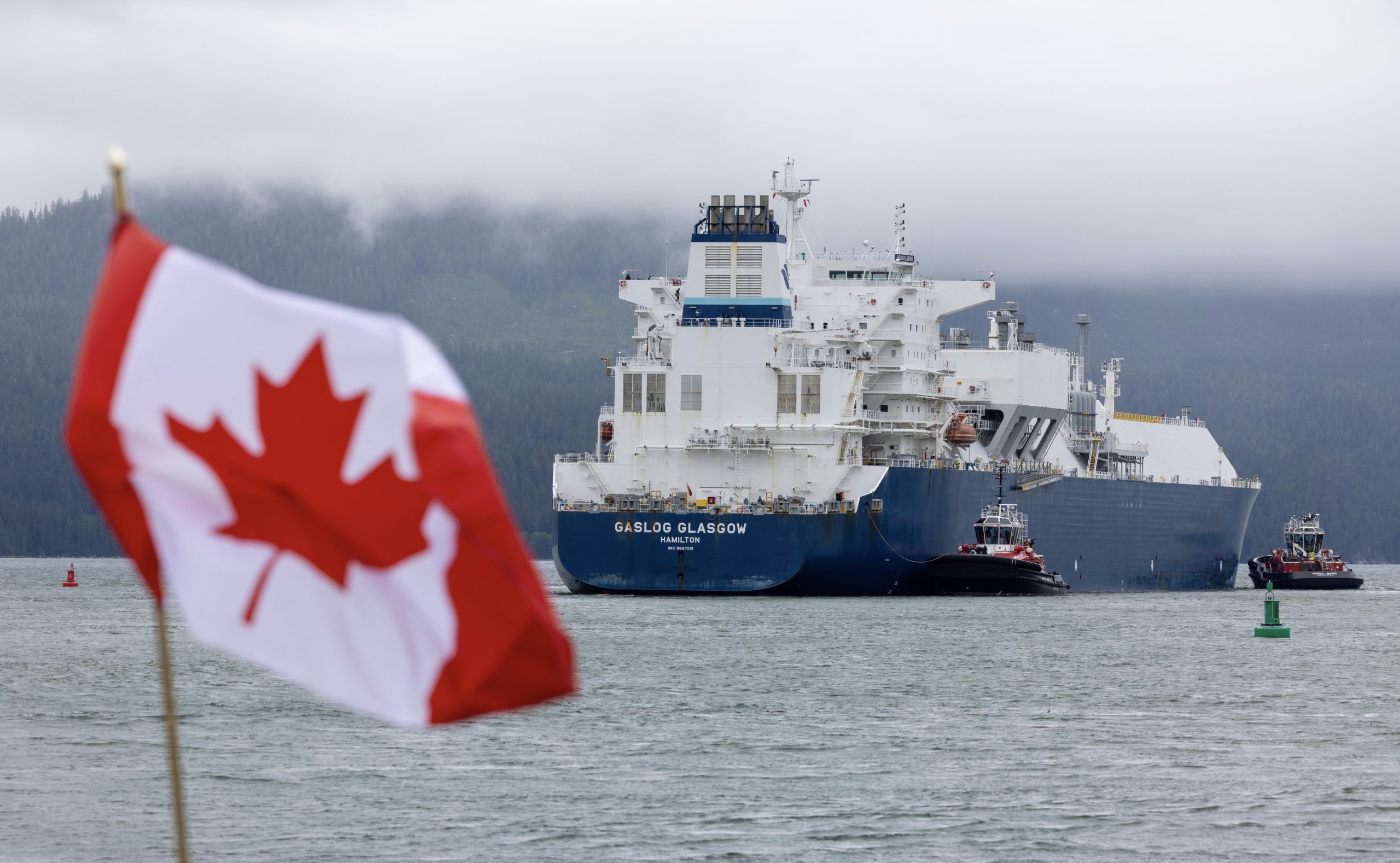
LNG Canada Train 2: A New Era for North American Gas Exports
The global liquefied natural gas (LNG) market is poised for a significant supply injection as Shell’s LNG Canada project prepares to load its first cargo from Train 2 as early as this week. This pivotal development marks a crucial step in Canada’s emergence as a major player in the international LNG arena, solidifying its position to serve burgeoning demand, particularly across Asia. With Train 1 already contributing to global supply—evidenced by the facility’s 15th cargo departing just this past Sunday—the imminent activation of Train 2 signals an accelerating ramp-up for this multi-billion dollar joint venture. For investors tracking energy markets, this event is more than just a project milestone; it represents a tangible addition to global energy security and a strategic long-term play in the evolving natural gas landscape.
Strategic Significance in a Dynamic Energy Market
LNG Canada, as the nation’s inaugural large-scale LNG export facility, holds immense strategic importance. Located on British Columbia’s west coast, its geographical advantage provides a direct conduit to high-growth Asian markets, which are increasingly seeking reliable and diverse energy sources to fuel economic expansion and support energy transition efforts. The project, led by Shell as the majority stakeholder, alongside partners Petroliam Nasional Bhd., PetroChina Co., Mitsubishi Corp., and Korea Gas Corp., represents a concerted international effort to capitalize on the robust global demand for natural gas. The ramp-up of Train 2, expected to bring the facility closer to its full two-train capacity by 2026, positions these stakeholders to capture significant value from long-term supply contracts and spot market opportunities. This added supply comes at a time when global energy markets are keenly focused on diversification and stability, making new, reliable sources like LNG Canada particularly attractive.
Navigating Current Market Volatility and Future Demand
The commissioning of LNG Canada’s Train 2 arrives amidst a period of notable volatility in the broader energy complex. As of today, Brent crude trades at $90.38 per barrel, experiencing a sharp daily decline of 9.07% within a range of $86.08 to $98.97. Similarly, WTI crude is priced at $82.59, down 9.41%, trading between $78.97 and $90.34. This significant downward pressure on crude prices—a continuation of a trend that saw Brent fall nearly 20% from $112.78 just weeks ago on March 30th—highlights the dynamic nature of global energy markets. While crude oil faces its own set of demand and supply challenges, the outlook for natural gas and LNG remains robust, driven by its role in power generation, industrial processes, and as a transitional fuel. The new supply from LNG Canada will help meet this persistent demand, particularly as geopolitical factors continue to reshape global energy trade flows. Investors are closely watching how new supply projects will balance against global economic growth projections and the pace of energy transition initiatives.
Upcoming Catalysts and Investor Outlook
Looking ahead, the energy market calendar is packed with events that will undoubtedly shape the near-term investment landscape, even as LNG Canada’s Train 2 begins its journey. Just this Sunday, April 19th, the OPEC+ Full Ministerial Meeting is scheduled, an event that will be scrutinized for any shifts in production policy following the recent crude price declines. Investors will be keenly interested in whether the alliance opts for further cuts or maintains current quotas, impacting global supply. Further out, the weekly API and EIA crude inventory reports on April 21st, 22nd, 28th, and 29th, respectively, along with the Baker Hughes Rig Count on April 24th and May 1st, will provide critical insights into North American supply-demand dynamics and drilling activity. While these events primarily focus on crude, their outcomes often ripple across the entire energy complex, influencing sentiment for natural gas and LNG investments. The addition of significant LNG capacity from projects like Shell’s LNG Canada offers a long-term diversification strategy for portfolios heavily weighted towards crude, providing exposure to a commodity with a distinct demand profile and growth trajectory.
Addressing Investor Questions on Long-Term Energy Plays
A recurring theme in investor inquiries this week centers on the future trajectory of oil prices and the influence of major producers. Many are asking for predictions on the price of oil per barrel by the end of 2026, and seeking clarity on OPEC+ current production quotas. While LNG Canada primarily addresses natural gas supply, these questions underscore a broader market concern about energy stability and pricing. The ramp-up of projects like LNG Canada provides an important counter-narrative, illustrating significant capital deployment towards diversifying energy supply chains. For investors, integrating natural gas exposure through projects with long-term contracts and strategic market access, such as LNG Canada, can offer a hedge against the inherent volatility of crude markets. The full ramp-up of LNG Canada’s two trains by 2026 will coincide with these long-term outlooks, providing consistent supply into a global market that values both security and cleaner-burning fuels. This strategic positioning makes the project a compelling consideration for those building a resilient energy investment portfolio.