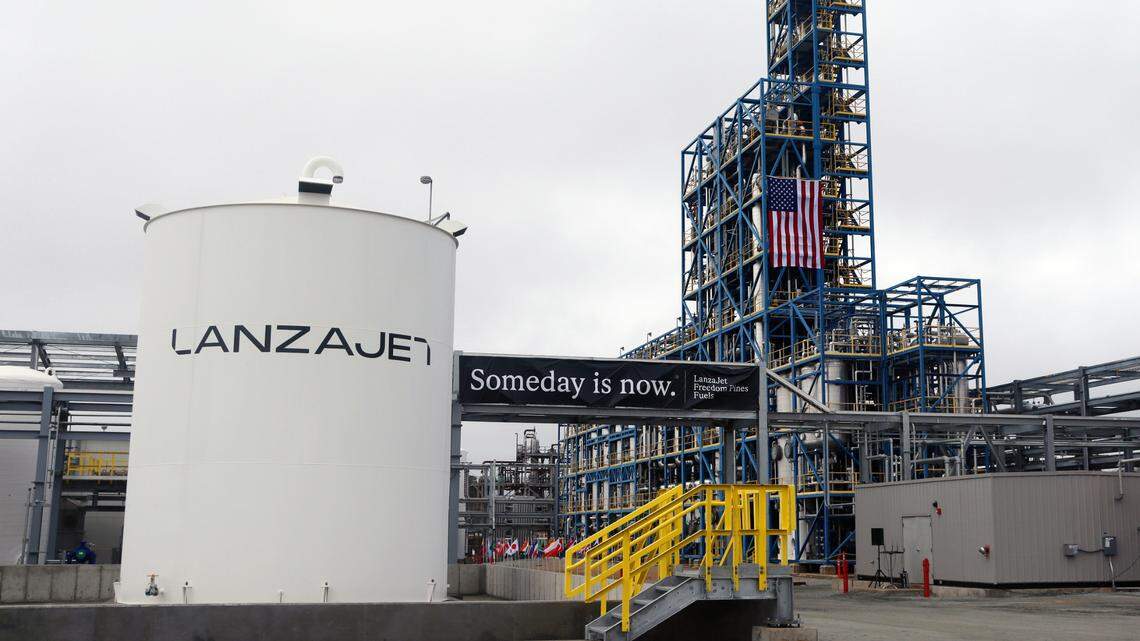
The recent capital injection into LanzaJet, spearheaded by aviation giant International Airlines Group (IAG) and energy major Shell, marks a significant inflection point for the nascent sustainable aviation fuel (SAF) market. With an initial $47 million secured in the first close of a broader $135 million equity raise, valuing the biojet developer at $650 million pre-money, this move signals a powerful commitment from industry heavyweights to scale ethanol-to-jet fuel technology. For investors monitoring the energy transition, this isn’t just another green initiative; it’s a strategic endorsement of a scalable, drop-in fuel solution that aims to de-risk future supply chains and offer a tangible pathway to decarbonizing air travel. This investment underscores the increasing urgency from both emitters and energy providers to secure viable alternatives to conventional jet fuel, moving beyond pilot projects to commercial-scale deployment.
De-Risking SAF Production and Scaling Technology for Global Reach
The infusion of $47 million in fresh capital is not merely a financial transaction; it’s a strategic vote of confidence in LanzaJet’s operational capabilities and its proprietary alcohol-to-jet (ATJ) technology. This funding directly supports continued operations and growth at the LanzaJet Freedom Pines Fuels facility in Georgia, which commenced production of ASTM-certified fuels at the close of 2025. This facility represents the world’s first fully integrated commercial-scale plant converting ethanol to jet fuel, a crucial step in proving the viability and scalability of this pathway. The participation of existing shareholders like Groupe ADP, LanzaTech, and Mitsui, alongside new co-leads IAG and Shell, validates the technology’s potential and strengthens its global deployment pipeline. Furthermore, the grant from the UK Department for Transport’s Advanced Fuels Fund for Project Speedbird in Teesside demonstrates governmental alignment, positioning LanzaJet to accelerate expansion across key markets and solidify its leadership in the biojet sector.
Strategic Feedstock Security and Offtake Agreements Fortify Investment Thesis
A perennial challenge for alternative fuel projects has been the securing of reliable, sustainable feedstock and guaranteed offtake. LanzaJet’s new multi-year tolling structure at Freedom Pines directly addresses these critical risks, a move that significantly enhances the bankability of current and future projects. Under this arrangement, the facility will process low-carbon, waste-based ethanol sourced domestically within the United States, complemented by renewable natural gas from a regional supplier. This dual approach to feedstock security, combined with guaranteed offtake for all plant production, mitigates supply chain volatility and market uncertainty. For investors, this structured approach reduces exposure to fluctuating input costs and ensures revenue predictability, transforming what might otherwise be a speculative venture into a more robust and attractive proposition. This de-risking strategy is paramount in a sector where project financing often hinges on long-term supply and demand certainty, directly addressing underlying investor questions about the operational viability and sustained profitability of SAF ventures.
SAF’s Growing Relevance Amidst Dynamic Crude Markets
The strategic push into sustainable aviation fuels, exemplified by the LanzaJet investment, takes on heightened significance when viewed against the backdrop of the current global energy market. As of today, Brent Crude trades at $93.86, representing a 3.79% increase, with WTI Crude at $90.63, up 3.67%. This upward movement comes after a period of considerable volatility, with Brent having declined from $118.35 on March 31st to $94.86 just yesterday, April 20th – a nearly 20% drop in less than three weeks. Such pronounced swings in conventional crude prices highlight the inherent risks and unpredictability of relying solely on fossil fuels. Investments in alternative, low-carbon solutions like SAF offer a strategic hedge against this volatility, providing airlines and energy companies with a more stable, environmentally compliant fuel source. While the immediate impact of SAF on global crude demand remains modest, these investments signal a long-term structural shift, gradually chipping away at the demand base for traditional petroleum products and offering a pathway to future energy security that is less susceptible to geopolitical and supply chain disruptions.
The Investment Horizon: Connecting Biojet to Broader Energy Narratives
For investors keenly observing the trajectory of energy markets, the LanzaJet investment provides crucial context for upcoming industry events and the long-term outlook. With the OPEC+ JMMC Meeting scheduled for April 21st, and the EIA Weekly Petroleum Status Reports on April 22nd and April 29th, the discussions around conventional crude supply and demand dynamics will be front and center. However, the burgeoning SAF sector, while often overshadowed by these traditional energy benchmarks, represents a critical element of the future energy mix. The EIA Short-Term Energy Outlook, due on May 2nd, will offer projections that increasingly must factor in the growth of alternative fuels. Investors frequently inquire about the future price of oil per barrel by the end of 2026, and while short-term movements are influenced by immediate supply-demand balances reported in weekly inventories and rig counts, the rise of SAF and other bio-based fuels introduces a structural shift in demand. This shift, driven by regulatory mandates and corporate decarbonization goals, suggests a long-term capping of crude demand growth, regardless of immediate geopolitical tensions. Therefore, understanding investments in companies like LanzaJet is key to formulating a comprehensive investment thesis that accounts for both the present realities of the oil market and the undeniable momentum of the energy transition.


