(Update) March 2, 2026, 3:25 PM GMT: Article updated throughout with Saudi statements, disruptions to economy.
For almost three days, there was little sign of a new war raging in the Gulf if you were based in Saudi Arabia. Most schools were business as usual on Monday morning, Saudis and foreigners reported heading to the office and carrying on with meetings, and flights continued to operate.
That now has the potential to shift after an area housing the country’s largest oil refinery suffered a drone strike and the kingdom reported intercepting multiple drones heading for Riyadh.
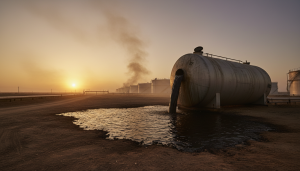
Saudi Aramco has since shut the Ras Tanura plant on the Persian Gulf while it assesses damages, Bloomberg reported. The kingdom confirmed some units are down and said a fire at the site was caused by debris from the interception of two drones aiming for the refinery.
An Iranian military source told the semi-official Mehr news agency that regional oil facilities are not the target of Tehran’s attacks.
Even so, the action around Ras Tanura stands to alter the calculus for Saudi Arabia. It’s the first major impact with possible fallouts for the kingdom’s $1.3 trillion economy since Iran began attacking Gulf states on Saturday in response to the Israel-US bombardment.
Any direct threat to prized oil assets may be somewhat of a red line for Saudi Crown Prince Mohammed bin Salman, who has in recent years tried to remain neutral in regional conflicts to avoid setbacks to his economic diversification agenda. MBS, as the de-facto leader is known, has denied US warplanes the option to use Saudi airspace to strike Iran.
“The attack on Saudi Arabia’s Ras Tanura refinery marks a significant escalation, with Gulf energy infrastructure now squarely in Iran’s sights,” said Torbjorn Soltvedt, principal Middle East analyst at risk intelligence company Verisk Maplecroft. “The attack is also likely to move Saudi Arabia and neighboring Gulf states closer to joining US and Israeli military operations against Iran.”
Up until a few years ago, it wasn’t uncommon for Saudi oil installations to be the target of attacks. In 2022, Yemen’s Houthi rebels targeted an Aramco oil depot in Jeddah, prompting retaliation by a Saudi-led coalition in Yemen.
The kingdom’s frustration with Iran had already appeared to be growing in the advance of Monday’s attack. On Sunday, it warned of consequences to Iranian actions, called on the international community for a firm response and summoned the Iranian envoy to the kingdom.
Ministers from Gulf Cooperation Council countries also gathered to discuss the possibility of coordinating steps to halt what they’ve called “treacherous” and “heinous” actions by Tehran.
Saudi Arabia confirmed the interception of five drones targeting assets in Riyadh on Monday, including the Prince Sultan US air base about 60 miles outside the capital.
Air traffic in Riyadh continued with limited disruption as of this afternoon but flights have slowed from the King Fahd International Airport near Aramco’s biggest oil fields since this morning. Travel is less than usual as the holy month of Ramadan is underway in the kingdom.
Saudi Arabian equities closed little changed after suffering their steepest drop in almost a year on Sunday. Shares of Aramco rose to the highest since May.
As Monday night approached in the region, there was no sign of let-up in the war.
The conflict continued to reverberate across the Middle East, with blasts heard across Israel, Qatar and the United Arab Emirates, as states intercepted Iranian missiles. In Lebanon, Israel bombed Beirut, opening a new front in the conflict. Three warplanes crashed in Kuwait after being mistakenly shot down by local air defenses, the US said.
US President Donald Trump said a bombing campaign against Iran – which began in alliance with Israel on Saturday after what he called Iran’s refusal to renounce nuclear weapons – will continue, perhaps for weeks.
What do you think? We’d love to hear from you, join the conversation on the
Rigzone Energy Network.
The Rigzone Energy Network is a new social experience created for you and all energy professionals to Speak Up about our industry, share knowledge, connect with peers and industry insiders and engage in a professional community that will empower your career in energy.
element
var scriptTag = document.createElement(‘script’);
scriptTag.src = url;
scriptTag.async = true;
scriptTag.onload = implementationCode;
scriptTag.onreadystatechange = implementationCode;
location.appendChild(scriptTag);
};
var div = document.getElementById(‘rigzonelogo’);
div.innerHTML += ” +
‘ ‘ +
‘ +
”;
var initJobSearch = function () {
////console.log(“call back”);
}
var addMetaPixel = function () {
if (-1 > -1 || -1 > -1) {
/*Meta Pixel Code*/
!function(f,b,e,v,n,t,s)
{if(f.fbq)return;n=f.fbq=function(){n.callMethod?
n.callMethod.apply(n,arguments):n.queue.push(arguments)};
if(!f._fbq)f._fbq=n;n.push=n;n.loaded=!0;n.version=’2.0′;
n.queue=[];t=b.createElement(e);t.async=!0;
t.src=v;s=b.getElementsByTagName(e)[0];
s.parentNode.insertBefore(t,s)}(window, document,’script’,
‘https://connect.facebook.net/en_US/fbevents.js’);
fbq(‘init’, ‘1517407191885185’);
fbq(‘track’, ‘PageView’);
/*End Meta Pixel Code*/
} else if (0 > -1 && 86 > -1)
{
/*Meta Pixel Code*/
!function(f,b,e,v,n,t,s)
{if(f.fbq)return;n=f.fbq=function(){n.callMethod?
n.callMethod.apply(n,arguments):n.queue.push(arguments)};
if(!f._fbq)f._fbq=n;n.push=n;n.loaded=!0;n.version=’2.0′;
n.queue=[];t=b.createElement(e);t.async=!0;
t.src=v;s=b.getElementsByTagName(e)[0];
s.parentNode.insertBefore(t,s)}(window, document,’script’,
‘https://connect.facebook.net/en_US/fbevents.js’);
fbq(‘init’, ‘1517407191885185’);
fbq(‘track’, ‘PageView’);
/*End Meta Pixel Code*/
}
}
// function gtmFunctionForLayout()
// {
//loadJS(“https://www.googletagmanager.com/gtag/js?id=G-K6ZDLWV6VX”, initJobSearch, document.body);
//}
// window.onload = (e => {
// setTimeout(
// function () {
// document.addEventListener(“DOMContentLoaded”, function () {
// // Select all anchor elements with class ‘ui-tabs-anchor’
// const anchors = document.querySelectorAll(‘a .ui-tabs-anchor’);
// // Loop through each anchor and remove the role attribute if it is set to “presentation”
// anchors.forEach(anchor => {
// if (anchor.getAttribute(‘role’) === ‘presentation’) {
// anchor.removeAttribute(‘role’);
// }
// });
// });
// }
// , 200);
//});