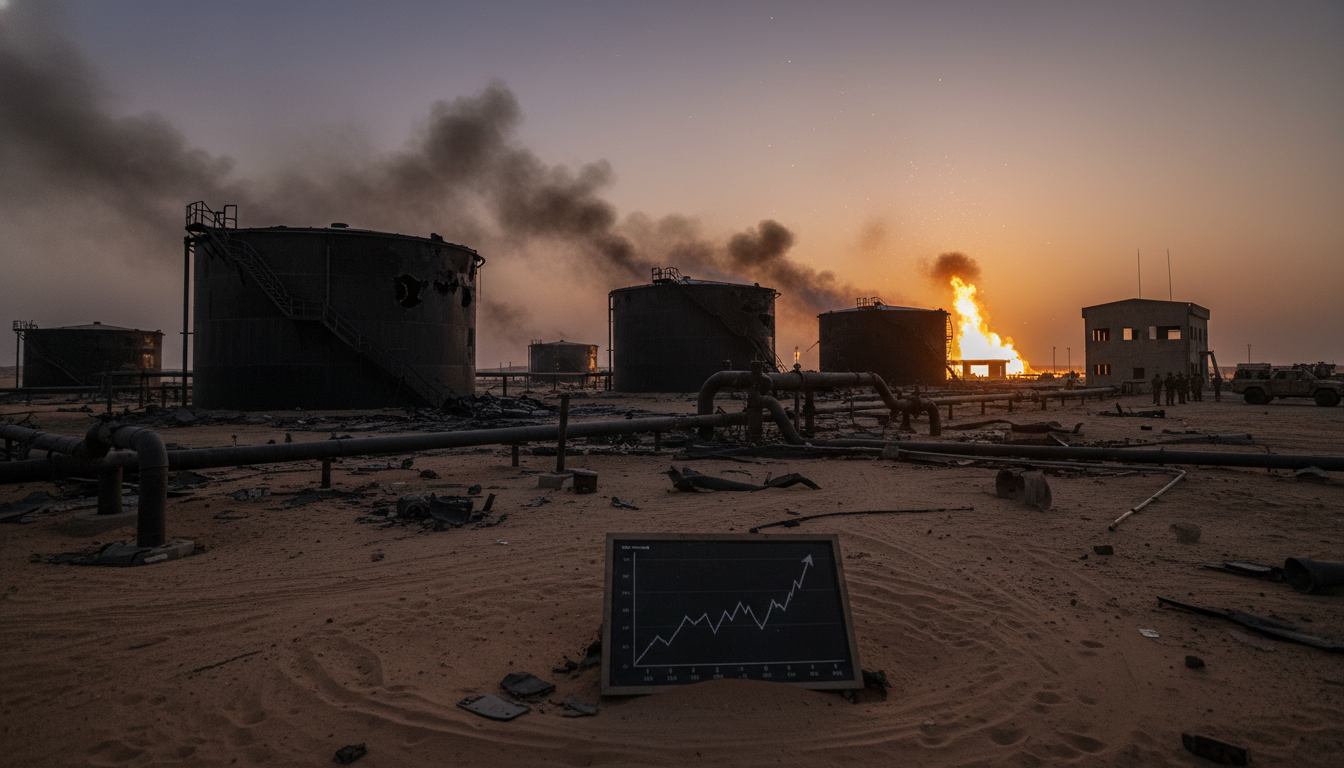
Geopolitical Tensions Rock Global Oil Markets: Saudi Arabia’s Production and Export Capacity Under Siege
The global oil market is grappling with significant disruptions originating from the heart of the world’s largest crude exporter. Saudi Arabia’s energy infrastructure has sustained direct hits, leading to a substantial reduction in both its crude oil production capacity and critical export pipeline flows. The Kingdom’s energy ministry recently confirmed a cumulative loss of approximately 600,000 barrels per day (bpd) in oil production capacity, alongside a 700,000 bpd decrease in throughput for its strategically vital East-West pipeline. This impairment signals a tightening of global supply, compelling investors to reassess geopolitical risk premiums embedded in energy asset valuations.
Direct Hits Slash Upstream Crude Output
The 600,000 bpd reduction in Saudi Arabia’s production capability represents a significant blow to the world’s primary source of incremental supply. Analysis indicates that specific upstream assets have been directly impacted. The Manifa field, a cornerstone of Saudi Aramco’s production, has seen its capacity diminish by an estimated 300,000 bpd. This loss is compounded by an additional 300,000 bpd deficit attributed to prior damage at the Khurais field. These figures underscore the vulnerability of key production sites to persistent aerial assaults, highlighting a direct threat to the Kingdom’s ability to maintain stable crude output levels. For energy investors, these capacity cuts translate directly into reduced available supply for global consumption, potentially driving upward pressure on crude benchmarks.
Critical Export Lifeline Impaired: East-West Pipeline Flows Reduced
Beyond the immediate impact on production, Saudi Arabia’s export logistics have also been severely compromised. The Kingdom’s East-West pipeline, a crucial conduit bypassing the often-volatile Strait of Hormuz, has experienced a 700,000 bpd reduction in its operational flow. This pipeline system has grown into one of Saudi Arabia’s principal avenues for moving crude from its eastern oil fields to Red Sea ports, offering a strategic alternative for global exports. The curtailment of throughput, attributed to a direct strike on one of its pumping stations, creates immediate logistical hurdles. Even if crude oil can be produced, its ability to reach international markets via this vital artery is now constrained, presenting a compounding challenge for global oil market stability and energy security, especially for destinations accessing Red Sea shipping lanes.
Downstream Operations and NGL Exports Also Targeted
The disruptions are not confined to upstream production and crude export pipelines; Saudi Arabia’s critical downstream refining infrastructure has also fallen victim to these attacks. Major processing hubs including Ras Tanura, Jubail, Yanbu, and Riyadh have reportedly suffered damage, affecting their operational capabilities. Furthermore, fires at processing facilities in Ju’aymah have resulted in a reduction of liquefied petroleum gas (LPG) and natural gas liquids (NGL) exports. This broadening scope of attacks, hitting both crude and refined product output as well as valuable NGL streams, underscores a systemic threat to the Kingdom’s comprehensive energy value chain. The impairment of refining capacity could lead to tighter supplies of gasoline, diesel, and other petroleum products, impacting global product markets, while reduced LPG/NGL exports affect petrochemical feedstocks and heating markets.
Persistent Threats Elevate Energy Security Concerns
These recent incidents are not isolated events but rather part of a sustained campaign of aerial assaults against Saudi Arabian energy infrastructure. Since the inception of the U.S.-Israeli conflict with Iran, the Kingdom has faced hundreds of missile and drone attacks. While the vast majority have been successfully intercepted by air defense systems, a sufficient number have managed to strike critical facilities, leading to the current operational disruptions. This ongoing threat environment fundamentally alters the risk profile for investing in Middle Eastern energy assets. The persistent targeting of energy infrastructure, coupled with the proven ability of assailants to inflict damage, injects a significant layer of geopolitical uncertainty and elevated security concerns into global oil supply forecasts.
Market Implications and Dwindling Resilience
As the world’s preeminent oil exporter, Saudi Arabia plays an unparalleled role in balancing global crude markets. Any quantifiable reduction in its ability to produce, refine, or export oil sends immediate ripples through the international energy complex. The reported disruptions directly subtract from the available global oil supply, an impact amplified by an increasingly tight market backdrop. Compounding this challenge, the Saudi energy ministry has disclosed that ongoing attacks are forcing a draw-down of the country’s operational and emergency inventories. This reliance on strategic reserves to backfill production losses diminishes the Kingdom’s inherent flexibility and its capacity to buffer future supply shocks, thereby eroding a key pillar of global energy security.
Investor Outlook: Navigating Heightened Geopolitical Risk in Energy
For investors focused on the energy sector, these developments in Saudi Arabia represent a tangible escalation of geopolitical risk. The consistent vulnerability of critical infrastructure to drone and missile strikes suggests that a geopolitical risk premium will remain a prominent feature in crude oil pricing. Market participants must closely monitor the trajectory of these attacks, the effectiveness of defensive measures, and Saudi Arabia’s ongoing efforts to restore full capacity. The strategic importance of Saudi oil to global economic stability means that sustained disruptions could lead to further price volatility and tighter market fundamentals. Investors should integrate this heightened and persistent threat landscape into their assessments of global oil supply dynamics and the broader energy investment outlook.