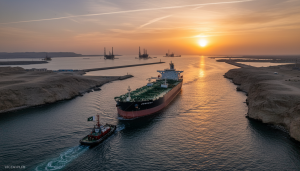
The global energy landscape continues to be reshaped by geopolitical tensions, with recent developments underscoring the resilience of energy trade routes despite escalating sanctions. A critical flashpoint emerged last week as a shipment of Russian liquefied natural gas (LNG) successfully docked at a Chinese terminal, the Beihai LNG station, an entity recently targeted by UK sanctions. This move, involving the ‘Arctic Mulan’ vessel carrying fuel from the already blacklisted Arctic LNG 2 project, serves as a potent reminder for investors: the pursuit of energy security often trumps Western sanctions, creating distinct and bifurcated market dynamics that demand close attention.
China’s Unwavering Energy Security Imperative Amidst Sanctions
The arrival of the ‘Arctic Mulan’ at the Beihai LNG station on Friday, carrying LNG sourced from Russia’s Arctic LNG 2 plant, is more than just a logistical event; it’s a strategic declaration. The UK’s recent sanctioning of the Beihai terminal, explicitly due to its receipt of restricted Russian cargoes since late August, was a clear attempt to disrupt this trade. However, Beijing’s response indicates a deep-seated commitment to securing its energy supply, regardless of Western pressure. China had proactively designated Beihai as the sole entry point for Arctic LNG 2 cargoes, anticipating potential Western retaliation. This foresight, coupled with the continued flow of gas, suggests a deliberate policy choice by China to prioritize its energy needs and strategic partnership with Russia.
Ship-tracking data further highlights this resolve, showing at least one additional cargo already en route to southern China from the Arctic region, expected to arrive after the November 13 sanctions wind-down period. Two more cargoes in East Asia are also heading to southern China, indicating a sustained pattern rather than an isolated incident. This defiance occurs even as Washington navigates complex trade relations with Beijing and seeks a resolution in Ukraine, with Western nations generally aiming to tighten Russia’s energy export revenues. For energy investors, this situation underscores the growing fragmentation of global energy markets, where access to specific supply chains can offer competitive advantages, or conversely, expose companies to significant geopolitical risk.
Market Volatility and the Price of Geopolitics
The broader energy market is currently navigating significant volatility, a reflection of both fundamental supply-demand dynamics and the persistent undercurrent of geopolitical risk. As of today, Brent crude trades at $90.38 per barrel, marking a sharp decline of 9.07% within the day, having ranged from $86.08 to $98.97. Similarly, WTI crude stands at $82.59, down 9.41%, with its daily range spanning $78.97 to $90.34. Gasoline prices also reflect this downturn, currently at $2.93, a 5.18% drop for the day. This recent price action follows a notable trend: Brent crude has seen a substantial decrease of nearly 20% over the past two weeks, dropping from $112.78 on March 30 to its current level. This significant adjustment highlights a market grappling with uncertainty.
The resilience of Russian energy flows to key consumers like China, despite robust sanctions, adds a layer of complexity to price forecasts. While sanctions aim to reduce supply and pressure prices upwards in some regions, the re-routing of these supplies creates alternative markets and potentially depresses prices in others, impacting global benchmarks. Investors are keenly asking about the future trajectory of oil prices, with queries about the price of oil per barrel by the end of 2026 being common. The current market volatility, exacerbated by geopolitical developments and the ongoing trade disputes, makes such predictions inherently challenging. It underscores the need for investors to factor in not just traditional supply-demand metrics, but also the unpredictable influence of political decisions and strategic alliances on global energy flows.
Upcoming Catalysts for Strategic Positioning
The immediate future holds several key events that could further shape the energy market and inform investor strategies. High on the calendar are the OPEC+ Joint Ministerial Monitoring Committee (JMMC) Meeting on April 19 and the full OPEC+ Ministerial Meeting on April 20. These gatherings are crucial, particularly given the recent downward pressure on crude prices. Investors are closely monitoring what OPEC+ current production quotas might be, and whether the alliance will consider further supply adjustments to stabilize the market. Any decisions made here could significantly impact short-to-medium-term crude prices and global supply balances, especially as the market digests the implications of Russian LNG finding new homes.
Beyond OPEC+, weekly data releases will offer vital insights into market fundamentals. The API Weekly Crude Inventory report on April 21, followed by the EIA Weekly Petroleum Status Report on April 22, will provide a snapshot of US crude and product inventories, offering clues about demand strength and refinery activity. These will be complemented by the Baker Hughes Rig Count on April 24, indicating drilling activity and future production trends. Similar reports will follow on April 28-29 for inventories and May 1 for the rig count. For investors, these events are not just data points; they are critical catalysts that, when viewed against the backdrop of ongoing geopolitical energy realignments, can signal shifts in investment opportunities, particularly for companies exposed to different segments of the value chain or specific geographic markets.
Investment Implications: Navigating a Fractured Energy Market
The continued flow of Russian LNG to China despite sanctions paints a clear picture of a global energy market undergoing significant structural changes. For investors, this signifies an accelerating bifurcation, where energy flows are increasingly dictated by geopolitical allegiances rather than purely economic efficiencies. Nations like China are prioritizing long-term energy security and strategic partnerships, creating a parallel energy ecosystem less susceptible to Western pressures. This means that while some companies might face increased compliance risks and reduced market access due to sanctions, others, particularly those with strong ties to non-Western markets or diversified assets, could find new avenues for growth.
The strategic implications for energy companies are profound. Those with exposure to traditional Western markets might need to de-risk by diversifying supply chains or focusing on cleaner energy transitions. Conversely, companies capable of navigating complex geopolitical landscapes, perhaps through joint ventures in developing nations or by serving markets less aligned with Western sanctioning bodies, could unlock unique value. The question of how individual companies, such as Repsol, will fare in this environment by the end of April 2026, becomes less about general market trends and more about their specific portfolio resilience, geopolitical exposure, and strategic agility. Investors should therefore focus on companies demonstrating robust risk management, adaptable supply strategies, and a clear understanding of the evolving global energy map, where political will often overrides conventional market forces.