Escalating Geopolitical Risks Tighten Russian Oil Export Outlook
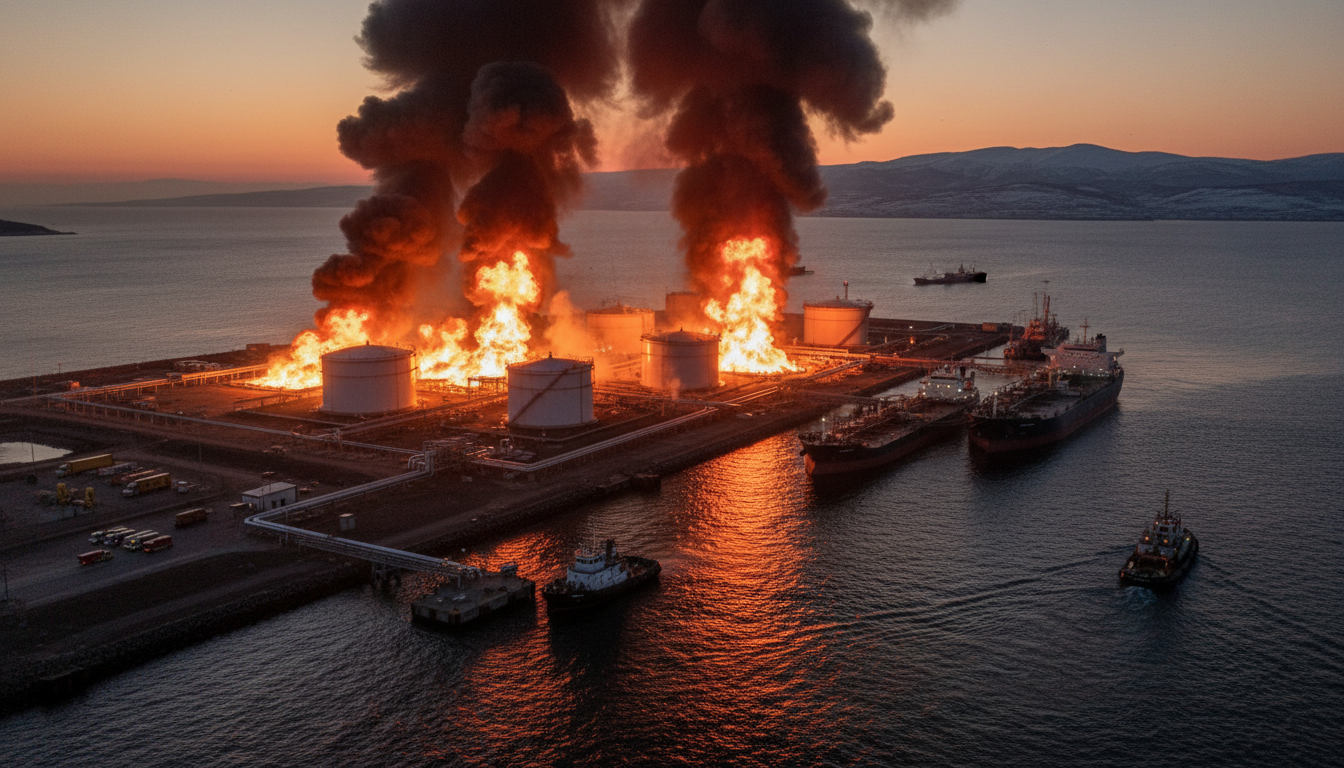
The global energy landscape faces renewed volatility following a significant drone strike on Russia’s Ust-Luga port, a critical export hub on the Baltic Sea. This latest incident, which sparked a substantial fire at facilities integral to Russian energy shipments, underscores the intensifying aerial campaign against Russian infrastructure and injects fresh uncertainty into an already fragile global supply picture. For energy investors, these events signal an elevated risk premium for Russian assets and highlight the persistent geopolitical forces shaping commodity markets.
Direct Impact on Russian Export Capacity and Market Reaction
The attack on Ust-Luga, confirmed by local authorities, targeted a cornerstone of Russia’s Baltic oil export network. This port typically handles an average of 450,000 barrels of crude per day, alongside refined petroleum products from Novatek PJSC, coal, and other vital cargo. While the full extent of the damage is still being assessed, any prolonged disruption at such a strategic location has immediate implications for global supply. This incident follows a similar strike earlier in the week on Primorsk, another key Russian oil export facility in the Baltic, which led to at least a 36-hour halt in cargo loadings. The deliberate targeting of these maritime export hubs underscores a calculated strategy aimed at constraining Russia’s ability to generate revenue from its energy resources, directly impacting its financial capacity. As of today, Brent Crude trades at $92.46, reflecting a -0.84% dip within a day range of $91.39 to $94.21. WTI Crude stands at $88.72, down -1.06%, while gasoline prices are at $3.1, a -0.96% decrease. While these figures represent a marginal retreat from earlier highs, the underlying geopolitical tension continues to provide a floor, preventing a steeper decline.
Investor Focus: Price Direction Amidst Supply Shocks
Our proprietary reader intent data reveals a consistent theme this week: investors are keenly focused on oil price direction and future outlooks. Questions range from immediate WTI movements to predictions for the price of oil per barrel by the end of 2026. These concerns are amplified by the recent events in the Baltic Sea. While Brent crude briefly surged above $100 per barrel earlier this month due to broader geopolitical tensions, our 14-day trend data shows a subsequent correction, moving from $101.16 on April 1st to $94.09 on April 21st. This cooling period, partly attributed to nascent U.S. diplomatic efforts to de-escalate Middle Eastern conflicts, now faces renewed upward pressure from the Russian supply disruptions. Investors are grappling with this push-pull dynamic: the potential for de-escalation in one theater against escalating risks in another. The sustained targeting of Russian energy infrastructure fundamentally alters the risk-reward calculus for crude and refined products, suggesting that while short-term price movements can be volatile, the underlying supply tightness points to a higher floor for oil prices in the medium term. The strategic objective behind these attacks—to curtail Russia’s financial lifeline—means these are not isolated incidents but part of an ongoing, impactful strategy.
Forward-Looking Analysis: Navigating Upcoming Data and Geopolitical Headwinds
Looking ahead, the market will be closely scrutinizing a series of upcoming energy events for further signals on supply and demand balances, especially in light of the Russian export disruptions. This Wednesday, April 22nd, the EIA Weekly Petroleum Status Report will offer fresh insights into U.S. crude inventories and refinery activity, providing a crucial domestic counterpoint to international supply concerns. Further EIA reports are slated for April 29th and May 6th, offering continuous updates. Additionally, the Baker Hughes Rig Count on April 24th and May 1st will indicate North American production trends. However, perhaps the most critical forward-looking indicator will be the EIA Short-Term Energy Outlook released on May 2nd. This report will provide updated forecasts for global supply, demand, and prices, incorporating the latest geopolitical developments and their potential impact on crude flows. Investors will be seeking updated assessments on how sustained disruptions to Russian exports might alter global balances, potentially leading to upward revisions in price forecasts. The confluence of these ongoing geopolitical risks and the impending data releases will dictate market sentiment and provide clearer direction for energy investments in the coming weeks and months.


