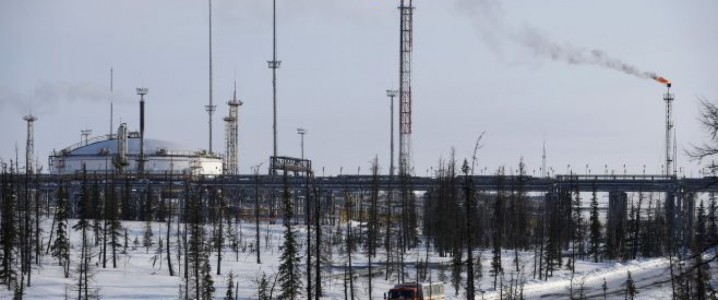
The financial bedrock of Russia’s economy, its formidable oil and gas sector, is currently navigating turbulent waters, as evidenced by a substantial decline in profitability and state revenues. Recent data paints a stark picture for investors tracking global energy markets, revealing a significant contraction in earnings that underscores the escalating pressures from global crude price dynamics and geopolitical measures.
Russian Energy Giants See Profits Halve
In a development that signals deepening economic strain, the collective net profits of Russia’s prominent oil and gas enterprises plummeted by nearly half in the first quarter of the current year compared to the same period in 2024. This dramatic downturn saw combined net profits slide to an estimated $9.9 billion (789.5 billion Russian rubles) for Q1 2025, a sharp drop from the robust $18 billion (1.445 trillion rubles) recorded in Q1 2024. This performance metric, sourced from Russia’s federal statistics agency Rosstat, highlights an accelerating erosion of profitability within a sector critical to the nation’s fiscal health.
For investors, this reduction in core profitability signals a challenging operating environment. Lower net earnings can impede reinvestment into production, exploration, and infrastructure, potentially impacting future supply capabilities and market share. It also directly reflects the combined headwinds faced by these companies, which have seen their financial resilience tested on multiple fronts.
Triple Threat: Price Declines, Sanctions, and a Stronger Ruble
Several converging factors have coalesced to exert immense downward pressure on the financial performance of Russian energy companies. Foremost among these is the sustained decline in global crude oil prices, which directly impacts the revenue generated from hydrocarbon exports. The flagship Urals crude, a key benchmark for Russian oil, has seen its price hover near the $50 per barrel mark, significantly below levels observed in prior periods and below what might be considered a comfortable fiscal breakeven for state budgets.
Concurrently, the tightening grip of Western sanctions continues to reshape the landscape for Russian oil exports. These measures, designed to limit Moscow’s energy revenues, introduce complexities in logistics, shipping, insurance, and financial transactions, often forcing Russian producers to sell their crude at considerable discounts to international benchmarks. This creates a dual challenge: lower global prices compounded by a specific “sanctions discount” for Russian barrels.
Adding to these external pressures, a strengthening Russian ruble has also played a counterintuitive role in diminishing profitability. While a stronger domestic currency might seem positive at first glance, for an export-oriented sector like oil and gas, it means that dollar-denominated sales, when converted back into rubles, yield fewer rubles. This effectively reduces the ruble-denominated revenue and, consequently, the ruble-denominated profits of these companies, even if the dollar price received per barrel remains stable.
Fiscal Challenges Mount as Energy Revenues Recede
The implications of this profitability squeeze extend far beyond the balance sheets of individual companies; they directly impact the Russian federal budget. With approximately one-third of every ruble flowing into the national treasury originating from oil and gas activities, the sector’s financial health is inextricably linked to the government’s fiscal capacity. The recent decline in oil prices has, therefore, translated directly into reduced state revenues from these vital energy resources.
In a clear acknowledgment of the deteriorating outlook, Moscow announced in late April revised projections for its energy income. The government now anticipates a substantial 24% reduction in oil and gas revenues this year compared to earlier estimates. This downward revision underscores the severity of the oil price crash that commenced in early April, pushing the value of Urals crude significantly lower and creating a substantial hole in anticipated state earnings. For investors, this signals potential fiscal tightening, which could have broader economic implications.
Export Value Plummets Despite Stable Volumes
Further illustrating the financial headwinds, the value of Russian crude oil exports recorded its lowest level in over two years during May. While the volume of crude oil shipments in the four weeks leading up to May 25 remained largely consistent with the preceding four-week period, the monetary value derived from these exports plunged to levels not seen since April 2023. This decoupling of export volume from export value is a critical indicator for market watchers, signifying that Russia is selling its oil at significantly lower prices per barrel, likely due to a combination of global market discounts and the impact of price caps and other sanctions.
This erosion of export value is a direct consequence of the downward trend in oil prices, which began to exert a significant impact on Russia’s earnings starting in April. The sustained inability to command higher prices for its crude, even as it maintains export volumes, points to the effectiveness of the market pressures and sanctions regime in limiting Moscow’s financial gains from its vast energy resources.
May Budget Revenue: A Glimpse into the Abyss
The budgetary impact became particularly acute in May, with oil and gas revenues for the Russian federal budget totaling approximately $6.5 billion (512.7 billion rubles). This figure represents a staggering plunge of over 35% when compared to the revenue generated in the same month of 2024. Even more concerning, this marks the lowest monthly oil and gas revenue for the Russian budget since June 2023, according to independent calculations. This sustained decline highlights a persistent and intensifying fiscal challenge for the Kremlin, which relies heavily on these revenues to fund state operations and strategic initiatives.
For global energy investors, this trend reinforces the ongoing geopolitical risks associated with Russian energy supplies and the potential for continued volatility in crude markets as these dynamics evolve. The sharp decline in state income from oil and gas will undoubtedly force fiscal adjustments and could have far-reaching economic consequences that extend beyond the energy sector itself.
Investor Outlook: Navigating Persistent Uncertainty
The confluence of falling oil prices, the escalating impact of Western sanctions, and a stronger domestic currency has created a challenging financial environment for Russia’s oil and gas sector. The near halving of net profits for energy companies in Q1 2025 and the significant drop in state energy revenues underscore a systemic vulnerability. Investors tracking the global energy landscape must recognize that these trends are not isolated events but rather indicators of persistent structural pressures on Russia’s primary economic engine.
As long as global crude prices remain subdued and geopolitical tensions continue to drive sanctions policies, the financial performance of Russian energy firms and the stability of the nation’s budget will likely face ongoing headwinds. Monitoring the trajectory of Urals crude prices, the evolving efficacy of sanctions, and Moscow’s fiscal responses will be crucial for understanding the broader implications for international energy markets and the global economic outlook. The current data signals a period of entrenched difficulty for a key player in the world’s energy supply chain, demanding careful consideration from all market participants.