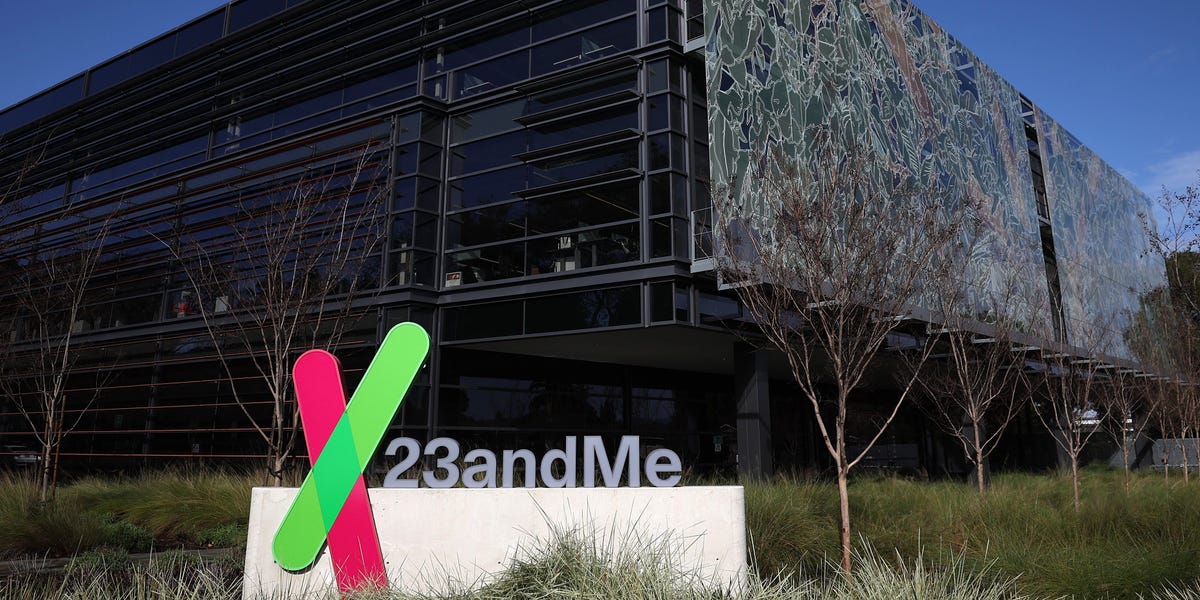
The landscape of investment opportunities is constantly shifting, often presenting stark examples of market volatility and the rapid revaluation of assets. A recent development in the biotechnology sector underscores this dynamic, as Regeneron Pharmaceuticals moves to acquire key business lines and the extensive biobank from the financially distressed DNA testing firm, 23andMe. This acquisition, valued at $256 million, represents a precipitous decline from 23andMe’s peak market capitalization of $6 billion just three years prior, offering a compelling case study for investors monitoring market cycles and strategic asset plays.
Regeneron’s Strategic Acquisition Amidst Financial Distress
Biotechnology stalwart Regeneron Pharmaceuticals announced its intention to purchase significant operational components from 23andMe. The deal encompasses 23andMe’s personal genome service, its total health and research services divisions, and crucially, its vast biobank containing genetic samples from millions of customers. This strategic maneuver positions Regeneron to significantly enhance its large-scale genetics research capabilities, aligning with its long-term mission to advance medical treatments and preventative health solutions.
George Yancopoulos, Regeneron’s cofounder, chief scientific officer, and president, articulated the company’s vision, stating that the acquisition would empower 23andMe to continue its core mission of educating individuals about their DNA and personal health, while simultaneously bolstering Regeneron’s broader scientific endeavors. Investors should note that 23andMe is expected to maintain its existing consumer genome service offerings, suggesting a strategic carve-out designed to maximize the value of its intellectual property and customer data, rather than a complete absorption.
From 23andMe’s perspective, the transaction offers a critical lifeline. Mark Jensen, chair of 23andMe’s special committee of directors, emphasized that the agreement prioritizes maximizing business value and preserving the company’s foundational mission. A vital component of the deal involves Regeneron’s commitment to adhering strictly to 23andMe’s established privacy policies and all relevant legal frameworks concerning customer genetic data. This commitment to data integrity and consumer consent is paramount, especially in an era of heightened scrutiny over personal information. The transaction is slated for completion in the third quarter of the current fiscal year, marking a significant milestone for both entities.
The Precipitous Decline of a Biotech Innovator
For many investors, 23andMe’s journey serves as a cautionary tale of rapid ascent followed by an equally swift decline in market valuation. The San Francisco-based firm, which gained widespread popularity for its direct-to-consumer saliva sample service analyzing ancestry and health risks, launched onto the public markets in 2021. Briefly, its market capitalization soared to an impressive $6 billion, signaling immense investor confidence in its innovative approach to personalized health data.
However, the company struggled to translate its initial market enthusiasm into sustained profitability. The subsequent years were plagued by a series of operational and financial setbacks that ultimately led to its undoing. In March, the company officially filed for Chapter 11 bankruptcy protection, a definitive signal of insurmountable financial distress. This pivotal moment coincided with the immediate resignation of CEO and cofounder Anne Wojcicki, marking the end of an era for the pioneering genetic testing firm.
The challenges facing 23andMe were multifaceted. In the preceding year, the company faced a substantial $30 million settlement in a class-action lawsuit following a significant data compromise affecting some user accounts. This incident underscored the critical importance of robust cybersecurity and data protection, a lesson for all companies dealing with sensitive personal information. Compounding these issues were two unsuccessful attempts by Wojcicki to take the company private, signaling a disconnect between public market expectations and the company’s intrinsic value. To stem the bleeding, 23andMe also undertook significant cost-cutting measures, including the painful layoff of approximately 40% of its workforce, a move that often precedes a company’s deep financial restructuring.
Further insights into the company’s dire financial state emerged from a November Securities and Exchange Commission filing, which revealed a staggering $2.3 billion in debts against a mere $126 million in cash and cash equivalents. This significant liquidity gap highlighted the urgent need for additional capital, a need that ultimately could not be met through conventional means, paving the way for the current asset sale and bankruptcy proceedings. For investors, this trajectory illustrates the inherent risks associated with high-growth, unproven business models, even those with significant market potential.
Investment Implications and Market Signals
This acquisition by Regeneron carries several important implications for the broader investment community. Firstly, it highlights the enduring value of proprietary data and biobanks in the healthcare and biotechnology sectors. Despite 23andMe’s financial woes, its collection of genetic samples and associated health data remains a highly coveted asset, capable of driving substantial research and development efforts. For investors, this reinforces the concept that even in bankruptcy, core intellectual property and unique data assets can command significant value.
Secondly, the transaction serves as a stark reminder of the volatile nature of market capitalization, particularly for companies operating in rapidly evolving technological frontiers. A $6 billion valuation evaporating to an asset sale of $256 million within a few years underscores the importance of rigorous due diligence, realistic growth projections, and a clear path to profitability. Investors in the energy sector, accustomed to commodity price swings, can appreciate parallels in how market sentiment and fundamental performance can rapidly impact company valuations.
Moreover, the emphasis on data privacy and compliance in the acquisition agreement signals a growing trend. Regulatory scrutiny and consumer awareness regarding personal data protection are intensifying, making robust privacy frameworks a non-negotiable component of any data-centric business model. Companies that fail to adequately protect sensitive information face not only reputational damage but also significant financial penalties and class-action litigation, directly impacting shareholder value.
Finally, this deal represents a strategic consolidation within the biotech industry, where larger, established players are well-positioned to acquire valuable assets from distressed firms at attractive valuations. For astute investors, identifying companies with strong balance sheets and a clear M&A strategy for synergistic acquisitions can be a compelling approach to portfolio optimization and long-term value creation. The Regeneron-23andMe deal provides a clear illustration of how market downturns can create opportunities for strategic growth through asset accumulation at a discount, echoing similar dynamics seen in various capital-intensive industries, including oil and gas.