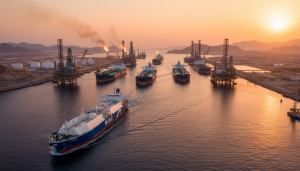
Baltic Sea Emerges as Critical Energy Flashpoint Amid Rising Geopolitical Tensions
The tranquil waters of the Baltic Sea, long a vital artery for European trade and energy, are rapidly transforming into a new arena of geopolitical confrontation, carrying significant implications for energy supply security and investor confidence across the region. Polish Prime Minister Donald Tusk issued a stark warning this week, highlighting the escalating risks to critical infrastructure amidst a series of provocative incidents involving Russian vessels. This development underscores a deepening concern for energy market participants monitoring the stability of European supply chains.
The latest alarm was triggered by reports of a sanctioned Russian tanker conducting “suspicious maneuvers” in close proximity to the crucial undersea power cable linking Poland and Sweden. Polish authorities confirmed their armed forces intervened, prompting the vessel to depart for an undisclosed Russian port. While initial assessments indicated no damage to the interconnector, a vital conduit for regional electricity flow, Poland is undertaking meticulous checks to ascertain if any explosive devices were covertly placed. This incident alone injects a new layer of risk assessment for investors considering long-term energy projects in the Baltic littoral states.
Undersea Infrastructure Under Scrutiny: Cables, Conduits, and Confrontation
This recent encounter is far from isolated, fitting into a disturbing pattern of maritime incidents that have plagued the Baltic Sea in recent months. Several vessels have faced detention on suspicion of damaging crucial undersea telecommunications cables, pointing to a broader vulnerability of vital subsea infrastructure. Compounding these worries, Baltic nations have intensified scrutiny of unregistered tankers, often referred to as Russia’s ‘shadow fleet.’ These vessels, frequently operating outside conventional regulatory frameworks, pose dual threats: potential security breaches that could disrupt energy flows or communication, and significant environmental hazards should an incident occur.
The gravity of the situation is deeply felt in Poland, a nation strategically positioned with borders adjacent to Russia’s key ally, Belarus, and its highly militarized exclave of Kaliningrad, home to a significant naval base at Baltiysk. Prime Minister Tusk emphasized that the sheer volume of “too many incidents” since Russia’s full-scale invasion of Ukraine prevents Poland from treating maritime security lightly. These geopolitical realities directly impact the risk premium associated with energy investments in the region, demanding careful consideration from financial stakeholders.
Further escalating tensions, Russia explicitly declared its intent to defend its vessels in the Baltic Sea by all legal means. This declaration followed a recent skirmish where Russia briefly deployed a fighter jet after Estonia attempted to halt an oil tanker within its economic zone, underscoring the volatile nature of maritime enforcement in disputed waters. For energy companies and their investors, this environment translates into higher operational risks, potential insurance premium hikes, and the ever-present threat of supply chain interruptions.
Poland’s Strategic Energy Pivot and Future-Proofing Efforts
In response to this heightened threat landscape and a longstanding strategic imperative to reduce reliance on Russian energy, Poland has embarked on an ambitious expansion of its energy infrastructure. This robust diversification strategy includes the construction of a gas link to Norway, securing a non-Russian source of natural gas. Furthermore, the country has significantly expanded its liquefied natural gas (LNG) import terminal capabilities, bolstering its capacity to receive global LNG shipments and enhance energy supply flexibility. Port capacities have also seen substantial upgrades, not only to manage growing commercial flows but also to facilitate the critical transit of military aid to neighboring Ukraine, intertwining energy security with broader regional stability.
Looking ahead, Poland is not resting on its laurels. The nation is actively integrating offshore wind farms into its energy mix, leveraging its extensive Baltic coastline for renewable power generation. Concurrently, plans are underway for the construction of its first nuclear power plant. Both these strategic infrastructure projects are inherently tied to the Baltic Sea – the offshore wind farms are physically located within its waters, and the nuclear plant will likely be situated along its coast. This concentration of critical energy assets in a disputed maritime zone amplifies the need for robust protective measures and underscores the financial implications of regional instability for long-term energy investment.
Bolstering Maritime Defense: A Prerequisite for Energy Security
Recognizing the direct link between national defense and the safeguarding of its energy future, Poland, as NATO’s highest spender relative to the size of its economy, has initiated a comprehensive rearmament program. This includes substantial investments aimed at bolstering its naval capabilities, directly relevant to protecting vital maritime energy infrastructure. Plans are in motion to acquire advanced submarines, enhancing subsurface surveillance and deterrence. Moreover, orders have been placed for the construction of three new frigates, designed to provide enhanced surface protection for Poland’s maritime interests, including its energy assets and shipping lanes.
For investors in the oil and gas sector and broader energy markets, these developments in the Baltic Sea represent a critical risk factor. The escalating confrontation, the vulnerability of undersea cables, and the presence of unregulated ‘shadow fleets’ demand constant vigilance. While Poland’s strategic energy diversification and robust defense spending aim to mitigate these risks, the volatile geopolitical environment necessitates a cautious approach to regional energy investments. The future stability of European energy supply is increasingly tethered to the evolving security dynamics of this vital northern sea.