The dawn of the artificial intelligence (AI) era, dramatically underscored by the emergence of conversational AI models, has ignited an intense technological arms race among the world’s leading tech giants and innovative startups. Yet, amidst this fierce competition, Google CEO Sundar Pichai offers a nuanced perspective, suggesting that the AI revolution is not a zero-sum game but rather an expansive frontier where multiple players can thrive.
Speaking on a recent industry podcast, Pichai articulated his belief that the vast potential of AI ensures success for many participants. This sentiment was echoed by podcast host David Friedberg, who challenged the prevalent misconception that the AI landscape would yield only one victor and numerous vanquished. Instead, Friedberg described AI as ushering in an “entirely new world” – a paradigm shift far exceeding the scope of any single dominant entity. For investors in the oil and gas sector, this collaborative yet competitive environment holds profound implications, as the accelerating pace of AI development promises transformative changes for operational efficiency, resource discovery, and sustainable energy practices.
AI’s Broadening Horizon: A Catalyst for Energy Innovation
Pichai’s reflections came in response to inquiries about formidable rivals such as Microsoft, xAI, OpenAI, and Meta, along with their visionary leaders. Acknowledging the exceptional caliber of this group, Pichai underscored the mutual respect that coexists with intense rivalry. He playfully referenced Microsoft CEO Satya Nadella’s challenge for Google to “come out and show that they can dance” with the advent of the new Bing, highlighting the dynamic interplay of innovation and competitive spirit. Furthermore, Pichai disclosed a recent meeting with Elon Musk, praising the billionaire’s unparalleled ability to conceptualize and build future-defining technologies. These interactions signal a future where cross-industry collaboration, even among competitors, could accelerate AI advancements applicable to highly complex sectors like oil and gas.
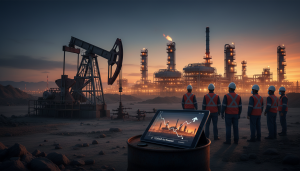
The energy industry, traditionally reliant on vast infrastructure and complex processes, stands to gain immensely from these developments. Advanced AI models, born from this crucible of innovation, are poised to revolutionize everything from seismic data interpretation and reservoir modeling to predictive maintenance for pipelines and drilling equipment. Imagine AI algorithms optimizing drilling paths in real-time to maximize yield and minimize environmental impact, or autonomous systems predicting equipment failures before they occur, drastically reducing downtime and operational costs. This competitive push by tech leaders directly translates into a richer toolkit for energy companies seeking to enhance their bottom line and meet evolving global demands.
The Unprecedented Opportunity Landscape for Oil & Gas
Pichai emphatically stated that AI presents an “opportunity landscape” far grander than any prior technological advancement. He posited that future industry leaders might not even exist today, drawing a parallel to the internet’s emergence in 1983, a full decade before Google’s inception. This foresight is critical for oil and gas investors. Just as the internet spawned entirely new business models and market leaders, AI is expected to birth innovative energy solutions and companies that could redefine the sector.
For the oil and gas industry, this translates into unprecedented avenues for value creation. AI can unlock efficiencies across the entire value chain: in upstream exploration, by identifying new reserves with greater accuracy; in midstream operations, by optimizing logistics and preventing spills; and in downstream refining, by enhancing process control and reducing energy consumption. Beyond conventional operations, AI is also a linchpin for the energy transition, enabling more efficient carbon capture technologies, optimizing renewable energy grids, and developing advanced materials for energy storage. Companies that proactively invest in AI integration and foster a culture of data-driven decision-making will undoubtedly gain a significant competitive edge.
Talent and Execution: The Linchpins of AI Success in Energy
Pichai highlighted that success in the AI race will ultimately hinge on a company’s ability to “innovate and execute with the best talent.” This principle resonates deeply within the capital-intensive and technologically demanding oil and gas sector. Google’s aggressive pursuit of top AI talent, including a reported $2.7 billion deal to bring back AI scientist Noam Shazeer, underscores the premium placed on human capital in this transformative era. Other tech titans are mirroring this strategy, with OpenAI CEO Sam Altman directly engaging candidates and Meta’s Mark Zuckerberg reportedly dispatching personal emails to AI researchers at Google’s DeepMind.
For oil and gas firms, this intensifies the imperative to attract and retain world-class AI and data science professionals. The sector, often perceived as traditional, must actively rebrand itself as a frontier for cutting-edge technological application. Investing in internal AI capabilities, establishing partnerships with leading tech firms, and even acquiring specialized AI startups will be crucial strategies. Companies that successfully bridge the gap between deep energy expertise and advanced AI capabilities will be best positioned to innovate, optimize operations, and achieve superior financial returns. The competition for talent, while fierce among tech companies, sets a precedent for how critical specialized expertise will be across all industries, including energy.
The Unrelenting AI Race and Its Ripple Effect on O&G Investment
While Pichai champions a multi-winner scenario for AI, the current competitive landscape shows no signs of abatement. The relentless pursuit of AI breakthroughs by tech giants directly benefits the broader economy, including the oil and gas industry. Each advancement in natural language processing, computer vision, or machine learning algorithms offers new tools and methodologies that can be adapted to solve complex energy challenges. From optimizing geological surveys with advanced image recognition to predicting market fluctuations with sophisticated predictive analytics, the applications are vast and varied.
Investors should view this ongoing AI race not merely as a tech narrative, but as a fundamental driver of efficiency and growth across all industrial sectors. Oil and gas companies that demonstrate a clear strategy for AI adoption, exhibit robust data infrastructure, and actively invest in the necessary talent and technologies are signaling their readiness for the future. Conversely, firms lagging in AI integration risk falling behind competitors who leverage these tools to drive down costs, enhance safety, and accelerate their transition towards more sustainable energy portfolios. The multi-faceted competition among AI developers ensures a continuous flow of innovation, providing the energy sector with ever more powerful tools to navigate its complex future.