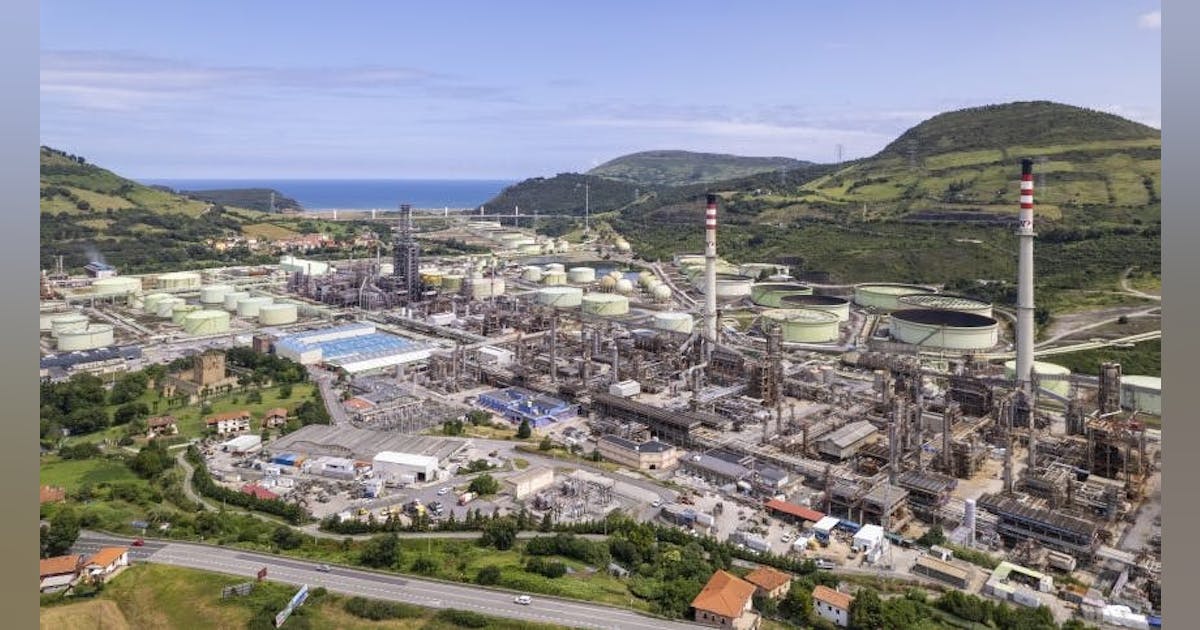
The European refining landscape is currently navigating a significant operational shift as Petróleos del Norte SA (Petronor), a key subsidiary of Repsol SA, commences a major turnaround at its Múskiz refinery and industrial complex. This critical event, the first comprehensive overhaul in six years for the 220,000-b/d facility near Bilbao, Spain, represents a substantial investment and a temporary reduction in regional refined product supply. Our analysis delves into the strategic implications of this €89 million undertaking, examining its impact on Repsol’s operational efficiency, the broader European energy market, and the investment outlook amidst fluctuating crude prices and an active calendar of market-moving events.
Strategic Turnaround at Múskiz: Repsol’s Long-Term Vision
Petronor’s decision to initiate this extensive turnaround at its Múskiz refinery on May 15 underscores Repsol’s commitment to modernizing its assets and enhancing sustainable operations for the long term. This isn’t merely routine maintenance; it’s a strategic investment aimed at bolstering the refinery’s safety, efficiency, and environmental performance for the next operational cycle. The project focuses on Crude Distillation Plant 1, involving the shutdown of 14 units and the inspection and reconditioning of over 393 pieces of equipment. With an expected completion by mid-July, the duration of this outage signals its comprehensive nature and the depth of the work being undertaken.
Crucially, the €89 million ($99.6 million) investment extends beyond standard upkeep to incorporate significant upgrades. A key enhancement involves adjustments to the Plant 1 crude unit’s preflash column, initially installed in March 2024. This modification will enable the separation of lighter products, such as butane and gasoline, without requiring energy-intensive furnace heating. Petronor projects this specific upgrade alone will reduce the site’s carbon dioxide emissions by more than 26,000 tonnes per year, aligning with Repsol’s broader decarbonization targets and appealing to investors increasingly focused on ESG metrics. Further improvements include modifications to the main crude unit column, various furnace enhancements, and the replacement of internal reactors in the G3 desulfurization unit. The integration of automated key production processes, following a similar pattern to the 2019 turnaround, is also expected to drive operational excellence and reduce human intervention risks. These forward-looking investments position Múskiz as a more robust and environmentally compliant asset within Repsol’s portfolio.
Refined Product Supply Dynamics Amidst Market Volatility
The temporary halt of a 220,000 b/d refining capacity in Europe inevitably creates ripple effects across the refined product markets. While the Múskiz turnaround is a planned event, its timing coincides with a period of notable volatility in global crude markets. As of today, Brent crude trades at $90.38 per barrel, marking a significant 9.07% decline from its opening, and reflecting a broader downturn of 18.5% over the past 14 days, plummeting from $112.78. WTI crude mirrors this trend, currently priced at $82.59, down 9.41%. Gasoline prices, in tandem, have dipped to $2.93, a 5.18% reduction today, yet the underlying supply-demand balance for refined products remains a key concern for investors.
The Múskiz outage removes a substantial volume of refined product output from the European market, particularly affecting the supply of gasoline and other light products. While the market has seen a recent correction in crude prices, the removal of this capacity could contribute to regional supply tightness, potentially bolstering refining margins for other European operators in the short to medium term. Adding to the complexity, Petronor also reported proximal, albeit unrelated, maintenance events involving its fluid catalytic cracking (FCC) unit and several desulfurization units (G4, H4, HD3) due to an instrumentation failure. Although these units are reportedly restarting, the combined effect of multiple operational disruptions in a single complex can exacerbate supply concerns and prompt market participants to seek alternative sources, highlighting the fragility of regional supply chains.
Investor Focus: Navigating Repsol’s Outlook and Broader Market Catalysts
Investors are keenly observing Repsol’s performance, with many asking about the company’s prospects through the end of April 2026 and their predictions for crude oil prices by year-end. The Múskiz turnaround, while a planned operational pause, will undoubtedly factor into Repsol’s second-quarter financial reporting. The temporary reduction in throughput from a facility of this scale implies a direct impact on refined product sales volumes and, potentially, refining margins for the quarter. However, the substantial €89 million investment and the focus on emissions reduction (over 26,000 tonnes of CO2 annually) could enhance Repsol’s long-term operational resilience and improve its standing with sustainability-focused investors, potentially yielding future financial benefits through carbon credit mechanisms or improved access to green financing. For investors evaluating Repsol, the immediate operational impact must be weighed against these strategic, long-term value drivers.
Regarding the broader oil price outlook, the current market dynamics are a confluence of geopolitical tensions, demand forecasts, and supply management. While the recent price dip might suggest easing pressures, the fundamental questions about global supply and demand balances persist. Investors are seeking clarity on how various factors, from economic growth to strategic petroleum reserve policies, will shape the trajectory of crude prices towards the end of 2026. This ongoing uncertainty underscores the importance of monitoring key market indicators and upcoming events that could provide clearer direction for energy investments.
Upcoming Events and Their Influence on Energy Markets
The energy market calendar is packed with critical events over the next two weeks that will profoundly influence crude prices and, by extension, the economic impact of the Múskiz turnaround. Investors are particularly focused on the upcoming OPEC+ Joint Ministerial Monitoring Committee (JMMC) meeting on April 18, followed by the Full Ministerial meeting on April 19. These gatherings are crucial for understanding the cartel’s production quotas and overall supply strategy. With many investors asking about OPEC+’s current production levels, any adjustments or reaffirmed commitments will send strong signals to the market, potentially offsetting or exacerbating the supply tightness from refinery outages.
Beyond OPEC+, the weekly API Crude Inventory report on April 21 and 28, and the EIA Weekly Petroleum Status Report on April 22 and 29, will provide vital snapshots of U.S. crude and product inventories. These reports are indispensable for gauging real-time demand and supply balances, especially when a significant European refinery is offline. Furthermore, the Baker Hughes Rig Count on April 24 and May 1 offers insights into future production trends in North America. As the Múskiz refinery aims for a mid-July restart, these upcoming data releases and policy decisions will collectively shape the market environment into which its full 220,000 b/d capacity will eventually return, determining the prevailing price landscape for both crude and refined products.