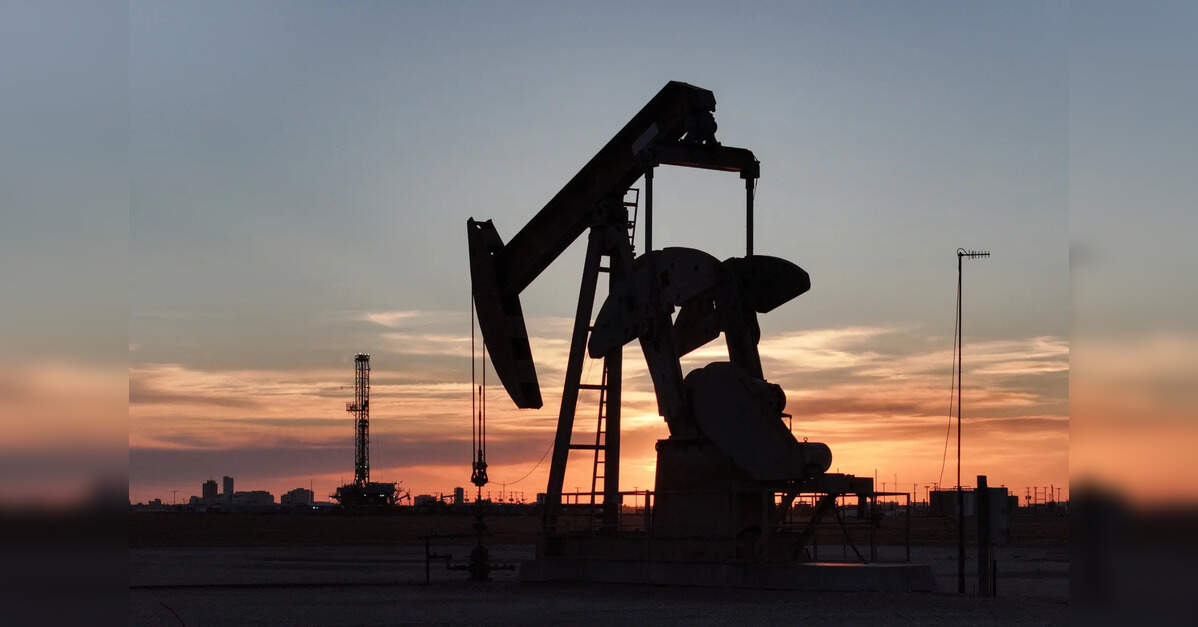
The global oil market finds itself at a critical juncture, buffeted by a confluence of macroeconomic anxieties and persistent geopolitical tensions. While a historically weak dollar would typically provide a tailwind for crude valuations, the prevailing risk-off sentiment, largely driven by renewed protectionist trade threats, has overshadowed this dynamic. Investors are grappling with extreme volatility, attempting to price in the complex interplay between supply-side risks stemming from West Asia and demand-side fears rooted in the global economic outlook. Our proprietary pipelines reveal a market under significant pressure, demanding a strategic and informed approach to oil and gas investing.
Navigating Current Market Headwinds: The Dollar’s Shadow and Crude’s Slide
The influence of currency markets on commodity prices remains undeniable, even as other factors exert more immediate pressure. Recalling last year’s dynamics, the dollar notably touched a three-year low in June 2025, reaching levels not seen since April 2022, following an 8% decline year-to-date. This weakness was primarily fueled by mounting concerns over the outlook for the US economy, including potential inflation spikes and recessionary risks tied to proposed trade and tax policies. While a weaker dollar generally makes dollar-denominated commodities like oil more attractive to international buyers, the broader macroeconomic uncertainty that underpins this dollar depreciation is currently acting as a significant deterrent for risk assets, including crude oil.
This sentiment is starkly reflected in today’s trading. As of this morning, Brent Crude trades at $90.38 per barrel, marking a sharp decline of 9.07% within the day, with a trading range between $86.08 and $98.97. Similarly, WTI Crude has fallen by 9.41% to $82.59, fluctuating between $78.97 and $90.34. This daily drop extends a more significant downturn; our proprietary market data indicates Brent has shed a substantial 18.5% over the past two weeks alone, falling from $112.78 on March 30 to $91.87 just yesterday. This sustained depreciation underscores the market’s deep concern over demand prospects amidst the current economic climate, despite any theoretical support from a historically weaker dollar. Even gasoline prices are feeling the pinch, currently at $2.93 per gallon, down 5.18% today.
Geopolitics vs. Protectionism: A Tug-of-War for Oil Prices
The current volatility in oil markets is a direct consequence of a powerful tug-of-war between two opposing forces: persistent geopolitical risk premiums and a resurgence of protectionist trade rhetoric. Just recently, crude prices saw a notable surge, with Brent jumping 4.3% in a single day, the most significant rise since October. This rally was a direct response to escalating tensions in West Asia, specifically following threats from Iran regarding nuclear talks and the subsequent advisory for some US embassy staff to depart Iraq. Further fueling supply fears, the UK Navy issued a warning to vessels navigating the critical Strait of Hormuz, a choke point through which over a quarter of the world’s oil supplies traverse.
However, this bullish momentum was quickly blunted by a decisive shift towards a risk-off mood. The catalyst: renewed tariff threats emanating from Washington. Statements indicating an intent to send letters to trading partners within one to two weeks, outlining unilateral tariff rates ahead of a July 9 deadline to reimpose higher duties on various economies, immediately dampened appetite for risk assets. The market is clearly prioritizing the potential for global trade disruptions and the resulting economic slowdown over immediate supply-side geopolitical concerns, leading to the sharp price corrections we observe today.
The Road Ahead: Key Catalysts in the Next Fortnight for Energy Investors
For astute oil and gas investors, the next two weeks will be crucial, packed with events that could significantly shape crude price trajectories. Our event calendar highlights several key dates that demand close attention. First and foremost are the upcoming OPEC+ meetings: the Joint Ministerial Monitoring Committee (JMMC) convenes today, April 18, followed by the Full Ministerial Meeting tomorrow, April 19. These gatherings are paramount as the cartel will weigh global supply-demand dynamics and decide on production quotas. Given the significant price depreciation witnessed recently, any signals regarding potential output adjustments could trigger substantial market reactions.
Beyond OPEC+, investors should closely monitor weekly inventory data from the United States. The American Petroleum Institute (API) will release its weekly crude inventory figures on Tuesday, April 21, and again on April 28. These will be followed by the official EIA Weekly Petroleum Status Reports on Wednesday, April 22, and April 29. These reports provide vital insights into US supply and demand balances, offering a snapshot of storage levels and refinery activity. Furthermore, the Baker Hughes Rig Count, scheduled for release on Friday, April 24, and May 1, will offer a granular view of drilling activity and future production trends in North America. Each of these data points will serve as critical inputs for fundamental analysis, influencing short-term trading strategies and informing longer-term investment decisions in the energy sector.
Investor Pulse: Deciphering the Oil Market’s Future Amid Uncertainty
Our proprietary reader intent data reveals a clear focus among investors on the future direction of oil prices, especially amidst the current volatility. A recurring question this week is, “What do you predict the price of oil per barrel will be by end of 2026?” This reflects a natural desire for clarity in an exceptionally opaque market. Closely related is the inquiry, “What are OPEC+ current production quotas?”, highlighting the market’s recognition of the cartel’s pivotal role in supply management.
Predicting oil prices, particularly over a multi-year horizon, is inherently challenging. The end-of-2026 outlook for crude oil is heavily contingent on a complex interplay of factors including the trajectory of global economic growth, the resolution or escalation of geopolitical flashpoints, and crucially, the ongoing production policy decisions by OPEC+. The immediate focus, as highlighted by investor questions, remains squarely on OPEC+’s upcoming deliberations regarding production quotas. Any decision to maintain, increase, or cut output will have profound implications for market balance and price stability in the coming months. We advise investors to remain agile, focusing on fundamental shifts in supply and demand, closely tracking the outcomes of the scheduled OPEC+ meetings, and analyzing the incoming economic data, especially as tariff threats loom. Understanding these key drivers, rather than relying on singular price targets, will be essential for navigating the oil market’s inherent uncertainties.


