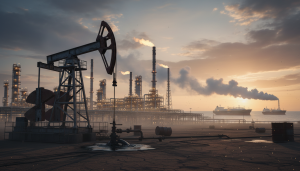
The data is unambiguous: global upstream investment has not returned to pre-2014 levels. Spare capacity outside OPEC remains thin. U.S shale growth – once the world’s swing supplier – is moderating as capital discipline replaces expansion-at-any-cost.
Demand, however, has not collapsed.
According to Lars Hansen, Head of Research at The Gold & Silver Club, the imbalance is structural rather than cyclical.
“We are witnessing a market priced for abundance when the data increasingly points to constraint. Investment has lagged for nearly a decade. Supply growth cannot simply be willed into existence once capital has been withheld.”
That imbalance does not resolve itself gently.
The AI Boom Is an Energy Story
Artificial intelligence is widely framed as a software revolution.
In reality, it is an Energy story.
Data centres are among the most energy-intensive assets ever constructed. Training large-scale AI models requires vast computational power, advanced cooling infrastructure and resilient grids. Hyperscale facilities are expanding rapidly across North America, Europe and Asia.
More compute. More fabrication. More automation. More cooling.
Energy demand scales with technological progress. It always has.
Despite rapid renewable build-outs, fossil fuels remain critical for baseload stability, petrochemicals, aviation, maritime transport and heavy industry. Oil remains deeply embedded across global logistics and manufacturing supply chains.
Hansen adds: “AI does not reduce energy intensity – it amplifies it. Every digital layer rests on a physical foundation. Markets are underestimating the scale of the energy requirement beneath the AI transition.”
The structural demand floor appears materially stronger than consensus forecasts imply.
Geopolitics: The Underpriced Variable
Layer geopolitical fragility onto constrained supply and the asymmetry becomes clearer.
A significant portion of global seaborne Crude still transits through the Strait of Hormuz – a chokepoint exposed to persistent regional tensions. Yet markets continue to price relative stability.
History suggests that when chokepoints destabilise, price reactions are abrupt rather than gradual. Volatility expands. Hedging accelerates. Capital scrambles for exposure.
The current geopolitical risk premium appears modest relative to the potential scale of disruption.
Scarcity Precedes Rotation
The view at The Gold & Silver Club is direct: Oil today resembles Gold before its breakout phase – under-owned, cash generative and structurally tightening.
That combination is powerful.
“When a sector is structurally under-owned yet fundamentally improving, reallocations can be swift,” Hansen notes. “Rotations do not begin with consensus approval. They begin with scarcity.”
Oil now sits at the intersection of three forces: constrained supply, AI-driven demand expansion and mounting geopolitical fragility.
The downside appears increasingly cushioned by years of underinvestment. Upside risks are building quietly beneath the surface.
In markets dominated by narrative extremes, the most asymmetric opportunity is often the one few are discussing – until price forces recognition.
Underinvestment. Rising demand. Policy miscalculation.
The message is becoming clearer: momentum is building, capital is rotating and 2026 may prove to be the year Energies outperform the Precious Metals.