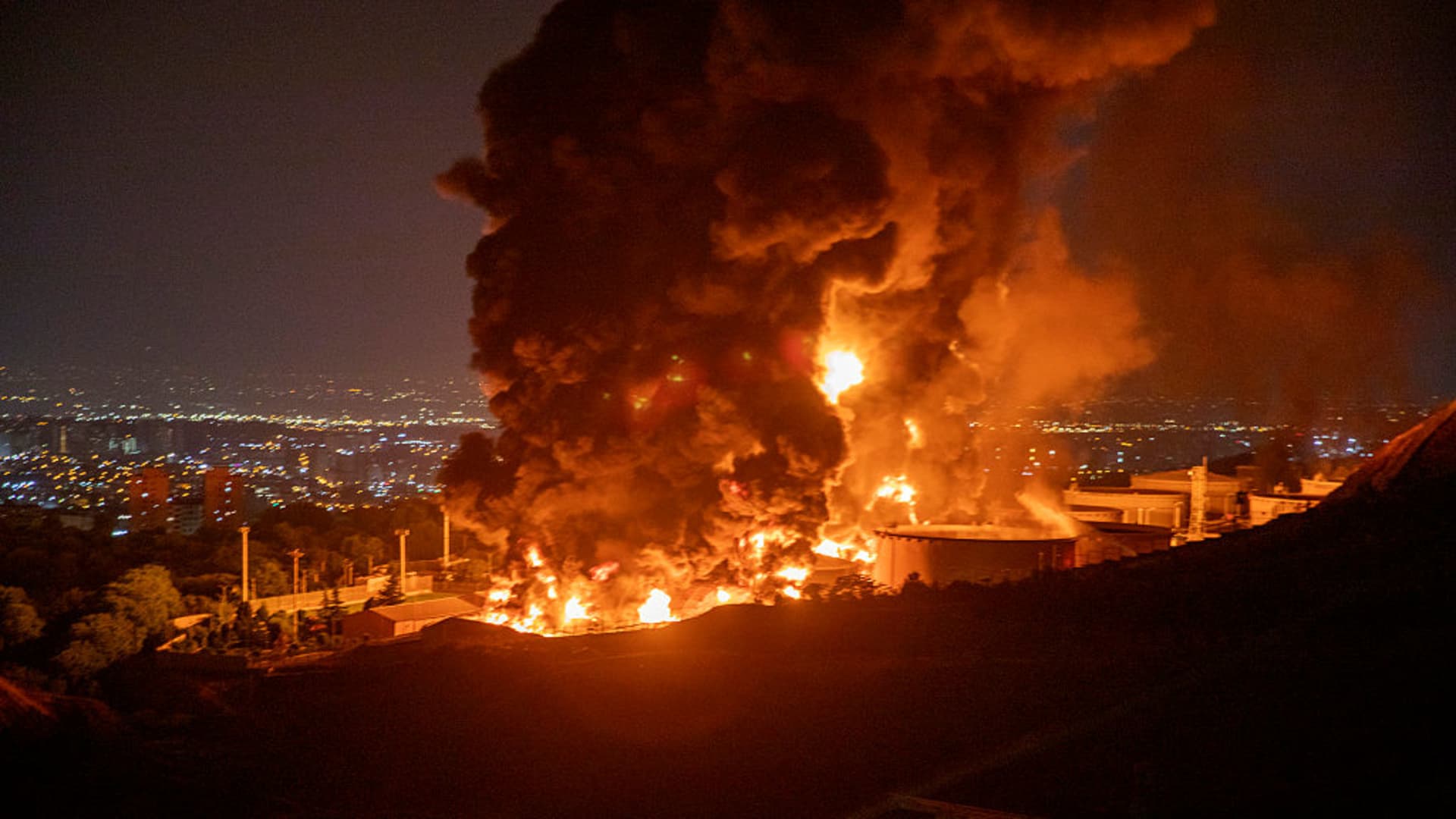
The global crude oil market is rapidly re-evaluating its trajectory, shifting to a distinctly bearish outlook following the recent ceasefire between Iran and Israel. This dramatic recalibration comes as President Donald Trump hints at a potential relaxation of sanctions on the Islamic Republic’s oil exports, profoundly altering the supply-side dynamics that had recently driven prices sharply higher.
For a brief but intense 12-day period, the escalating tensions between Iran and Israel sent shockwaves through energy trading floors. U.S. crude oil prices experienced a significant ascent, climbing over 15% from June 13, the date Israel commenced its air campaign. The market reached its zenith on the evening of Sunday, June 22, in the aftermath of reported U.S. strikes on key Iranian nuclear sites. At its peak during this period of heightened anxiety, global benchmark Brent crude touched $81.40 per barrel, while West Texas Intermediate (WTI) topped out at $78.40. Traders were acutely focused on the potential for major supply disruptions emanating from the vital Middle East region.
However, this rally proved to be exceptionally short-lived. A swift and sharp sell-off materialized as soon as it became clear that Iran had meticulously calibrated its retaliatory actions to prevent further escalation, notably avoiding any targeting of regional oil infrastructure. The market’s relief was palpable, leading to an immediate unwinding of the geopolitical risk premium. WTI, in particular, saw a precipitous decline, plummeting $14.40 per barrel, or 18%, from its Monday high to Tuesday’s low, coinciding precisely with the announcement of a ceasefire. This swift reversal underscores the market’s underlying sensitivity to fundamental supply and demand factors, once the immediate threat of conflict subsides.
Vikas Dwivedi, a global energy strategist at Macquarie Group, articulated the prevailing sentiment, noting, “In some ways, the market has gotten more bearish since before all this started.” His rationale points to the potential for Iran to resume selling its crude to China without the previous level of concern regarding U.S. retaliatory measures. This outlook suggests a significant shift in the global supply landscape. Prior to the Iran-Israel conflict, oil prices had already reached their lowest point since 2021, pressured by expectations that tariffs would dampen global demand and that the OPEC+ alliance would increase output more rapidly than anticipated. Martijn Rats, an analyst at Morgan Stanley, informed clients recently that the market is now reverting to these pre-existing soft fundamentals, indicating a persistent downward pressure.
The prospect of eased U.S. pressure on Iran’s oil sector is a pivotal element driving the current bearish sentiment. President Trump explicitly indicated his stance on Tuesday, using a social media platform to convey to China that it could continue purchasing oil from the Islamic Republic. Data from Kpler reveals that Beijing is the primary destination for the majority of Iran’s approximately 1.7 million barrels per day (mbpd) in crude exports. This statement, coupled with the rapid push for a ceasefire, suggests President Trump remains acutely sensitive to the economic implications of elevated oil prices, effectively placing a ceiling on the geopolitical risk premium even if underlying regional tensions persist, as noted by Francesco Martoccia, an analyst at Citigroup.
While a senior White House official subsequently clarified that U.S. sanctions on Iranian oil officially remain in effect, President Trump reiterated his conciliatory tone at the NATO summit in The Hague. He again implied that his administration would not disrupt the flow of Iranian crude oil, a gesture widely interpreted as an olive branch intended to aid the Islamic Republic in its recovery efforts following Israel’s bombing campaign. This mixed messaging from Washington creates a degree of uncertainty but leans towards a scenario where more Iranian oil could find its way onto the global market, adding to overall supply.
Looking ahead, financial analysts are now providing updated price forecasts reflecting this evolving environment. Dwivedi of Macquarie Group suggests that if investors gain confidence in the stabilization of the geopolitical situation, the market will likely trend downward. He projects Brent crude heading towards the low $60s per barrel, eventually settling in the high $50s later this year. Citigroup’s Martoccia offers a similar outlook, forecasting Brent crude could fall as low as $66 per barrel in the third quarter, with a further decline to $63 per barrel by the fourth quarter. For the immediate term, Dwivedi anticipates that oil prices will likely trade within a relatively narrow $5 range over the next few weeks, as market participants closely monitor the ongoing diplomatic and strategic interactions between Iran and Israel.
For investors in the oil and gas sector, the current landscape demands a cautious and analytical approach. The rapid dissipation of the geopolitical risk premium underscores the market’s underlying focus on supply and demand fundamentals. The potential for increased Iranian crude supply, coupled with lingering concerns over global economic growth and the production strategies of OPEC+, creates a scenario where sustained upward price momentum could be challenging. The journey towards the high $50s for Brent crude, as suggested by some analysts, highlights the importance of vigilance and a data-driven investment strategy in this dynamic and often unpredictable market.