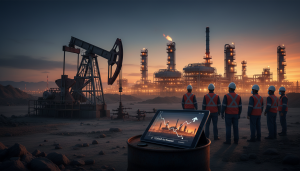
The AI Imperative: Reshaping Oil & Gas Investment Strategy
The global energy landscape is perpetually evolving, yet few transformations promise to reshape the oil and gas sector as profoundly as the current artificial intelligence revolution. Seasoned industry observers, having navigated cycles from the dot-com boom to the mobile era and the advent of Web 2.0, recognize the unparalleled scale of change AI is poised to unleash. For oil and gas investors, this isn’t merely a technological upgrade; it represents a fundamental shift in how value is created, risk is managed, and competitive advantage is secured.
This seismic shift provides an unprecedented opportunity for industry leaders and product strategists to redirect their focus towards attributes of creativity and innovation, now supercharged by AI capabilities. Companies that successfully integrate AI into their core operations will not only enhance efficiency but also unlock new avenues for growth and profitability, offering compelling prospects for discerning investors. The imperative is clear: understand AI’s potential, integrate its tools, and pivot strategies to capitalize on its transformative power.
Embracing the AI Toolkit: A Mandate for O&G Leadership
In this burgeoning AI era, a critical first step for any oil and gas executive, engineer, or investor is to actively engage with the new generation of AI tools. This isn’t about theoretical understanding but hands-on interaction – what some might metaphorically call ‘vibe coding’ or ‘vibe marketing’ for energy applications. The sheer accessibility of AI-powered platforms means that the barriers to experimentation have dramatically lowered. Instead of lengthy conceptual documents or speculative proposals, teams can now rapidly prototype AI-driven solutions, validate assumptions, and quickly learn what works and what doesn’t.
Consider the traditional lifecycle of an upstream project, from seismic interpretation to drilling. Historically, moving from a conceptual geological model to an operational drilling plan involved significant time, capital, and a degree of uncertainty. Today, AI allows geoscientists to rapidly test millions of reservoir scenarios, optimizing well placement with a precision that was previously unattainable. For instance, an AI model trained on historical drilling data and seismic imagery could identify optimal drilling locations with 15-20% higher accuracy, potentially reducing dry hole rates and boosting initial production rates by 5-10% in new fields. This rapid ideation and testing cycle is a game-changer, allowing companies to iterate on solutions for complex challenges, from optimizing refinery throughput to predicting equipment failures on offshore platforms.
From Conceptual Models to Tangible Operational Gains
One of AI’s most potent contributions to the oil and gas sector is its ability to bridge the gap between abstract concepts and physical, operational realities. Historically, many powerful ideas remained confined to theoretical models or simulation environments due to the immense complexity and cost of real-world implementation. Now, AI empowers engineers and operators to move beyond the conceptual realm, translating innovative ideas directly into tangible, measurable improvements in the field.
Imagine an AI-driven predictive maintenance system for a vast pipeline network. Instead of relying on scheduled inspections or reactive repairs, AI algorithms continuously analyze sensor data – pressure, temperature, flow rates, vibration – to anticipate potential failures with remarkable accuracy. This could lead to a 25-30% reduction in unplanned downtime and maintenance costs, saving millions in operational expenditures. Similarly, in refining, AI can optimize catalyst performance and feedstock blending, potentially increasing yield of high-value products by 2-5% and reducing energy consumption by 7-10%. These aren’t just theoretical savings; they translate directly into enhanced profitability and improved return on capital employed for investors.
The ability to quickly prototype an AI application, such as an intelligent drilling assistant that recommends optimal bit settings in real-time based on geological conditions, allows O&G firms to accelerate their learning curve. They can rapidly develop their “taste” for what truly works in a physical product or operational system, refining their craft and understanding the practical implications of AI-driven solutions. This agile approach minimizes sunk costs and maximizes the potential for breakthrough innovations, translating into more efficient capital deployment and higher asset utilization.
Cultivating an AI-First Mindset for Enhanced Value Creation
For investors assessing oil and gas companies, the adoption of an “AI-first” mindset among leadership is becoming a crucial differentiator. Companies that encourage their teams to spend significant time interacting with new AI tools are better positioned to uncover novel applications that drive efficiency and competitive advantage. This involves more than just purchasing software; it requires a cultural shift towards continuous experimentation and learning.
Consider the application of AI in carbon capture, utilization, and storage (CCUS) projects, a growing area of investment interest. AI models can optimize CO2 injection rates, predict reservoir behavior for long-term storage, and enhance the efficiency of capture technologies, potentially reducing the levelized cost of carbon capture by 10-15%. An O&G company actively prototyping AI solutions in this space demonstrates foresight and a commitment to future-proofing its operations against evolving environmental regulations and market demands.
Furthermore, AI is democratizing access to complex analytical capabilities. Data scientists and engineers can now leverage advanced machine learning models to analyze vast datasets from seismic surveys, well logs, and production history, identifying patterns and insights that were previously hidden. This translates into better-informed investment decisions, from evaluating acquisition targets to optimizing development plans for existing assets. Companies that empower their teams with these tools are effectively equipping them to “build an app” or “prototype something really quickly” that can validate assumptions about reserves, production profiles, and operational efficiencies, thereby de-risking investments.
Strategic Investment in AI Capabilities: The Long-Term Play
The overarching message for the oil and gas investment community is clear: AI is not a fleeting trend but a foundational technology set to redefine industry performance. Companies making strategic investments in AI capabilities today are positioning themselves for significant long-term gains. This includes investing in data infrastructure, talent development, and fostering an innovation culture that embraces rapid prototyping and AI-driven solutions.
Investors should scrutinize O&G companies for their AI strategy, looking beyond mere rhetoric to tangible deployments and measurable outcomes. Are they using AI to optimize drilling costs, potentially reducing per-well CAPEX by 5-8%? Are they leveraging machine learning for improved forecasting of commodity prices or demand, leading to better hedging strategies and trading profits? Is AI enhancing their ESG performance by optimizing methane emission detection and reduction, contributing to a lower carbon footprint and stronger social license to operate?
The AI revolution in oil and gas is not just about incremental improvements; it’s about unlocking entirely new paradigms of operational excellence, capital efficiency, and strategic foresight. For savvy investors, identifying and backing companies that are leading this charge will be key to navigating the next wave of value creation in the energy sector.