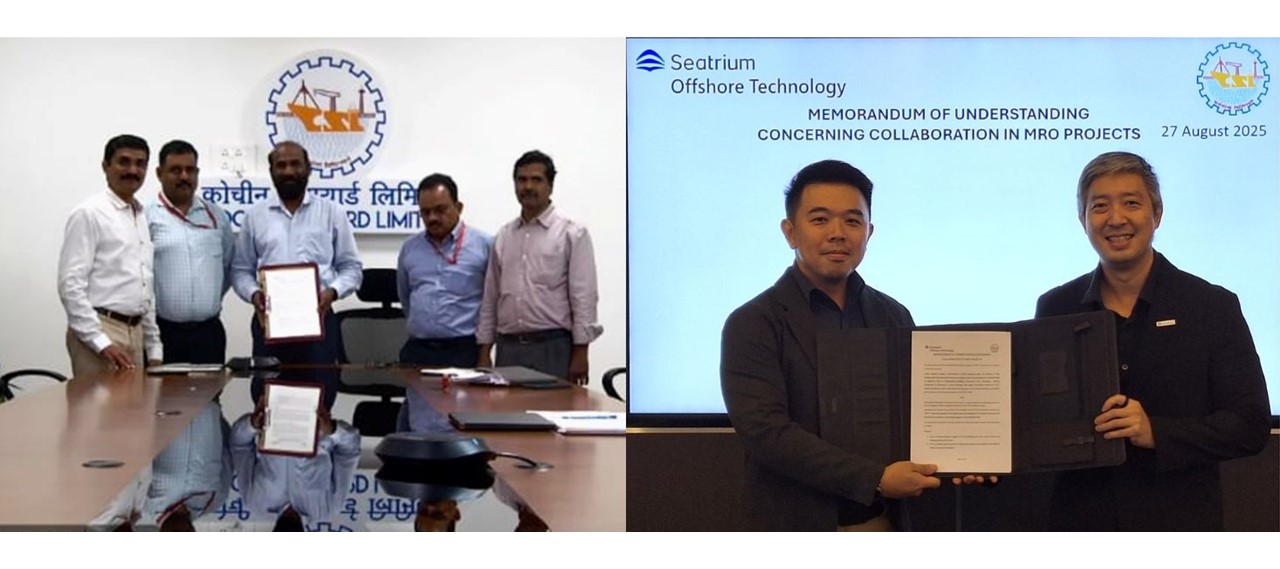
The offshore energy sector continues to capture significant investor attention, marked by strategic collaborations designed to navigate both evolving energy demands and market volatility. A recent Memorandum of Understanding (MoU) between Seatrium Offshore Technology (SOT), a subsidiary of Seatrium Limited, and Cochin Shipyard Limited (CSL), India’s largest shipbuilder and repairer, signals a concerted effort to enhance capabilities and expand footprint in key growth markets. This agreement, focusing on maintenance, repair, and overhaul (MRO) projects across Asia and exploring broader offshore opportunities, carries substantial implications for investors tracking the long-term trajectory of marine and energy services. It’s a move that underscores the strategic importance of localized expertise combined with global technological prowess in a sector poised for selective expansion.
Strategic Alignment in a Volatile Market
The collaboration between SOT and CSL is a prime example of industry players consolidating strengths to address complex market dynamics. SOT brings its engineering expertise and offshore technology, while CSL contributes extensive infrastructure and fabrication facilities. This synergy is particularly potent for MRO services, which are critical for sustaining existing offshore assets and extending their operational lifespecycles. Such partnerships become even more crucial when considering the current state of the global oil market. As of today, Brent crude trades at $90.38 per barrel, marking a significant 9.07% decline within the day, while WTI crude sits at $82.59, down 9.41%. This sharp daily drop extends a broader trend, with Brent having fallen from $112.78 just two weeks ago to $91.87 yesterday, representing an 18.5% reduction. This level of price volatility often prompts E&P companies to scrutinize capital expenditure. However, strategic alliances focused on efficient MRO and cost-effective solutions can offer a degree of resilience, ensuring essential asset upkeep continues even when new project sanctioning slows. For investors, this MoU suggests a focus on recurring revenue streams and operational efficiencies, a prudent strategy amidst fluctuating commodity prices.
India’s Offshore Ambition and Energy Security
India stands out as a critical focal point for this new partnership, identified by Seatrium as a key market for long-term growth. As one of the fastest-growing energy consumers globally, India’s drive for energy security is a powerful catalyst for offshore expansion. This isn’t merely about meeting current demand; it’s about bolstering long-term energy independence and diversification. The MoU builds upon an earlier 2024 agreement between Seatrium and CSL concerning the design and supply of equipment for jack-up rigs serving the Indian market, indicating a sustained, multi-faceted commitment to the region. This tiered approach suggests a strategic intent to capture various segments of India’s burgeoning offshore sector, from new build support to ongoing maintenance. Investors paying attention to global energy demand trends and national energy security agendas should view India’s offshore development as a significant growth vector for service providers like Seatrium and CSL.
Forward Implications for Offshore Investment Amidst Key Events
The success and growth trajectory of offshore service providers like Seatrium and CSL are intrinsically linked to broader industry activity and crude price stability. Looking ahead, a series of critical events could significantly influence the investment landscape for offshore players. The upcoming OPEC+ Joint Ministerial Monitoring Committee (JMMC) meeting on April 18th and the full Ministerial Meeting on April 19th are paramount. Given the recent steep decline in crude prices, investors are keenly awaiting signals from OPEC+ regarding potential adjustments to production quotas. A decision to maintain or further cut output could stabilize or even push prices higher, potentially encouraging more offshore CAPEX. Conversely, inaction could prolong price weakness, impacting future project sanctions. Beyond OPEC+, the consistent flow of data from API and EIA Weekly Petroleum Status Reports (scheduled for April 21st, 22nd, 28th, and 29th) offers critical short-term demand and inventory insights, while the Baker Hughes Rig Count (April 24th and May 1st) will provide a direct barometer of drilling activity. For investors, monitoring these events is crucial to gauge the operational environment in which alliances like the SOT-CSL MoU will operate and to anticipate shifts in offshore capital allocation.
Addressing Investor Concerns: Oil Price Outlook and Sector Resilience
One of the most pressing questions we observe from our reader base this week revolves around the future price of oil, specifically, “What do you predict the price of oil per barrel will be by end of 2026?” and “What are OPEC+ current production quotas?” These questions highlight a pervasive uncertainty that shapes investment decisions across the energy spectrum. While precise long-term forecasts are inherently challenging due to geopolitical factors and demand shifts, the current market volatility, exemplified by Brent’s $90.38 price today and its recent 18.5% drop, underscores the risk. However, it also emphasizes the strategic value of partnerships focused on essential services like MRO. Companies like Seatrium and CSL, by concentrating on the upkeep and enhancement of existing infrastructure, can exhibit a degree of resilience even when new exploration budgets are constrained. The stability of OPEC+ quotas, currently a significant market factor, directly influences the supply side. Any adjustments made in the upcoming meetings will cascade through the market, impacting not only crude prices but also the confidence for long-term offshore project commitments. Investors should recognize that while upstream E&P companies are directly exposed to price fluctuations, the offshore services sector, particularly those focused on maintenance, repair, and specialized equipment, can often weather downturns more effectively due to the critical nature of their services to ongoing operations. This strategic MoU positions both companies to capture necessary operational spend regardless of extreme price swings, providing a more stable revenue base for investors.