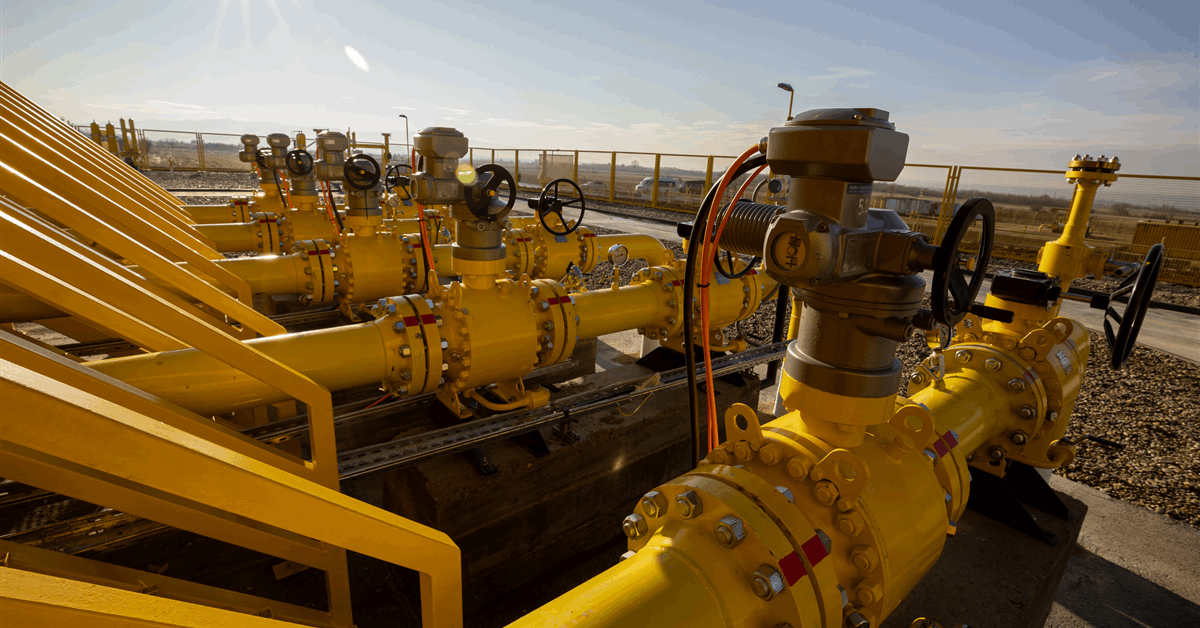
Norway’s role as a cornerstone of European energy security has once again been underscored by recent data indicating a notable uptick in its natural gas production. This positive development, marked by two consecutive months of increased output, provides a crucial counter-narrative to persistent global energy supply anxieties. For investors, understanding the nuances of Norwegian production trends, particularly in gas, offers vital insights into European market stability and the broader dynamics influencing crude prices amidst significant market volatility.
Norway’s Resurgent Gas Flow Bolsters European Energy Outlook
Preliminary official data confirms that Norway produced 332 million standard cubic meters a day (MMscmd) of natural gas in August. This figure not only represents a 0.7 percent increase from July’s final numbers but also exceeded the government’s forecast by 1.2 percent. This August performance marks the second consecutive month of rising gas production after a four-month period of decline, signaling a potential stabilization in Norway’s vital contributions to global supply.
The strategic importance of this resurgence cannot be overstated. In the first quarter of 2025, Norway cemented its position as the European Union’s leading gas supplier, accounting for a substantial 31 percent of total gas supply (both gaseous and liquefied). More specifically, it supplied 55 percent of the EU’s piped gas imports, a five-percentage-point increase from the fourth quarter of 2024, directly benefiting from the conclusion of the Ukraine-Russia transit deal. This robust supply pipeline from Norway is instrumental in easing European energy concerns, providing a reliable alternative to historical sources and offering a measure of predictability in an otherwise volatile geopolitical landscape. While production in the last six months remained below the corresponding period last year, the recent upward trend suggests operational improvements are taking hold.
Crude Markets Grapple with Supply & Sentiment Amid Norway’s Oil Performance
While Norway’s gas story offers some comfort, its oil production presents a slightly different picture against a backdrop of turbulent crude markets. In August, Norway’s oil production averaged 1.92 million barrels per day (MMbd). This figure, while 2.3 percent lower than July, still represents an impressive 8.1 percent increase from August 2024 and surpassed the Norwegian Offshore Directorate’s projection by 7.1 percent. Total liquids production followed a similar pattern, reaching 2.12 MMbd, down 2.3 percent month-on-month but up 6.2 percent year-on-year. This strong year-on-year performance and beat against projections demonstrate Norway’s continued capability in crude output.
However, these solid production figures from a key non-OPEC supplier are juxtaposed against a sharply declining global crude market. As of today, Brent crude trades at $90.38, marking a significant 9.07% decline today, within a range of $86.08 to $98.97. Similarly, WTI crude stands at $82.59, down 9.41% on the day, with a range between $78.97 and $90.34. This continued downward pressure extends a recent trend; Brent crude has fallen dramatically from $112.78 on March 30 to $91.87 just yesterday, an 18.5% drop in two weeks, now pushing further lower. Our proprietary reader intent data reveals that investors are keenly asking about the trajectory of crude prices, with a recurring question being, “what do you predict the price of oil per barrel will be by end of 2026?” The current market volatility, despite strong non-OPEC output beats like Norway’s, underscores the complex interplay of demand fears, inventory levels, and macroeconomic headwinds that are driving investor uncertainty.
Equinor’s Strategic Assets Drive Future Production Resilience
A significant driver behind Norway’s production resilience is the strategic operational execution by key players, notably majority state-owned Equinor ASA. In the second quarter of 2025, Equinor’s Norwegian equity gas production averaged 704,000 barrels of oil equivalent per day (boed), while liquids production stood at 655,000 boed. These figures highlight the substantial contribution of new developments coming online.
Equinor has successfully brought new fields into production, offsetting natural declines and planned maintenance. The Johan Castberg field, which started oil production, and the Halten East field, contributing gas, both commenced operations in late Q1 2025 and are now reaching plateau output. Furthermore, the recent startup of the Askeladd West field in the Barents Sea is critical, as it unlocks new feed gas for the Hammerfest LNG plant, ensuring continued liquefaction capacity. While Equinor anticipates scheduled maintenance to impact its full-year production by approximately 30,000 boed, the successful commissioning and ramp-up of these new assets demonstrate a robust pipeline of projects designed to sustain and potentially grow Norwegian output. This forward-looking investment and operational efficiency are crucial for Norway to maintain its position as a reliable, long-term energy supplier to Europe.
Navigating Macro Headwinds: OPEC+ Decisions and Inventory Data in Focus
While Norway offers a compelling story of stable and increasing supply, the broader energy market remains highly sensitive to macro factors and upcoming events. Investors are currently grappling with significant questions that extend beyond regional supply dynamics. Our internal analytics show a strong interest in “OPEC+ current production quotas,” indicating that market participants are closely watching for any signals regarding supply policy from the world’s major oil producers.
The market’s immediate attention now pivots to the upcoming OPEC+ Joint Ministerial Monitoring Committee (JMMC) meeting tomorrow, April 18th, followed by the full Ministerial meeting on April 19th. Any decisions or even strong rhetoric from these meetings could dramatically impact crude prices, especially given the current downward trajectory. Norway’s consistent, healthy output adds another variable to the global supply equation that OPEC+ will consider. Beyond these high-level policy discussions, the market will also closely scrutinize short-term supply-demand indicators. The API Weekly Crude Inventory report on April 21st and April 28th, alongside the EIA Weekly Petroleum Status Report on April 22nd and April 29th, will provide critical insights into U.S. inventory levels and demand trends. These data points, combined with the Baker Hughes Rig Count on April 24th and May 1st, will offer a more granular view of market balances. While Norway’s production provides a positive, stabilizing force for European gas markets, global oil prices are influenced by a complex interplay of demand fears, inventory builds, and OPEC+ policy, making the coming weeks pivotal for price discovery and investor sentiment.


