Northwind Fuels Delaware Basin Growth with Major Sour Gas Treating Expansion
Northwind has made a decisive move to solidify its position in the prolific Delaware Basin, announcing a significant expansion of its critical sour gas processing infrastructure. This strategic investment directly addresses the growing challenge and opportunity presented by “off-spec” natural gas, rich in CO2 and H2S, that characterizes a substantial portion of the region’s vast undeveloped reserves. By doubling its processing capacity, Northwind is poised to unlock significant value for producers and enhance the marketability of hydrocarbons from one of North America’s most active plays.
Industry projections underscore the immense potential remaining in the Delaware Basin, with estimates pointing to over 7,500 future well locations and at least six distinct geologic production benches awaiting development. Realizing this potential, however, is contingent upon robust midstream infrastructure capable of handling high concentrations of contaminants, alongside advanced acid gas injection (AGI) and carbon capture and storage (CCS) capabilities. Northwind’s latest initiative directly targets this bottleneck, positioning the company as a key enabler of future production growth.
Strategic Investment Signals Confidence in Delaware’s Future
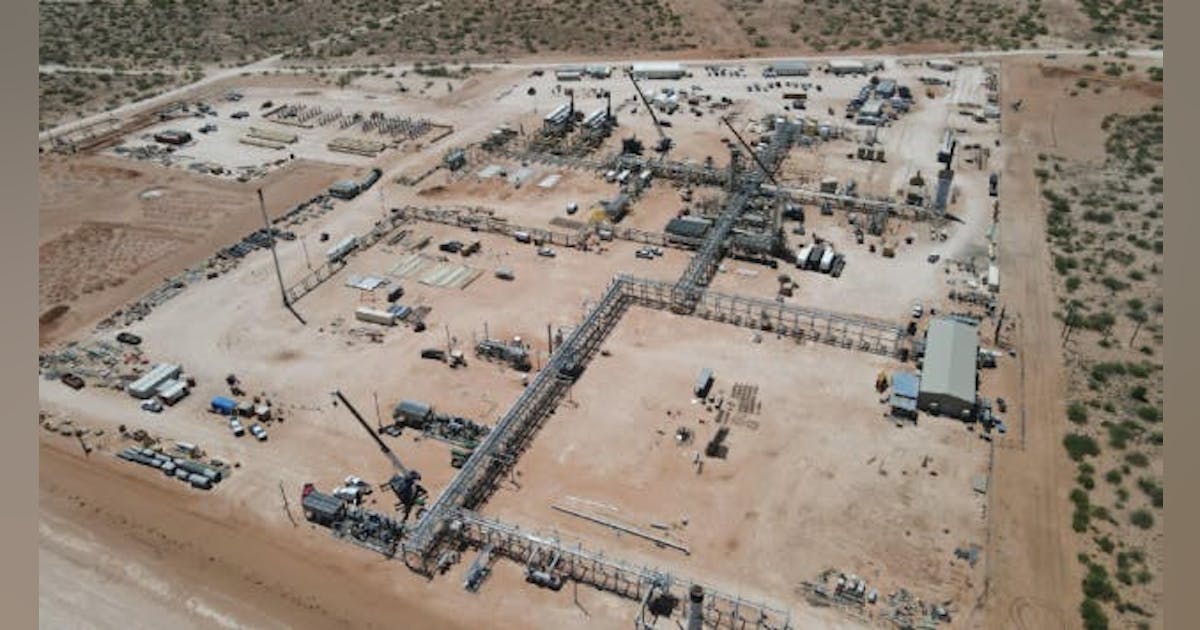
In March 2025, Northwind reached a final investment decision (FID) to proceed with a second-phase expansion of its flagship Titan complex. This ambitious project aims to double the facility’s amine-treating capacity to an impressive 400 million cubic feet per day (MMcfd) by 2026. This substantial increase in processing power is a clear signal of Northwind’s long-term commitment to the region and its confidence in the sustained economic viability of Delaware Basin production.
To underpin this significant capital expenditure, Northwind successfully completed the issuance of a new $700 million senior-secured first lien term loan on March 17. The net proceeds from this financing endeavor will be strategically allocated to refinance existing debt obligations, thereby optimizing the company’s capital structure, and to partially fund the extensive buildout of the Titan complex’s expanded capabilities. This financial maneuver demonstrates strong investor confidence in Northwind’s strategic vision and its ability to execute large-scale infrastructure projects.
Unpacking the Titan Treater Plant 2: A Deep Dive into Operations
While Northwind initially provided limited details regarding the planned expansion, the New Mexico Environmental Department (NMED) offered crucial insights on April 15, publishing Northwind’s revised New Source Review permit application for public review. This document, part of a mandatory 30-day public comment period, officially names the project “Titan Treater Plant 2” and outlines its comprehensive design and operational scope.
The new plant will feature a 220 MMcfd sour-gas treating facility specifically engineered to process high-pressure inlet field gas. Upon entering the facility, this raw gas will undergo an initial compression phase utilizing powerful gas-fired engines, preparing it for subsequent treatment stages.
Advanced Acid Gas Removal and Sequestration
Post-compression, the gas stream will be directed to a sophisticated dual-unit amine-treatment system. This critical stage is designed for the highly efficient removal of CO2 and H2S, transforming “sour” gas into a marketable product. The resulting acid-gas stream, rich in contaminants, will then be routed to a battery of five electric-driven compressors, which includes a redundant spare unit for operational reliability. These compressors will facilitate the injection of the acid gas deep underground via dedicated Acid Gas Injection (AGI) wells, effectively sequestering these compounds and significantly reducing atmospheric emissions.
Refining Sweet Gas for Market
The “sweetened” gas, having passed through the amine-treating units, will undergo further purification to meet stringent pipeline specifications. It will first enter a triazine contact tower, ensuring the removal of any residual sulfur compounds. Subsequently, the gas will be dehydrated using advanced triethylene glycol units, eliminating moisture content. Finally, the dry, clean gas will be compressed via high-efficiency gas-fired turbines, ready for pipeline injection and sale to market.
Efficient Condensate and Wastewater Management
The Titan Treater Plant 2 also incorporates robust systems for managing associated liquids. Condensate separated in the initial inlet-slug catcher will proceed to a sour-condensate stabilization train for further processing. Overhead gas from the stabilizer will be efficiently recycled back into the plant inlet via three electric-driven compressors, optimizing resource utilization. Stabilized condensate will be securely stored in four 1,000-bbl tanks, awaiting transport offsite. In scenarios where pipeline access is unavailable, the stabilized condensate can be readily loaded onto trucks for alternative delivery, ensuring continuous market access. Critically, any emissions from this storage and loading phase will be meticulously routed to the tank header through a vapor return line, minimizing environmental impact.
Furthermore, liquids collected through the plant’s closed-drain system will be directed to two 400-bbl slop-water tanks for temporary storage before being hauled offsite by trucks. A redundant vapor-recovery unit will be integral to the plant’s design, actively controlling emissions by routing vapors from the condensate and slop water tanks, as well as truck loading operations, back to the plant inlet for processing.
Key Equipment Investment Underpins Scale and Efficiency
The scope of the Titan Treater Plant 2 expansion is reflected in the significant equipment investments, which include:
- Seven 2,065-horsepower (hp) compressor engines, vital for inlet gas compression.
- Five 1,380-hp compressor engines dedicated to acid-gas injection.
- Six turbines, each rated at 6,370 hp, providing essential power generation for the facility.
- Two triethylene glycol dehydrators and their associated glycol regenerator heaters for efficient gas dehydration.
- One acid-gas flare and one process flare, serving as critical safety and emissions control devices.
- Dedicated slop-water loading infrastructure.
This comprehensive list of major equipment highlights the sheer scale and technological sophistication of Northwind’s commitment to delivering a state-of-the-art processing solution for the Delaware Basin.
Outlook: Unlocking Value and Sustaining Growth
Northwind’s substantial investment in the Titan complex expansion represents a pivotal development for the Delaware Basin. By proactively addressing the challenges of sour gas and integrating advanced AGI-CCS technologies, Northwind is not only enhancing its operational footprint but also enabling producers to bring more hydrocarbons to market efficiently and responsibly. This strategic financial commitment, supported by robust financing, positions Northwind as a critical infrastructure provider in the ongoing energy evolution of the Permian Basin, promising sustained growth and value creation for investors and the wider energy market.