Navigating the Energy Paradox: Newfoundland’s EV Bet in a Shifting Oil & Gas Landscape
Newfoundland and Labrador, a province historically intertwined with offshore oil and gas production, is making a significant and strategic pivot in its energy infrastructure. A combined investment of CAD 3.8 million from the provincial government and an additional CAD 463,000 from NL Hydro is set to dramatically expand the region’s electric vehicle (EV) charging network. This move, while seemingly local, offers a potent microcosm of the broader energy transition dynamics challenging traditional investment theses across the global oil and gas sector. For discerning investors, this initiative signals a tangible shift in regional energy policy, demanding a re-evaluation of long-term asset viability and diversification strategies.
The Green Shift in an Oil Province: Responding to Investor Queries
The commitment to EV infrastructure in a region known for its hydrocarbon resources highlights the complex investment landscape energy professionals now navigate. Our proprietary investor intent data reveals a growing bifurcation in investor inquiries. While questions surrounding “OPEC+ current production quotas” and “current Brent crude price” remain central to portfolio management, there’s an increasing parallel interest in the specifics of “EV charging networks” and “renewable energy integration.” This indicates that investors are not merely tracking traditional metrics but are actively seeking to understand how regional energy transitions will impact their holdings.
Newfoundland and Labrador’s decision directly addresses this evolving interest. The province has witnessed a remarkable 1,400% surge in battery-electric vehicles over the past decade, now totaling 1,700 units. This rapid adoption rate, coupled with NL Hydro’s impressive claim of generating over 90% of its electricity from renewable sources, positions the province as an attractive model for sustainable EV adoption. The utility’s charging network recorded a record 2,800 sessions last month, underscoring the escalating demand that these new investments aim to meet. This regional momentum serves as a critical data point for investors assessing the speed and scale of electrification in other oil-producing jurisdictions.
Strategic Deployment Amidst Global Price Volatility
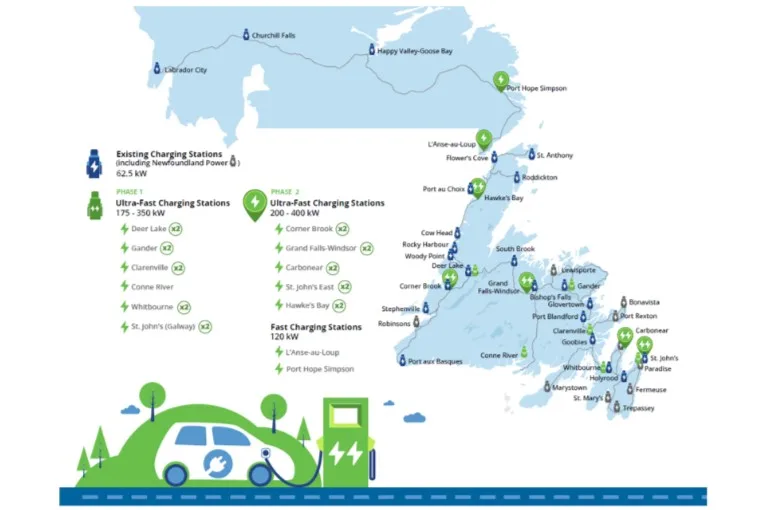
The expansion plan is robust and geographically targeted. It includes the installation of four new fast charging stations, capable of delivering up to 120 kW, in L’Anse-au-Loup and Port Hope Simpson in 2026. These will be the first fast chargers in Southern Labrador, significantly enhancing regional connectivity. Additionally, ten new ultra-fast chargers, boasting up to 400 kW capacity, are planned for deployment in 2026 across high-demand areas: two each in St John’s East, Carbonear, Grand Falls-Windsor, Corner Brook, and Hawke’s Bay. This strategic placement aims to manage demand at existing sites and reduce wait times, effectively cutting charging times in half for many users.
This localized energy transition unfolds against a backdrop of fluctuating global crude prices. As of today, Brent Crude trades at $98.05, reflecting a 1.35% decrease within the daily range of $97.92 to $98.67. WTI Crude mirrors this sentiment, standing at $89.46, down 1.88% from its daily high. While these prices offer a degree of stability compared to the dramatic swings of recent years, they represent a notable decline from the $112.57 mark observed just three weeks prior, indicating a 12.4% drop over the last 14 days. Gasoline prices, currently at $3.07 and down 0.65% for the day, also demonstrate the market’s response to supply-demand dynamics. The province’s investment in EV infrastructure suggests a long-term view that prioritizes energy independence and reduced reliance on fossil fuels, regardless of short-term crude market volatility. For investors, this implies that even in a robust crude environment, the structural shift towards electrification will continue to erode demand for refined products in specific geographies.
Forward Outlook: Funding, Timeline, and Macro Energy Catalysts
The funding for this ambitious project is meticulously phased, with CAD 1.9 million allocated for the 2025-26 fiscal year and a further CAD 1.9 million for 2026-27, ensuring sustained progress. This new project builds on the province’s existing efforts, which include 11 ultra-fast chargers scheduled for completion by the end of 2025 through the Zero Emission Vehicle Infrastructure Program (ZEVIP). Once fully implemented, Newfoundland and Labrador will boast 62 public fast chargers, including 21 ultra-fast units, alongside more than 220 Level 2 charging ports. This aggressive timeline underscores the provincial government’s commitment to creating a “greener transport sector.”
While Newfoundland’s EV expansion plays out over the next few years, macro-level energy events continue to shape the broader investment climate for oil and gas. Investors should closely monitor the upcoming OPEC+ Joint Ministerial Monitoring Committee (JMMC) meeting this Friday, April 17th, followed by the Full Ministerial meeting on Saturday, April 18th. The outcomes of these discussions on production quotas will invariably influence short-to-medium term crude pricing. Further insights into U.S. supply dynamics will come from the API Weekly Crude Inventory reports on April 21st and April 28th, complemented by the EIA Weekly Petroleum Status Reports on April 22nd and April 29th. The Baker Hughes Rig Count, scheduled for April 24th and May 1st, will offer a crucial pulse on future drilling activity and production capacity. These global and national data points, while seemingly distinct from a regional EV network, are inextricably linked to the capital allocation decisions made by oil and gas investors. They inform the context within which provinces like Newfoundland and Labrador choose to diversify their energy matrices, influencing the perceived risk and return of traditional fossil fuel assets versus emerging clean energy infrastructure.
Implications for Oil & Gas Investors: Diversification and Regional Assessment
For investors heavily weighted in traditional oil and gas, Newfoundland and Labrador’s initiative serves as a tangible example of the “energy transition risk” in action. While the province continues to derive significant revenue from offshore production, its proactive investment in EV infrastructure signals a long-term strategy to reduce internal fossil fuel consumption. This regional shift raises questions about potential future demand erosion for refined products and the broader implications for existing gasoline distribution networks.
Conversely, this scenario also presents opportunities. Oil and gas companies with forward-thinking leadership might view this as a blueprint for diversification, exploring investments in renewable energy, carbon capture technologies, or even participating directly in the burgeoning EV charging ecosystem. The call for local businesses to apply as site hosts in Newfoundland and Labrador illustrates a community-level economic development angle that could be replicated by energy majors seeking to integrate into new value chains. Ultimately, the Newfoundland case highlights the imperative for oil and gas investors to move beyond purely geopolitical and supply-side analysis, incorporating granular, regional-level energy policy and infrastructure development into their due diligence to accurately assess the evolving risk and reward profiles of their portfolios.