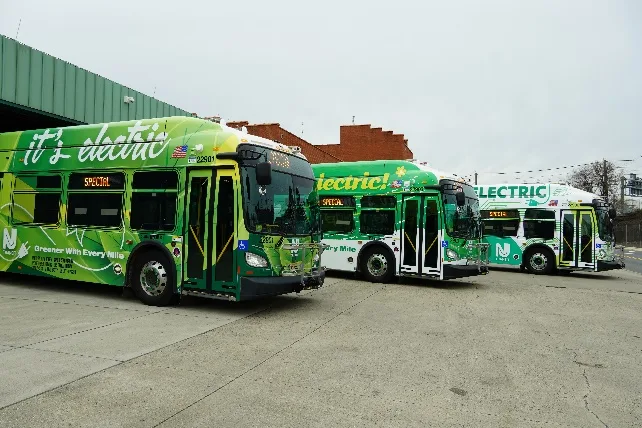
The recent announcement by NJ Transit regarding its extensive bus fleet modernization program offers a microcosm of the complex and often contradictory signals shaping the future of oil demand. While the public transportation authority is investing a substantial $500 million to upgrade its vehicles, the bulk of this procurement — 260 units — is for ‘clean diesel’ buses, with only a small fraction (26 units) earmarked for battery-electric models. This decision, while seemingly localized, underscores a critical dynamic for oil and gas investors: the energy transition is not a monolithic, rapid shift, but rather a nuanced, staggered process characterized by interim solutions and persistent reliance on traditional fuels. Understanding these mixed signals, particularly in the context of broader market movements and investor sentiment, is crucial for navigating what continues to be a volatile energy landscape.
The Nuance of Electrification: Mixed Signals for Diesel Demand
The NJ Transit decision to largely replace its aging fleet with modern diesel-powered buses, even while committing to a smaller number of electric vehicles, highlights the immediate operational and infrastructural realities facing many transit operators. While the long-term vision may be full electrification, the short-to-medium term often involves pragmatic upgrades that still lean on conventional fuels. This isn’t an isolated incident; similar patterns are observed globally where the cost, range anxiety, charging infrastructure needs, and operational complexities of electric heavy-duty vehicles mean a continued, albeit cleaner, diesel footprint. For oil investors, this translates into a prolonged, albeit gradually diminishing, demand floor for diesel and other refined products, rather than an abrupt decline. As of today, Brent Crude trades at $90.38 per barrel, experiencing a sharp 9.07% decline within a day’s range of $86.08 to $98.97. Similarly, WTI Crude stands at $82.59, down 9.41% from its open, fluctuating between $78.97 and $90.34. Gasoline prices are also feeling the pressure, currently at $2.93 per gallon, down 5.18%. This significant daily drop, following a 14-day trend where Brent has fallen by $20.91 or 18.5% from $112.78 on March 30th to $91.87 on April 17th, underscores how broader macroeconomic factors and supply-side narratives currently overshadow the gradual demand erosion from electrification. However, these localized decisions continue to chip away at the longer-term demand outlook, creating a persistent, underlying headwind that investors must factor into their models.
Investor Focus: Navigating the Energy Transition’s Pace
Our proprietary reader intent data reveals a clear preoccupation among investors: they are actively seeking clarity on future oil price trajectories. Questions like “what do you predict the price of oil per barrel will be by end of 2026?” dominate the discourse, indicating a deep concern about the longevity of current price levels and the impact of both geopolitical events and structural demand shifts. The NJ Transit scenario provides a tangible example of these structural shifts at play. While 26 electric buses may seem negligible in the grand scheme of global oil demand, they represent a concrete, albeit slow, step towards reduced fuel consumption. When aggregated across hundreds of cities and thousands of transit agencies worldwide, these incremental decisions create a significant long-term demand headwind for oil. Investors are grappling with how to balance these nascent, slow-burn demand erosions against more immediate supply-side shocks and geopolitical premiums. Another frequent query, “What are OPEC+ current production quotas?”, further emphasizes the dual challenge of assessing both demand-side evolution and supply-side management. The key for investors is to recognize that while electrification is undeniably progressing, its pace is uneven and often tempered by practical considerations, leading to a prolonged transition period where refined products like diesel will retain considerable market relevance.
Upcoming Catalysts and the Road Ahead for Oil Demand
While the long-term energy transition narrative plays out, the near-term oil market will continue to be heavily influenced by critical scheduled events. Investors must pay close attention to the upcoming OPEC+ Joint Ministerial Monitoring Committee (JMMC) meeting on April 18th, followed by the Full Ministerial meeting on April 19th. These gatherings are pivotal, as any decisions on production quotas could significantly impact global supply and, consequently, crude prices, especially given the recent downward price pressure. Further insights into real-time demand and supply dynamics will come from the API Weekly Crude Inventory reports on April 21st and 28th, and the EIA Weekly Petroleum Status Reports on April 22nd and 29th. These reports will provide crucial data points on U.S. inventory levels, refining activity, and product supplied, offering a tangible pulse on current market health. Additionally, the Baker Hughes Rig Count on April 24th and May 1st will indicate future drilling activity, signaling potential changes in supply. While transit electrification represents a gradual, structural headwind, these recurring calendar events provide the immediate catalysts that can drive significant price swings, demanding agile portfolio adjustments from investors. The interplay between these short-term supply/demand indicators and the longer-term energy transition trends will define market opportunities and risks in the coming weeks and months.
Strategic Implications for Oil & Gas Portfolios
For oil and gas investors, the NJ Transit example serves as a potent reminder that the energy transition is not a uniform or linear process. The continued reliance on conventional fuels for a significant portion of transit upgrades, even as electric options emerge, highlights the need for a nuanced investment strategy. Companies heavily focused solely on crude exploration and production might face increasing long-term demand uncertainty, while those with diversified portfolios, including robust refining capabilities for distillates or investments in alternative fuels and carbon capture, may be better positioned. The question of how individual companies like Repsol will perform by the end of April 2026, a query frequently posed by our readers, underscores the need for granular analysis of company-specific strategies to navigate these crosscurrents. Companies that can adapt their product offerings to meet evolving demand patterns – from cleaner conventional fuels to next-generation energy solutions – will likely outperform. The key takeaway for investors is to maintain a dual perspective: acknowledge the inevitable, albeit slow, shift towards electrification and its long-term implications for oil demand, while simultaneously recognizing the ongoing relevance of traditional market drivers and the critical role of timely data and strategic positioning.